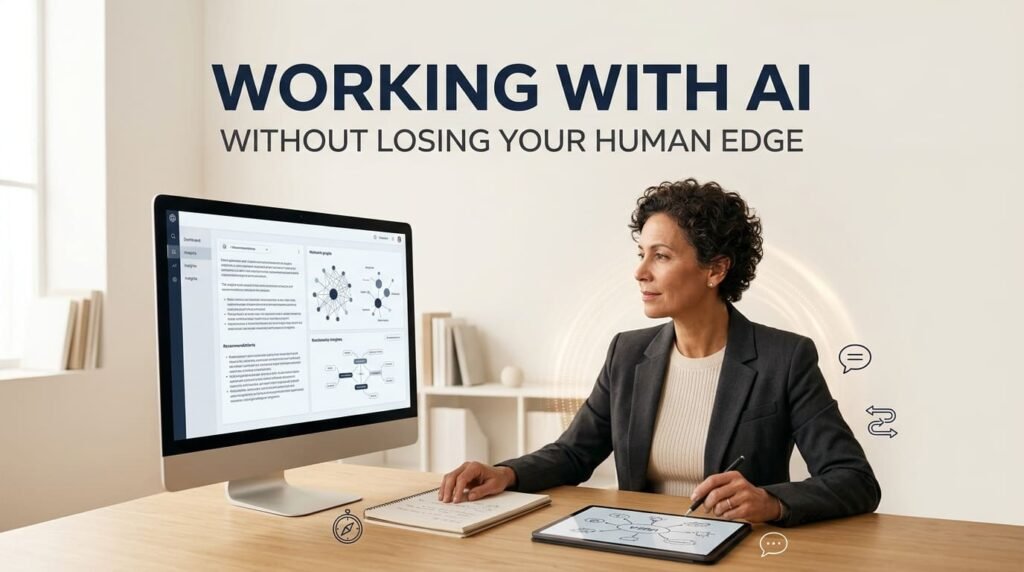
Artificial intelligence is changing how people work, learn, communicate, and make decisions. Tasks that once required hours of research, writing, analysis, or preparation can now be completed much faster with the help of AI tools.
For professionals, this creates opportunities to improve productivity, explore new ideas, and reduce repetitive work. But it also raises an important question: As AI becomes more capable, how do we use it effectively without losing the human skills that make our work valuable?
The answer is not to avoid AI or compete with it at every task. It is to understand where AI can help, where human judgment remains essential, and how to combine both to produce better results.
The OECD’s report, Skills in the AI Age, highlights the importance of foundational knowledge, digital capabilities, critical thinking, creativity, collaboration, and continuous learning as work evolves.
The challenge for professionals is therefore not simply to learn how to use AI. It is to learn how to work alongside it without surrendering independent thinking, professional responsibility, or the ability to make sound decisions.
1. AI Can Accelerate Work, but Productivity Is More Than Speed
One of the most visible benefits of AI is speed. It can prepare an initial report, summarize information, suggest solutions, organize ideas, or generate a first draft in a fraction of the time some tasks previously required.
However, faster output does not automatically mean better work.
An AI-generated report may contain inaccurate information. A recommendation may overlook an organization’s circumstances. A polished email may sound professional but communicate the wrong message. An apparently useful analysis may be based on incomplete information.
If the output is accepted without review, the time saved during generation can be lost correcting mistakes—or worse, the mistakes may never be noticed.
True productivity considers more than how quickly a task is completed. It also considers accuracy, usefulness, quality, and the consequences of the final result.
Imagine a manager using AI to prepare a business recommendation. AI can organize available information and compare possible approaches, but the manager still needs to evaluate the assumptions, consider the organization’s priorities, and understand how the decision may affect employees and customers.
The same principle applies to writers, educators, analysts, recruiters, and other professionals.
AI can accelerate the production of work. Human judgment helps determine whether that work is worth using.
The objective should be better outcomes, not simply more output.
2. Critical Thinking Is Becoming a Professional Advantage
When information becomes easier to generate, evaluating that information becomes increasingly important.
AI tools can produce confident explanations and persuasive recommendations. Yet confidence in the wording does not guarantee accuracy. An answer may be incomplete, outdated, or inappropriate for the circumstances in which it will be used.
Critical thinking helps professionals distinguish between an answer that sounds reasonable and one that stands up to examination.
Before accepting an AI-generated response, ask:
- Does this answer address the actual problem?
- What assumptions is it making?
- Is the information accurate and supported by reliable evidence?
- What important details might be missing?
- What could go wrong if I follow this recommendation?
- Is there a simpler, safer, or more effective alternative?
These questions apply to everyday workplace decisions.
A recruiter should evaluate whether an AI-assisted screening process is fair and appropriate. A team leader should examine the reasoning behind a proposed change. A researcher should verify important claims against reliable sources. An employee preparing a report should check the figures and conclusions before sharing them with colleagues.
AI can help explore options, but professionals must retain responsibility for evaluating the result.
This does not mean humans are always right and AI is always wrong. People also make mistakes and hold biases. The advantage comes from combining useful technology with evidence, experience, careful reasoning, and a willingness to question assumptions.
The goal is not to reject AI-generated information. It is to avoid accepting it without thinking.
3. Experience and Context Still Matter
Professional decisions rarely exist in isolation. The right approach depends on the situation, the people involved, available resources, organizational priorities, and potential consequences.
AI can analyze the information provided to it, but important context may be missing. It may not know the history of a workplace disagreement, the practical limitations of a team, or the reasons an earlier initiative failed.
Human experience helps identify which details matter.
Consider an organization introducing a new AI-assisted process. A recommendation might suggest automating a repetitive administrative task to save time.
That could be a sensible improvement. However, the process may also involve exceptions, sensitive information, customer concerns, or responsibilities that require human oversight.
A thoughtful professional would examine the complete workflow before deciding what should be automated.
This requires more than familiarity with the technology. It requires understanding the work itself.
Experience is especially valuable when it helps people recognize patterns, ask better questions, and identify consequences that are not immediately obvious.
However, experience should not become an excuse to resist every new tool. Established methods can become outdated, and familiar processes are not always the most effective.
The strongest professionals combine experience with curiosity. They use what they already know to evaluate new possibilities while remaining willing to learn when circumstances change.
4. Creativity Is More Than Generating Ideas
AI can generate headlines, presentation outlines, product concepts, campaign ideas, and alternative approaches to a problem. This can be particularly useful when beginning a project or exploring possibilities.
But generating ideas is only one part of creativity.
Creative work also requires understanding the audience, recognizing meaningful problems, selecting useful ideas, and developing them into something that serves a real purpose.
For example, a team might use AI to generate ten ideas for improving customer experience. The value does not come simply from producing the list. It comes from identifying which ideas address genuine customer needs, which are practical to implement, and which are likely to create meaningful improvements.
The same principle applies to communication, strategy, teaching, and leadership.
AI can provide alternatives, but human direction helps establish the purpose, priorities, and standards by which those alternatives should be evaluated.
Creativity also benefits from experience outside the immediate task. Conversations with colleagues, observations of customer behavior, personal experiences, and knowledge of the wider environment can reveal opportunities that a prompt may not capture.
The most productive approach is to use AI to expand the range of possibilities while retaining human responsibility for selecting and refining the final direction.
5. Communication and Empathy Cannot Be Reduced to Output
Work is not simply a collection of tasks. It involves people who have different expectations, concerns, experiences, and communication styles.
AI can help draft emails, summarize meetings, prepare feedback, and suggest ways to explain complex subjects. These are useful capabilities, particularly when professionals need to communicate clearly under time pressure.
However, effective communication requires more than well-structured sentences.
It involves listening, recognizing context, understanding the audience, and considering how a message may affect the people receiving it.
Imagine an employee struggling with a new responsibility. A manager could use AI to generate a standard performance message. But an effective conversation also requires understanding whether the employee needs clearer expectations, additional training, constructive feedback, or support with an underlying problem.
The same distinction applies to workplace disagreements.
AI can suggest ways to phrase a difficult conversation, but it cannot remove the responsibility to listen carefully, assess the situation fairly, and engage with another person’s perspective.
In The Art of Constructive Disagreement: How Healthy Conflict Drives Better Teams, I explore why productive disagreement depends on how people communicate, challenge ideas, and work through differences.
Similarly, Psychological Safety at Work: What It Is and How to Build It examines the importance of creating conditions in which people can ask questions, express concerns, and contribute without unnecessary fear.
These skills matter in AI-assisted workplaces because technology can support communication, but it cannot make every human interaction effective by itself.
Professional value is not measured only by what you produce. It is also reflected in how you work with people.
6. Adaptability Means Learning Without Losing Your Strengths
As AI changes workplace processes, some responsibilities will become easier to automate or accelerate. Other responsibilities may evolve, and new skills may become more important.
This does not mean every professional must become an AI specialist. It means people need to understand how their work is changing and identify the skills that will help them remain effective.
In Why Adaptability Is the New Job Security, I discuss why career resilience increasingly depends on learning, applying transferable skills, and adjusting when familiar responsibilities change.
Adaptability is not about abandoning your professional identity or chasing every new trend. It is about building on your strengths while learning how to apply them in new circumstances.
A finance professional might use AI to prepare an initial analysis, then focus more attention on interpreting results and explaining business implications.
A teacher might use AI to prepare learning materials while concentrating on student understanding, feedback, and classroom needs.
A software developer might use AI to accelerate implementation while continuing to apply technical judgment, debugging, testing, and problem-solving.
In each case, the tools change how some tasks are performed, but the professional still needs to understand the work and its intended outcome.
A practical approach to adaptability is to follow this cycle:
Notice → Learn → Experiment → Evaluate → Apply
Notice what is changing in your role. Learn the relevant tools and concepts. Experiment in a suitable setting. Evaluate the results. Apply what works.
This is more sustainable than trying to learn every new technology simply because it exists.
7. Maintain Digital Discipline and Professional Responsibility
Working effectively with AI also requires knowing when to pause, verify, or step away from technology.
Constant access to AI tools, messaging platforms, notifications, and digital workflows can create the impression that every task should be completed immediately. But continuous activity is not the same as productive work.
Professionals need time to concentrate, reflect, make decisions, and review important work without unnecessary interruptions.
My article Digital Discipline in an Always-Connected World explores the importance of managing technology intentionally rather than allowing digital tools to control attention.
The same principle applies to AI. Use it when it provides a meaningful benefit, but do not assume that every task requires an AI-assisted workflow.
There are also practical responsibilities to consider:
- Privacy: Avoid sharing confidential workplace, customer, or employee information with tools that have not been approved for that use.
- Accuracy: Verify important facts, calculations, and recommendations before acting on them.
- Fairness: Examine whether AI-assisted decisions could disadvantage people or reproduce existing biases.
- Accountability: Ensure that someone remains responsible for decisions and outcomes.
- Transparency: Follow relevant workplace policies and disclose AI assistance when required.
These considerations are particularly important when AI is used in recruitment, employee evaluation, financial decisions, customer communication, or other situations that can materially affect people.
AI adoption should improve the way work is done without removing the safeguards that responsible professional practice requires.
8. Build a Better Working Relationship with AI
The most useful question is not whether AI should be used at work. It is how to use it in a way that strengthens professional capability.
A practical approach begins with a few habits.
Think before prompting. Define the problem, the desired outcome, and the relevant constraints before asking AI for help.
Use AI to explore options. Ask for alternative approaches, potential risks, and explanations rather than accepting the first suggestion.
Verify important results. Consult reliable sources, check calculations, review assumptions, and test outputs when appropriate.
Keep developing core skills. Continue learning the knowledge and abilities that allow you to judge the quality of AI-generated work.
Protect time for independent thinking. Make room to reflect, solve problems, and form your own assessment instead of immediately asking AI to decide everything.
Take responsibility for the outcome. Review what will be published, communicated, implemented, or used to make a decision.
Know when not to use AI. A direct conversation, a trusted procedure, or a simple manual task may sometimes be more appropriate.
These habits help transform AI from a source of ready-made answers into a tool for learning, exploration, and better decision-making.
9. Organizations Must Support Human-AI Collaboration
The responsibility for successful AI adoption does not rest entirely on individual employees.
Organizations also need to establish clear expectations, provide appropriate training, protect sensitive information, and explain how AI should be used in different roles.
If employees are expected to use AI but receive no training, guidance, or time to learn, the organization risks inconsistent results and unnecessary mistakes.
Managers should help teams understand which tasks AI can support, which decisions require human review, and who is accountable for the final outcome.
Organizations should also recognize that different roles require different approaches. A low-risk drafting task does not need the same controls as a decision involving employment, finances, or sensitive personal information.
Microsoft’s 2026 Work Trend Index examines how AI and AI agents are changing work, including the importance of human judgment and organizational support. Its findings reinforce a broader point: adopting AI effectively involves more than providing access to tools. Workflows, skills, and responsibilities must evolve as well.
A healthy workplace should encourage experimentation while making it safe to question AI-generated recommendations, report errors, and seek clarification.
Employees should not be expected to accept every AI-driven change without discussion. They should be encouraged to understand its purpose, identify potential problems, and contribute practical feedback.
Human-AI collaboration works best when both technology and workplace culture support responsible use.
Final Thoughts: Let AI Extend Your Capabilities
AI is becoming an important part of modern professional life. It can reduce repetitive work, accelerate learning, expand creative possibilities, and help people approach difficult tasks from new directions.
But its value depends on how it is used.
When AI replaces questioning with unquestioning acceptance, productivity can come at the expense of understanding. When it supports exploration, verification, learning, and better decisions, it can help people become more capable.
The human advantage is not that people can outperform AI at every task. It is the ability to combine knowledge, context, experience, creativity, communication, and accountability to address real needs.
Use AI to challenge your thinking, not eliminate it. Use it to learn faster, not stop learning. Use it to explore possibilities, not avoid making decisions.
And remember that adaptability should be a shared responsibility: professionals need opportunities to develop new skills, while organizations need to provide the support and conditions that make responsible change possible.
Let AI accelerate your work. Keep developing the judgment that makes your work valuable.
Frequently Asked Questions
Will AI replace human skills in the workplace?
AI can automate or assist with many tasks, but professional work also involves judgment, context, communication, accountability, and adapting to unfamiliar situations. The balance varies by role and will continue to evolve.
How can professionals use AI without becoming dependent on it?
Define the problem before prompting, review and verify outputs, continue practicing core skills, compare alternative solutions, and take responsibility for the final result. Use AI as an assistant rather than an unquestioned authority.
Why is critical thinking important when using AI?
AI-generated answers can contain errors, missing context, or unsuitable recommendations. Critical thinking helps professionals question assumptions, check evidence, identify risks, and decide whether an output is appropriate.
What human skills remain valuable in the AI era?
Critical thinking, communication, problem-solving, creativity, adaptability, collaboration, and professional judgment remain valuable across many roles. Their relative importance depends on the work and the decisions involved.
Should every professional learn to use AI?
Understanding relevant AI tools can help many professionals adapt to changing workflows. However, the appropriate tools and level of expertise depend on the role, the tasks involved, organizational policies, and the risks of using AI.
What is the difference between using AI and depending on AI?
Using AI means applying it where it provides value while retaining the ability to evaluate results and make informed decisions. Depending on AI means accepting its output without sufficient understanding, verification, or independent judgment.
What can employers do to support human-AI collaboration?
Employers can provide training, clear usage policies, privacy safeguards, opportunities for feedback, and appropriate human review. They should also help employees understand how responsibilities are changing and where human oversight remains necessary.
About the Author — Mirza Hadi Baig
Mirza Hadi Baig is a Full-Stack Web Developer, Technical Problem Solver, Product Builder, and AI SEO & GEO Strategist with 17+ years of experience across the technology industry.
His journey spans IT education, healthcare IT, WordPress and WooCommerce development, technical troubleshooting, and digital product creation.
Since 2021, he has focused on building and maintaining websites, solving complex technical challenges, developing WordPress plugins, and creating practical online tools. His work combines hands-on development experience with an interest in technical SEO, AI search visibility, emerging technologies, and AI-assisted software development.
Mirza is the creator and developer behind several practical projects, including HS3Dev AI Content Index, Schema Genie Pro, SecurePass Generator, GEOscope Content Analyzer, and ButtonCraft Generator.
As the author behind Workplace Wisdom Herald, he explores professional growth, workplace culture, adaptability, career resilience, work-life balance, and the human skills people need to navigate a changing world of work.
His approach combines practical experience, continuous learning, experimentation, and a problem-solving mindset.
Workplace Wisdom Herald is about understanding the changing workplace, making thoughtful professional decisions, and building healthier, more resilient working lives.
Connect with Mirza: hadi-mirza.com
LinkedIn: linkedin.com/in/hadibaig
Follow and subscribe to Workplace Wisdom Herald for more insights on professional growth, workplace culture, and the future of work.