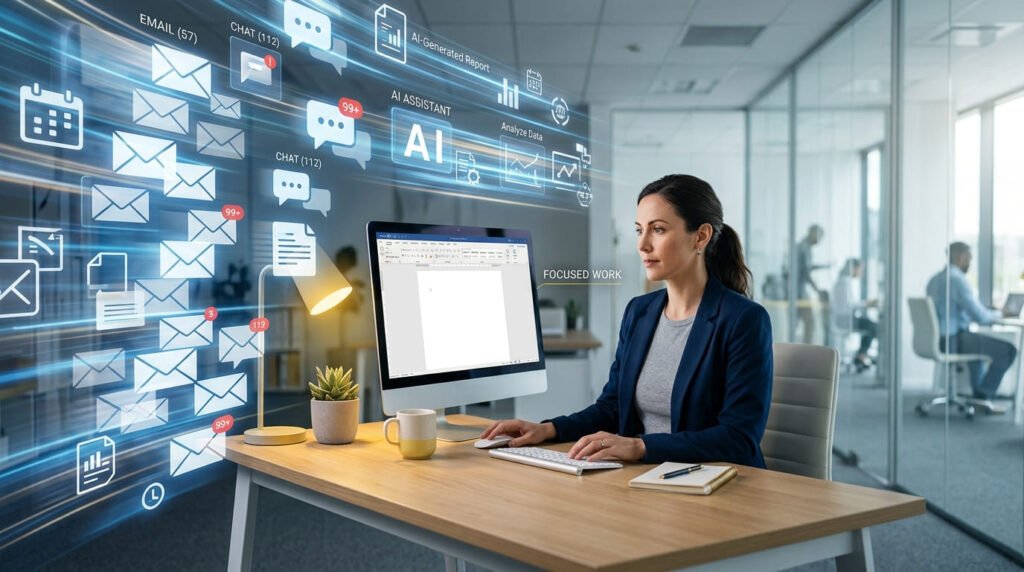
We have never been more connected.
A message can reach us in seconds.
A meeting can start with one click.
A notification can interrupt us at any moment.
A work task can follow us from the office to the dinner table.
Technology has made work faster and communication easier. But being always connected doesn’t necessarily mean being more productive.
Sometimes, the ability to access everything at any time simply makes it harder to decide what deserves our attention right now.
That is where digital discipline matters.
Being Connected Is Not the Same as Being Available
Modern workplaces often blur the boundary between communication and availability.
An employee may check email during dinner, respond to a message before bed, or feel obligated to reply immediately because everyone else appears online.
But not every message is urgent.
Not every notification requires an immediate response.
And being constantly available can create a hidden cost: fragmented attention.
Digital discipline begins with understanding that:
Being reachable doesn’t mean you have to be constantly responsive.
Healthy workplaces need communication, but they also need periods where people can focus without interruption.
Notifications Are Small Interruptions With a Big Cost
One notification may seem harmless.
Check the message.
Reply quickly.
Return to the task.
But the brain doesn’t always return to the original task instantly.
Repeated interruptions can break concentration and encourage a pattern of constantly switching between work.
Instead of:
Focus → Complete → Move on
we create:
Work → Notification → Message → Email → Work → Chat → Notification
The result can feel like a busy day without producing meaningful progress.
A simple solution is to reduce unnecessary interruptions.
Try:
- Turning off non-essential notifications
- Checking messages at planned intervals
- Using “Do Not Disturb” during focused work
- Separating urgent communication from routine communication
- Creating clear expectations around response times
Digital discipline is not about rejecting technology.
It’s about controlling when technology gets your attention.
The Always-Connected Culture Needs Boundaries
Digital discipline shouldn’t become another responsibility placed entirely on employees.
Organizations also influence digital behavior.
If managers send messages late at night and expect immediate responses, employees may feel pressure to remain connected even when no formal rule requires it.
Healthy digital culture should establish reasonable expectations around:
- Response times
- After-hours communication
- Meeting frequency
- Notification use
- Remote-work availability
- Emergency communication
A workplace can use technology extensively while still respecting people’s time.
The goal isn’t less communication.
It’s better communication.
Productivity Requires Attention, Not Just Activity
One of the biggest digital workplace traps is confusing activity with productivity.
A person can answer dozens of messages, attend several meetings, check multiple dashboards, and still make little progress on important work.
Digital discipline asks a different question:
What meaningful work did I actually accomplish?
This means protecting time for tasks that require deeper thinking.
For example:
Communication tasks
Email, chat, meetings
↓
Focused work
Writing, analysis, coding, planning, problem-solving
↓
Review
Check results and priorities
Not every hour needs to be filled with notifications and conversations.
Some of the most valuable work happens when nothing is interrupting you.
Digital Discipline Also Means Knowing When to Disconnect
Technology makes it possible to continue working almost anywhere.
That doesn’t mean we should.
If work follows us everywhere, recovery becomes difficult.
Checking one email before sleeping can become twenty minutes of work.
Opening a workplace chat during family time can mentally bring the office back into the room.
Disconnecting isn’t laziness.
It is part of maintaining sustainable performance.
Simple boundaries can help:
- Create a work shutdown routine
- Keep work notifications off during personal time
- Avoid unnecessary work messages late at night
- Separate work and personal devices where practical
- Protect uninterrupted personal time
Rest is not the opposite of productivity.
It supports sustainable productivity.
AI Makes Digital Discipline Even More Important
AI is adding another layer to the always-connected workplace.
AI tools can summarize meetings, generate emails, analyze documents, automate tasks, and provide answers almost instantly.
That can be incredibly useful.
But faster information doesn’t automatically produce better decisions.
AI can increase the amount of information available to us while simultaneously increasing the temptation to consume more of it.
The better approach is to ask:
Does this AI tool reduce unnecessary work?
Does it improve the quality of my decision?
Does it help me focus on higher-value work?
Am I using AI intentionally or simply adding another stream of information?
AI should help reduce digital overload—not become another source of it.
A Simple Digital Discipline Framework
You don’t need a complicated productivity system.
Start with five questions:
1. What deserves my attention?
Identify your most important work.
2. What can wait?
Not every message requires immediate action.
3. What can be automated?
Use technology and AI for repetitive tasks where appropriate.
4. When do I need uninterrupted focus?
Protect those periods.
5. When does work end?
Create a clear boundary between professional and personal time.
This turns digital discipline from an abstract idea into a practical habit.
Digital Discipline Is a Workplace Skill
As technology becomes more integrated into work, knowing how to use digital tools is no longer enough.
We also need to know when not to use them.
The ability to mute notifications, delay responses, protect focus, question unnecessary meetings, and disconnect after work may seem simple.
But these behaviors require intentionality.
Digital discipline is therefore not about becoming less connected.
It’s about becoming more intentional about connection.
Final Thought
Technology gave us the ability to communicate instantly.
AI is making information and assistance even faster.
But speed isn’t the same as effectiveness.
The modern workplace doesn’t necessarily need people who are available every minute.
It needs people who can focus when focus is required, communicate when communication matters, and disconnect when work is done.
You don’t need to be available all the time to be valuable.
Digital discipline is the ability to decide when technology deserves your attention—and when it doesn’t.
Frequently Asked Questions
What is digital discipline in the workplace?
Digital discipline is the intentional use of technology to protect attention, productivity, communication quality, and personal boundaries instead of allowing notifications and digital tools to control your time.
How can I reduce digital distractions at work?
Turn off unnecessary notifications, schedule specific times for email and messaging, use focus periods, reduce unnecessary meetings, and separate urgent communication from routine communication.
Is being always available good for productivity?
Not necessarily. Constant availability can create interruptions and reduce focused work. Clear communication expectations and reasonable response times can support both productivity and wellbeing.
How does AI affect digital discipline?
AI can reduce repetitive work and information overload, but it can also create more notifications, information, and digital activity. Using AI intentionally is important so that it supports focus rather than increasing digital distraction.
How can managers encourage digital discipline?
Managers can model healthy communication habits, avoid unnecessary after-hours messages, establish response-time expectations, protect focused work, and avoid creating a culture where constant availability is treated as commitment.
Why is disconnecting from work important?
Disconnecting gives people time to recover mentally and physically. Clear boundaries between work and personal time can support sustainable performance and reduce the feeling that work is always present.
What is the difference between digital discipline and avoiding technology?
Digital discipline isn’t about avoiding technology. It’s about using digital tools intentionally and deciding when they are useful rather than allowing them to constantly interrupt attention.
About the Author
Mirza Hadi Baig is a Full-Stack WordPress Developer | Technical Problem Solver | AI SEO & GEO Strategist who writes about technology, AI, digital transformation, workplace practices, and the changing relationship between people and technology.
Through Workplace Wisdom Herald, he explores practical questions around workplace culture, productivity, career growth, leadership, wellbeing, and the future of work.
He is also an AI enthusiast and continuous learner, interested in how AI can enhance human capability, simplify work, and support better decision-making without replacing human judgment.
His perspective is simple:
Technology should make work better—not make people permanently available.