When the Job Changes
For many years, job security was associated with stability.
Stay with a good company.
Become experienced.
Master your role.
Build a reputation.
Keep doing good work.
That formula still matters—but the workplace around it has changed.
A role that feels secure today may look very different a few years from now. Technology can change how work is performed. Organizations restructure. Teams become smaller or larger. New skills become important. Some responsibilities disappear while completely new ones emerge.
And sometimes, the employee hasn’t changed at all.
The job has changed.
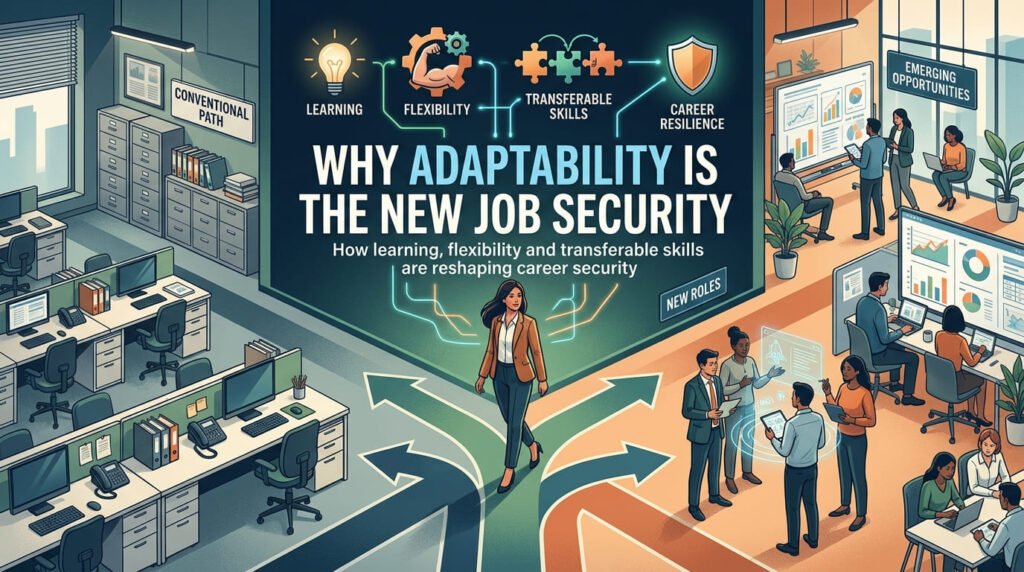
This is why adaptability is becoming an increasingly important part of career resilience.
Adaptability does not mean constantly changing who you are, chasing every workplace trend, or accepting every new demand without question.
It means developing the ability to learn, adjust, and remain effective when circumstances change.
That may be one of the most practical forms of job security available today.
What Does Job Security Mean Today?
The traditional idea of job security was largely connected to stability.
A stable employer, a permanent position, long tenure, and deep knowledge of a particular role could provide a strong sense of security.
But modern careers are less predictable.
A company can change its strategy. A department can be reorganized. A familiar process can become automated. A new technology can change how a team works.
So job security increasingly requires a different question.
Instead of asking:
“How can I make sure my current job never changes?”
Consider asking:
“How can I remain valuable when my job changes?”
That is a very different mindset.
It moves career security away from depending entirely on the permanence of one position and toward developing capabilities that can continue to create value in different circumstances.
The shift looks like this:
Traditional security
Stable role → Long experience → Specialized knowledge → Predictability
Modern career resilience
Learning → Adaptation → Transferable skills → Continued relevance
This doesn’t mean experience has become less valuable.
Quite the opposite.
Experience becomes more powerful when a person can apply it to new situations.
Why Adaptability Has Become So Important
Change has always existed in the workplace.
What has changed is its speed, frequency, and reach.
A new system can affect an entire department. A change in customer expectations can alter an organization’s priorities. Remote and hybrid work have changed how many teams collaborate. Automation can remove repetitive tasks while increasing the importance of analytical and interpersonal skills.
AI is another example.
A role may not disappear, but some of its tasks can change significantly.
A person who once spent hours preparing information manually may now spend more time reviewing, interpreting, communicating, and making decisions based on that information.
The value of the employee hasn’t necessarily disappeared.
The nature of the value has changed.
That distinction matters.
Adaptability helps people respond to changes such as:
- New technologies
- Organizational restructuring
- Changing customer expectations
- New workplace processes
- Shifting responsibilities
- Changing team structures
- New communication methods
- Evolving professional skills
The goal isn’t to predict every change.
Nobody can.
The goal is to become better prepared to respond when the change arrives.
Adaptability Doesn’t Mean Becoming Someone Else
There is a common misunderstanding about adaptability.
People sometimes hear:
“Be adaptable.”
and interpret it as:
“Learn everything. Change constantly. Keep up with every trend.”
That isn’t sustainable.
You don’t need to become an entirely different professional every time the workplace changes.
Instead, think about two types of capabilities.
Your core strengths
These are the qualities and knowledge that form your professional foundation:
- Judgment
- Communication
- Problem-solving
- Reliability
- Domain expertise
- Relationship building
- Critical thinking
- Professional integrity
These shouldn’t be discarded whenever something new appears.
Your adaptable skills
These help you apply those strengths in changing circumstances:
- Learning new tools
- Understanding new processes
- Working with different teams
- Accepting feedback
- Experimenting with new approaches
- Adjusting priorities
- Learning from mistakes
- Transferring knowledge between situations
The goal is not to replace your professional identity.
The goal is to make your existing strengths more useful in changing environments.
A strong accountant who learns new financial technology is still an accountant.
A strong manager who learns how to lead a hybrid team is still a manager.
A skilled writer who learns how to work with AI-assisted tools is still a writer.
The skill evolves.
The professional foundation remains.
Learning Agility Is the Real Advantage
Adaptability begins with a willingness to learn, but it goes beyond taking courses.
One of the most valuable career capabilities is learning agility—the ability to learn something new, apply it, evaluate the result, and adjust.
A simple cycle looks like this:
Notice → Learn → Experiment → Adjust → Apply
Imagine a company introduces a new digital system.
One employee immediately thinks:
“This is another unnecessary change.”
Another asks:
“What does this system change, and what do I need to understand to work effectively with it?”
The second employee isn’t necessarily more intelligent or more technically skilled.
They simply approach change differently.
They are willing to understand it before deciding whether it is useful.
That mindset can become a significant professional advantage.
Learning agility means:
You don’t need to know everything.
You need to remain capable of learning what becomes important.
AI Is Changing the Meaning of Adaptability
AI deserves attention here, but it shouldn’t become the entire story.
One of the most important changes AI introduces into the workplace is the transformation of tasks.
Some repetitive activities may become automated.
Some research processes may become faster.
Some administrative work may require less manual effort.
Some employees may begin using AI as part of their everyday workflow.
But this doesn’t mean every job suddenly disappears.
In many cases, the more immediate question is:
Which parts of the job are changing?
Consider an employee whose role includes preparing reports.
If AI or automation can handle part of the data preparation, the employee may have more time for:
- Interpreting results
- Identifying problems
- Explaining findings
- Making recommendations
- Communicating with stakeholders
The work changes.
The human contribution can become more focused on judgment, context, communication, and decision-making.
This is why adaptability matters.
The employee doesn’t necessarily need to become an AI engineer.
They need to understand how their work is changing and learn how to work effectively within that new environment.
What Adaptable Employees Actually Do
Adaptability is easier to understand through behavior than through definitions.
An adaptable professional tends to:
Learn before being forced to learn
They pay attention to changes in their industry and workplace before those changes become urgent.
Ask questions
Instead of immediately rejecting a new process, they try to understand its purpose.
Experiment
They test new approaches instead of assuming the old way is always the best way.
Accept feedback
They use feedback to improve rather than treating every correction as a personal criticism.
Transfer knowledge
They recognize that something learned in one situation may be useful somewhere else.
Adjust without abandoning standards
Adaptability does not mean lowering professional standards.
It means finding better ways to maintain those standards when circumstances change.
Think beyond their current job description
A job description describes today’s responsibilities.
Career resilience also requires thinking about what those responsibilities may become tomorrow.
But Adaptability Has a Limit
This is an important part of the conversation.
We should not turn adaptability into another workplace expectation where employees are told:
“Keep adapting, no matter what.”
There is a difference between healthy adaptability and constant instability.
If employees are continuously expected to:
- Work longer hours
- Learn everything on their own
- Accept unclear expectations
- Compensate for poor management
- Take on additional responsibilities without support
- Adapt to constant organizational chaos
that isn’t necessarily adaptability.
It may be organizational dysfunction.
Employees need resilience, but organizations also have responsibilities.
A healthy workplace doesn’t simply demand adaptability.
It creates conditions where adaptability is possible.
That means giving people:
- Time to learn
- Clear communication
- Reasonable expectations
- Training opportunities
- Psychological safety
- Feedback
- Support during transitions
- Opportunities to apply new skills
Adaptability should be a shared workplace capability, not an excuse to place every burden of change on employees.
What Employers Must Do
If organizations want adaptable employees, they need adaptable workplaces.
A company cannot reasonably tell its workforce to continuously develop while providing no opportunity to learn.
Leaders can support adaptability by creating an environment where people can:
Ask questions without fear.
Learn new skills.
Experiment responsibly.
Move between responsibilities.
Share knowledge.
Give and receive feedback.
Understand why change is happening.
This matters because people respond differently when they understand the reason behind change.
Compare:
“We’re changing the process. Just follow the new instructions.”
with:
“We’re changing this process because the current system is creating delays. Here’s what is changing, why it matters, and how we’ll help the team transition.”
The second approach doesn’t eliminate uncertainty.
But it gives people context and agency.
And those two things make adaptation easier.
The ADAPT Framework
Adaptability can sound abstract until you turn it into a practical habit.
A simple framework is ADAPT:
A — Awareness
Pay attention to changes around you.
What is changing in your industry, organization, role, or profession?
D — Develop
Build relevant skills before they become urgent.
You don’t need to learn everything.
Identify what is most likely to matter.
A — Apply
Use what you learn in real work.
Knowledge becomes valuable when it changes how you perform.
P — Pivot
When something no longer works, be willing to adjust.
Changing direction isn’t always failure.
Sometimes it is evidence that you have learned something.
T — Transfer
Take lessons from one situation and apply them somewhere else.
That is where experience becomes a long-term advantage.
A Real Workplace Example
Consider a marketing coordinator whose role originally includes:
- Preparing regular reports
- Updating spreadsheets
- Creating presentations
- Coordinating campaigns
- Collecting performance information
Over time, automation reduces the amount of manual reporting required.
The employee has two possible reactions.
Reaction one:
“The company doesn’t need this work anymore, so my role is becoming less valuable.”
Reaction two:
“If reporting is becoming easier, what higher-value work can I learn?”
The employee begins developing skills in:
- Data interpretation
- Customer insights
- Campaign strategy
- AI-assisted research
- Presentation
- Communication
The role changes.
But the employee’s value doesn’t necessarily disappear.
It evolves.
This is the real purpose of adaptability.
Not simply surviving change.
Using change as an opportunity to expand your usefulness.
Build Career Security Around Transferable Strengths
One of the strongest ways to become adaptable is to develop skills that remain useful across different roles and environments.
For example:
Communication
is useful in almost every profession.
Problem-solving
transfers between industries.
Critical thinking
helps when circumstances are uncertain.
Relationship building
remains valuable even when tools change.
Learning ability
becomes increasingly important as technology and processes evolve.
Professional judgment
helps determine when a new tool, process, or idea should—or shouldn’t—be adopted.
These capabilities don’t guarantee employment.
Nothing can.
But they can make a professional more resilient when circumstances change.
Ask Yourself a Different Career Question
Many professionals ask:
“How can I protect my current job?”
A more useful question may be:
“How can I remain valuable if my current job changes?”
Take a few minutes to consider:
- What parts of my work are changing?
- Which of my skills are becoming more valuable?
- Which tasks are becoming automated?
- What should I learn next?
- Which of my strengths can transfer to another role?
- What is changing in my industry?
- Am I learning proactively or only reacting when change becomes unavoidable?
- Does my workplace give me opportunities to adapt and grow?
These questions turn adaptability from a vague career concept into a practical habit.
Mentor’s Closing Note
Job security used to feel like a destination.
Find the right organization.
Get the right position.
Become good at the job.
Stay there.
Today, career security is more dynamic.
Your role may change.
Your tools may change.
Your team may change.
Your organization may change.
Even your industry may change.
But that doesn’t mean you have to live in constant fear of becoming irrelevant.
Adaptability isn’t about chasing every trend.
It isn’t about abandoning your strengths.
And it isn’t about accepting every workplace change without question.
It is about remaining curious enough to learn, flexible enough to adjust, and grounded enough to know what should not change.
The strongest professionals aren’t necessarily those who know exactly what the future will look like.
They are often the ones who can say:
“I don’t know what will change next—but I know how to learn, adapt, and keep contributing.”
That may be the new meaning of job security.
Not the promise that your job will never change—but the confidence that you can continue growing when it does.
Frequently Asked Questions
Q: Is adaptability really more important than job experience?
Not necessarily. Experience remains extremely valuable, but adaptability helps professionals apply that experience when roles, tools, and expectations change. The strongest combination is deep experience with a willingness to keep learning.
Q: Why is adaptability important for job security?
Adaptability can help employees remain effective when technology, responsibilities, workplace processes, or organizational priorities change. It does not guarantee employment, but it can strengthen career resilience.
Q: Does adaptability mean constantly learning new skills?
No. Adaptability isn’t about learning everything. It means identifying changes that matter, developing relevant skills, and applying what you learn to changing circumstances.
Q: How does AI affect job security?
AI can change tasks within existing jobs by automating or accelerating some activities. This makes it increasingly important for professionals to understand how their roles are changing and develop skills that complement new technologies.
Q: What is learning agility?
Learning agility is the ability to learn from new situations, apply knowledge, evaluate results, and adjust. It helps professionals respond effectively when familiar methods no longer work.
Q: Can employers expect employees to be adaptable?
Employers can reasonably expect employees to learn and adjust to legitimate workplace changes, but adaptability should not become an excuse for constant overload, unclear expectations, or lack of organizational support. Employers also have a role in providing communication, training, and reasonable conditions for change.
Q: How can I become more adaptable at work?
Start by paying attention to changes in your role and industry. Identify one relevant skill to develop, experiment with new approaches, ask questions, seek feedback, and look for ways to transfer what you learn into your existing work.
Q: Is adaptability the same as flexibility?
They overlap but aren’t identical. Flexibility often means adjusting to a particular change, while adaptability is the broader ability to learn, adjust, and remain effective across changing situations.
Q: What is the biggest mistake people make about adaptability?
Thinking that adaptability means abandoning their existing strengths and constantly chasing new trends. Effective adaptability builds on your strengths rather than replacing them.
Q: Can adaptability improve career resilience?
Yes. Developing transferable skills, learning agility, and the ability to work through change can make it easier to respond when roles or workplace conditions evolve. However, career resilience also depends on organizational conditions and factors outside an individual’s control.
References & Further Reading
World Economic Forum — The Future of Jobs Report 2025
The World Economic Forum identifies resilience, flexibility and agility among the most important core skills for today’s workforce. Its 2025 report also projects that nearly 40% of workers’ core skills will change by 2030, reinforcing the importance of continuous skill development.
World Economic Forum — Future of Jobs Report 2025
LinkedIn Learning — 2025 Workplace Learning Report
LinkedIn’s 2025 Workplace Learning Report highlights the relationship between learning, career development and organizational adaptability. It reports that 49% of learning and talent-development professionals say their executives are concerned employees do not have the skills needed to execute business strategy.
LinkedIn Learning — 2025 Workplace Learning Report
OECD — Skills Outlook 2025
The OECD’s Skills Outlook examines the skills needed for a changing world of work and emphasizes lifelong learning and adaptive problem-solving as skill demands evolve. It also highlights that access to skills development affects people’s ability to adapt to changing labor markets.
Microsoft — 2026 Work Trend Index
Microsoft’s 2026 Work Trend Index examines how AI and AI agents are changing work and argues that organizational support matters alongside individual readiness. Its research describes a gap between employees’ willingness to adapt and the systems, incentives and leadership needed to support that adaptation.