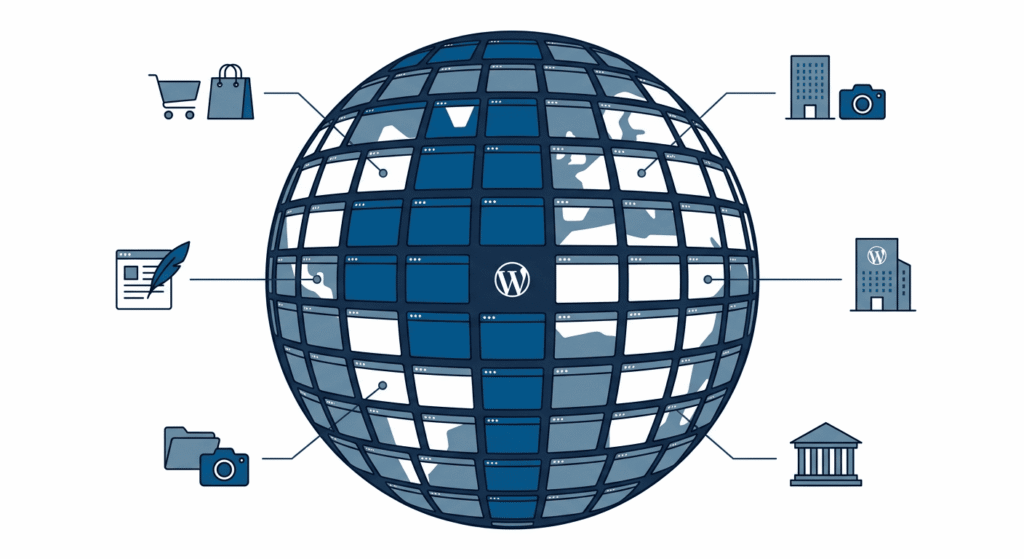
Over 40 percent of every website on the internet runs on WordPress. That is not a legacy statistic from a decade ago — that is today, right now, in a market full of competitors, alternatives, and newer platforms all claiming to be the better choice.
That number deserves a moment of pause.
Not 40 percent of small blogs. Not 40 percent of hobbyist sites. Forty percent of the entire web — from personal portfolios to government websites, from independent coffee shops to Fortune 500 companies, from local service businesses to global eCommerce operations generating millions in revenue every month.
When a technology holds that kind of market share for that long, in a space as fast-moving and competitive as web development, it is not holding it by accident. It is holding it because it earns it — every day, on every project, for every type of user who needs to build something on the web.
This article is an honest look at why. Not a marketing pitch. Not a comparison designed to make every other platform look bad. A genuine examination of why WordPress has held and continues to grow its position as the foundation of a significant portion of the modern web — and what that means for both the business owners choosing a platform and the developers building on one.
The numbers first — because they matter
Before getting into the why, the what needs to be established clearly.
As of 2024, WordPress powers approximately 43 percent of all websites on the internet. Among websites using a known content management system, that share rises to over 62 percent. The next closest competitor — Shopify — sits at around 4 percent of the total web. Wix, Squarespace, Joomla, and Drupal account for the remaining share between them.
To put that in concrete terms: for every ten websites you visit today, roughly four of them are running on WordPress underneath — regardless of how they look, what they do, or how much they cost to build.
This is not a niche. This is infrastructure.
What makes these numbers particularly significant is that they are not declining. WordPress’s market share has grown steadily year on year, even as new platforms have launched, even as the no-code movement has matured, and even as developers have had more alternatives available to them than at any point in the history of web development.
Something is working. Several things, actually.
It started as a blogging tool — and became something else entirely
WordPress launched in 2003 as a fork of an existing blogging platform called b2/cafelog. The original vision was straightforward — a clean, user-friendly tool for publishing blog posts on the web. It did that job well, and it built an early community of users and developers around it.
What happened next was not planned so much as it was enabled.
The plugin architecture — introduced early in WordPress’s development — meant that anyone could extend what WordPress did without touching the core code. The theme system meant anyone could change how it looked without rebuilding it. The GPL licence meant the code was open source — free to use, free to modify, free to redistribute, free to build businesses on top of.
These three decisions — extensibility, theming, and open source — created the conditions for something that no single company could have built deliberately: an ecosystem.
Developers built plugins. Designers built themes. Hosting companies built WordPress-specific infrastructure. Agencies built entire businesses around WordPress delivery. Tutorial creators built audiences teaching WordPress skills. Over two decades that ecosystem has grown into something with genuine network effects — every new developer who learns WordPress makes the community more valuable, every new plugin makes the platform more capable, every new site built on WordPress is evidence for the next person deciding what to build on.
That ecosystem is now one of WordPress’s most durable competitive advantages — and it is the thing that is hardest to replicate.
Why business owners keep choosing it
From a business owner’s perspective — someone who needs a website that works, that they can manage, that does not require a developer for every small change, and that does not lock them into a platform they cannot escape from — WordPress makes a compelling case on multiple fronts.
The cost of entry is low — genuinely low
WordPress itself is free. The software costs nothing to download, install, or use. A basic WordPress site can be up and running on shared hosting for a few dollars a month. That accessibility matters enormously for small businesses, startups, and individuals who need a professional web presence without a significant upfront investment.
As requirements grow, costs grow proportionally — but the starting point is accessible to virtually anyone.
The learning curve is manageable
A business owner with no technical background can learn to publish posts, update pages, manage a product catalogue, and handle basic site administration in WordPress without developer involvement. The block editor introduced in recent years — known as Gutenberg — has made content editing more visual and intuitive than at any previous point in the platform’s history.
This independence matters. A business that can update its own website without raising a support ticket for every change is a business with lower ongoing operational costs and faster time-to-publish for content.
Ownership without lock-in
This is one of the most underappreciated advantages of WordPress for business owners and one worth stating clearly: you own everything.
Your content lives in a database you control. Your files live on a server you control. Your domain points wherever you decide to point it. If you outgrow your current hosting, you move the site. If you outgrow your current developer or agency, you take the site with you. If the platform changes in a direction you do not like, you have full access to your own data and your own code.
This is not the case with every platform. Proprietary hosted website builders keep your content inside their system. Moving away from them means rebuilding from scratch. WordPress does not create that dependency — which is why many business owners who have been through a platform migration once choose WordPress specifically to avoid going through one again.
The plugin ecosystem solves almost every requirement
Need an eCommerce store? WooCommerce. Need a membership site? Multiple mature options. Need booking and appointments? SEO management? Email marketing integration? Learning management? Multi-language support? Forms, surveys, popups, live chat, analytics, CRM integration — the plugin ecosystem covers virtually every business requirement a website might have, with multiple competing options at different price points for most of them.
The practical implication is that building on WordPress rarely requires custom development from scratch. The building blocks exist. The work is configuration, integration, and customisation — which is faster, cheaper, and lower risk than building equivalent functionality from the ground up.
Why developers keep building on it
The business owner’s perspective and the developer’s perspective are not always the same, but on WordPress they converge more than people expect.
The development environment is mature and well-documented
WordPress has been in active development for over twenty years. The codebase is extensively documented. The hooks and filters system — which allows developers to extend and modify WordPress behaviour without altering core files — is well understood and consistently implemented. The developer documentation at developer.wordpress.org is comprehensive. Stack Overflow has answers to WordPress development questions going back more than a decade.
When a developer encounters a problem building on WordPress, the solution has almost certainly been encountered and documented before. That accumulated knowledge base is one of the most practical advantages of building on a mature platform.
It scales further than most people realise
One of the most persistent misconceptions about WordPress is that it is a small-site platform — suitable for blogs and brochure sites but not for anything serious. The evidence does not support this.
The Walt Disney Company runs WordPress. The New York Times Company uses WordPress for several properties. TechCrunch, The White House official website, BBC America, Sony Music, Reuters blogs — all WordPress. WooCommerce, which runs on WordPress, powers a significant portion of global eCommerce.
WordPress scales to the level of infrastructure and investment put behind it. A shared hosting WordPress installation and an enterprise WordPress installation are both WordPress — in the same way that a bicycle and a Formula 1 car are both vehicles. The platform is not the limiting factor at most scales that most projects will ever reach.
Full stack development opportunity
For developers, WordPress offers a genuinely full stack development environment. The front end — HTML, CSS, JavaScript, and increasingly React through the block editor and headless implementations. The back end — PHP, MySQL, REST API, server configuration. DevOps — WordPress-specific hosting infrastructure, caching layers, CDN configuration, deployment pipelines.
A developer who builds on WordPress professionally is not learning a narrow, platform-specific skill set. They are working across the full stack, in a real production environment, on sites that are in active use by real users. The transferable skills — database design, API integration, performance optimisation, security hardening, authentication, and more — apply far beyond WordPress itself.
The headless and decoupled future
For developers concerned that WordPress is a legacy technology, the headless WordPress ecosystem is worth understanding. WordPress as a backend — managing content through its familiar admin interface and exposing that content via the REST API or GraphQL — with a modern JavaScript frontend built in React, Vue, or Next.js consuming that content.
This architecture separates the authoring experience, which WordPress does exceptionally well, from the presentation layer, where modern JavaScript frameworks excel. It gives developers the freedom to build with modern tooling while giving content editors the familiarity of the WordPress interface. Frameworks like Faust.js and tools like WPGraphQL have made this architecture increasingly practical and production-ready.
WordPress is not standing still technically. It is adapting — which is part of why its market share continues to grow rather than erode.
The honest limitations — because no platform is perfect
An honest assessment of WordPress has to include its limitations. Ignoring them does not serve business owners trying to make an informed decision or developers evaluating which tool is right for a given project.
Performance requires active management
A WordPress site does not perform optimally out of the box. Caching configuration, image optimisation, database maintenance, plugin audit, hosting selection — these are all active management requirements that a static site or a SaaS platform handles automatically. On a properly configured WordPress site the performance gap is minimal or non-existent. On a neglected one it is significant.
Security requires the same
WordPress is the most targeted CMS on the internet — primarily because of its market share. The core software is actively maintained and security patches are released promptly. But plugins and themes introduce the majority of real-world vulnerabilities, and a WordPress site with outdated plugins on inadequate hosting is a genuine security risk. This is a management discipline, not a fundamental platform flaw, but it is a responsibility that comes with running WordPress that some platforms abstract away.
Plugin quality is inconsistent
The size of the plugin ecosystem is an advantage. It is also a responsibility. Not all plugins are equally well-coded, well-maintained, or well-supported. A plugin that has not been updated in three years may work fine or it may introduce a security vulnerability or a compatibility conflict. Evaluating plugin quality — update frequency, active installation count, support responsiveness, code quality — is a skill that takes time to develop and a step that cannot be skipped.
Not the right tool for every project
WordPress is not the answer to every web development question. A simple landing page with no content management requirement may be better served by a static site. A complex SaaS application with custom authentication and real-time features may be better built on a purpose-built application framework. A project where the client genuinely needs zero technical involvement and maximum managed simplicity may be better served by a fully hosted platform like Squarespace or Webflow.
The 43 percent market share means WordPress is the right choice for a very large proportion of web projects. It does not mean it is the right choice for all of them.
What the 43 percent actually means for you
For a business owner deciding what to build on: WordPress’s market share means an enormous pool of developers available to build and maintain your site, a vast ecosystem of tools and integrations to draw on, and a platform that will be actively developed and supported for the foreseeable future. It also means that whatever specific functionality your business needs, someone has almost certainly already built it.
For a developer deciding what to specialise in: WordPress’s market share means consistent demand for WordPress skills, a clear path to full stack development experience, an active community to learn from and contribute to, and a platform that — despite being over twenty years old — is actively evolving in directions that keep it relevant to modern development practices.
For both: the 43 percent is not inertia. It is not the web industry failing to find something better. It is the accumulated result of twenty years of development, millions of sites built, a global community of contributors, and a platform that has consistently adapted to remain useful to the people who build with it and the people who use what they build.
That is not nothing. That is quite a lot, actually.
Final thought
WordPress’s significance in the web development landscape is not sentimental. It is not about loyalty to a platform that was there first. It is about the practical reality of what WordPress delivers — for business owners who need a manageable, owned, extensible web presence, and for developers who need a mature, well-documented, full stack environment with consistent market demand.
The 43 percent is held one website at a time. Every site that gets built on WordPress, maintained properly, and delivers genuine value to its owner is part of why that number holds and grows. Understanding why it holds — not just that it holds — is what allows both business owners and developers to make better decisions about when to use it, how to use it well, and what to expect from it.
That understanding is what separates someone who uses WordPress from someone who uses WordPress well.
References & Further Reading
For deeper reading on the ideas covered in this article, these resources are worth your time: