
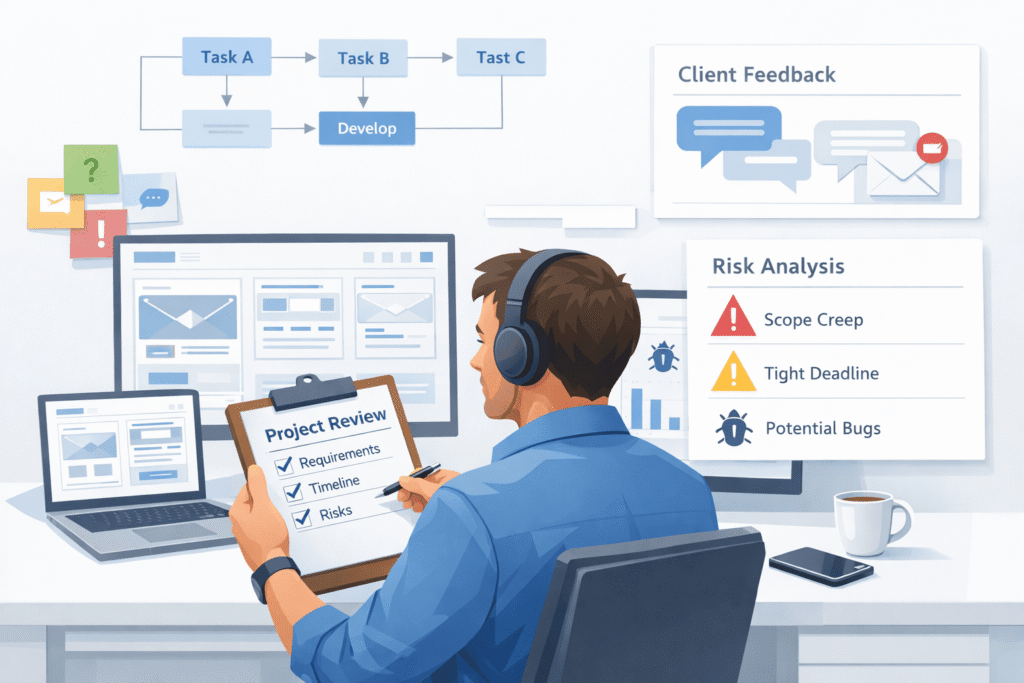
Introduction: Developers Don’t Just Evaluate the Project — They Evaluate the Client Too
Many clients assume developers decide to accept a project based on:
- Budget
- Timeline
- Technical requirements
Those factors matter — but experienced developers evaluate something much deeper before saying yes.
They assess:
- Project clarity
- Communication quality
- Decision-making process
- Long-term risk
- Client expectations
Because from a developer’s perspective, a project is not just code.
It’s a working relationship, an operational process, and a long-term responsibility.
This is why some projects get accepted quickly, while others are delayed, declined, or quoted significantly higher.
The hidden reality is:
Developers are not only pricing the work — they are pricing the complexity of working with the project and the client.
Understanding this changes how businesses approach hiring, communication, and project planning.
The First Evaluation: How Clear Is the Project?
One of the earliest signals developers look for is clarity. A project does not need to be perfectly documented, but it should communicate a clear business direction. Developers know that unclear projects usually become difficult projects later.
Before discussing technology, experienced developers usually look at one thing first:
Does the client actually understand what they want?
This doesn’t mean the client must be technical.
It means:
- Goals are reasonably defined
- Priorities are understandable
- Problems are explained clearly
Projects become risky when:
- Requirements constantly shift
- Objectives are vague
- Expectations are undefined
For developers, unclear projects signal:
- Endless revisions
- Scope confusion
- Decision delays
- Increased stress
A moderately complex project with clear direction is often preferred over a large project filled with uncertainty.
Developers Evaluate Communication More Than Clients Realize
Strong communication is often viewed by developers as a predictor of project success. Many technical problems can be solved, but communication issues tend to affect every stage of development.
Communication quality is often a stronger signal than technical complexity.
During early conversations, developers quietly observe:
- How feedback is given
- How questions are answered
- Whether expectations are realistic
- How decisions are made
Why?
Because communication problems during discovery usually become bigger problems during development.
For example:
- Delayed replies → delayed approvals
- Unclear feedback → repeated revisions
- Contradicting instructions → development confusion
Strong communication reduces risk, improves timelines, and creates smoother collaboration.
One Major Red Flag: “We Need Everything Quickly”
Urgency is common in web projects, but experienced developers try to understand the reason behind the urgency. A realistic fast-moving project is different from a project driven by panic or poor planning.
Urgency itself is not the problem.
The real concern is when urgency comes without:
- Planning
- Prioritization
- Realistic expectations
Experienced developers know that projects rushed from the beginning often suffer from:
- Poor decision-making
- Scope instability
- Quality compromises
This creates pressure not only on timelines, but also on system stability and maintainability.
Fast delivery is possible.
Chaotic delivery is expensive.
Developers Quietly Evaluate Scope Stability
Scope stability tells developers whether a project is likely to remain manageable or become unpredictable. Even technically simple projects can become difficult if requirements constantly change.
One of the biggest hidden risks in web projects is uncontrolled scope expansion.
This happens when:
- New features keep appearing
- Priorities constantly change
- Requirements evolve without structure
Developers pay close attention to whether the client:
- Understands project boundaries
- Can prioritize effectively
- Distinguishes “essential” from “optional”
A project with unstable scope usually means:
- Delays
- Budget tension
- Frustration on both sides
This is why experienced developers often ask many clarification questions early — they are measuring stability, not just collecting requirements.
Budget Isn’t Just About Money — It Signals Project Readiness
Budget conversations help developers understand how prepared the client is for the project. A realistic budget often reflects realistic expectations and proper planning.
Many clients think developers only care about the budget amount.
In reality, developers also evaluate:
- Whether the budget aligns with expectations
- Whether the client understands project complexity
- Whether long-term maintenance is considered
For example:
A client wanting:
- Custom systems
- Advanced integrations
- High scalability
With an unrealistic budget often signals deeper problems:
- Poor planning
- Misaligned expectations
- Future conflict risk
A realistic budget communicates seriousness and preparation.
Developers Assess Decision-Making Speed
Slow decision-making can damage project momentum more than technical complexity. Developers know that waiting for approvals or unclear leadership can quietly extend timelines for weeks.
Projects slow down when:
- Nobody owns decisions
- Approvals take too long
- Feedback loops are unclear
This becomes especially problematic in:
- Business websites
- SaaS projects
- Multi-stakeholder environments
Developers often evaluate:
- Who approves changes
- How quickly decisions happen
- Whether communication channels are structured
Even technically simple projects can become difficult if decisions constantly stall progress.
Technical Debt Is Evaluated Before Work Even Starts
Experienced developers rarely judge a project only by the visible features. They also evaluate the hidden condition of the system, especially when dealing with existing WordPress websites.
When working on existing websites — especially WordPress sites — developers often perform silent risk analysis.
They look for:
- Plugin overload
- Poor hosting
- Custom code quality
- Update history
- Performance issues
Why?
Because inherited problems increase:
- Development time
- Debugging complexity
- Breakage risk
A small “simple update” on a poorly maintained WordPress site can become a major repair project.
This is why some developers decline projects that appear straightforward on the surface.
Clients Who Want “Quick Fixes” Create Long-Term Problems
Developers pay attention to whether clients think strategically or reactively. Projects focused only on immediate fixes often become unstable over time.
Experienced developers become cautious when clients focus only on:
- Immediate fixes
- Lowest cost
- Fastest turnaround
Without discussing:
- Stability
- Maintenance
- Long-term impact
Why?
Because short-term fixes often create:
- Technical debt
- Repeated issues
- Fragile systems
Developers who care about quality evaluate whether the client values sustainable solutions or temporary patches.
Another Hidden Evaluation: Trust and Collaboration Potential
Trust heavily influences how smoothly a project moves. Developers are more confident in projects where collaboration feels healthy and professional from the beginning.
The best projects are collaborative.
Developers assess whether the client:
- Respects expertise
- Listens to recommendations
- Encourages problem-solving discussions
Projects become difficult when:
- Every recommendation is challenged aggressively
- Trust is absent
- Communication becomes transactional only
Good collaboration improves:
- Creativity
- Efficiency
- Final product quality
The strongest projects happen when both sides work toward the same outcome instead of protecting positions.
Why Some Developers Charge More After Initial Discussions
Initial meetings often reveal hidden complexity that wasn’t visible at first. This is why pricing sometimes changes after discovery discussions.
Clients are sometimes surprised when pricing increases after discovery calls.
Usually, this is not random.
Developers may identify:
- Unclear scope
- Communication risks
- Technical instability
- Timeline pressure
- High maintenance complexity
The quote adjusts not only for coding effort, but for:
- Risk management
- Extra coordination
- Potential revisions
- Project unpredictability
In many cases:
The more uncertain the project feels, the higher the pricing becomes.
What Makes Developers Feel Confident About a Project?
Developers are generally more comfortable accepting projects where expectations feel organized and realistic. Confidence comes from predictability, not just project size.
Experienced developers are usually more comfortable accepting projects when they see:
- Clear goals
- Realistic timelines
- Structured communication
- Defined priorities
- Collaborative mindset
- Reasonable flexibility
These factors reduce uncertainty and create healthier project environments.
Interestingly, many developers prefer:
- Smaller, organized projects
Over: - Larger, chaotic opportunities
Because predictability often matters more than project size.
How Clients Can Improve Their Chances of Better Collaboration
Clients don’t need technical expertise to create successful projects. What matters more is organization, honesty, and willingness to collaborate effectively.
Clients don’t need perfect documentation or technical expertise.
But they should aim for:
- Clear objectives
- Honest expectations
- Organized communication
- Defined priorities
Simple improvements help significantly:
- Write down goals before meetings
- Separate must-have vs nice-to-have features
- Define who approves decisions
- Be transparent about budget and timeline
These signals increase trust and improve project quality from the beginning.
Key Takeaways
- Developers evaluate clients as much as clients evaluate developers
- Communication quality strongly affects project success
- Unclear scope creates major hidden risk
- Budget discussions reveal expectation alignment
- Technical debt influences whether projects are accepted
- Trust and collaboration matter more than many clients realize
Conclusion: Great Projects Start Before Development Begins
The success or failure of many projects is often predictable long before development starts. Early conversations, planning habits, and communication patterns usually reveal how the project will evolve later.
Most people think project success starts with coding.
In reality, it starts much earlier:
- During discovery
- In conversations
- Through planning
- In expectation management
Experienced developers are not just evaluating whether they can build the project.
They are evaluating:
Whether the project can succeed realistically.
The strongest web projects happen when:
- Expectations are clear
- Communication is healthy
- Decisions are structured
- Both sides value long-term success
Because ultimately,
good development is not just about writing code — it’s about building sustainable working relationships around the code.
References and Further Reading:
- Atlassian – Project Scope Management https://www.atlassian.com/agile/project-management/scope-creep
- Harvard Business Review – Managing Client Expectations https://hbr.org/2016/11/how-to-manage-client-expectations
- Smartsheet – Project Planning Fundamentals https://www.smartsheet.com/project-planning-guide
- Wrike – Communication in Project Management https://www.wrike.com/project-management-guide/faq/what-is-project-communication-management/
- Indeed – Communication Skills in Development Projects https://www.indeed.com/career-advice/career-development/communication-skills
What’s Next in This Series: Smart Web Decisions
This article is part of an ongoing series published every Monday and Thursday, focused on helping businesses, founders, and website owners make smarter web decisions before problems become expensive.
Many website issues begin long before development starts — during planning, hiring, budgeting, hosting decisions, or unclear project expectations.
That’s why this series focuses on the practical side of web development decisions, not just the technical side.
In the coming articles, we’ll cover topics like:
- Questions to ask before starting an eCommerce website project
- Smart hiring decisions for small vs large business websites
- Dynamic vs static websites: what actually matters
- Domain and hosting mistakes that create long-term problems
- Why some websites become difficult to maintain and scale
- Common client mistakes developers notice immediately
- Website planning decisions that affect future performance and stability
The goal is simple:
To help you approach web development with more clarity, better planning, and fewer costly mistakes.
Whether you’re hiring a developer, managing a WordPress site, or planning a long-term digital project, each article in this series is designed to be practical, experience-driven, and easy to apply in real-world situations.
Next Article (Monday | Decision Guide & Project Planning):
How Small Website Decisions Quietly Create Big Long-Term Problems