
Introduction: The Pricing Decision That Quietly Shapes Your Entire Project
When businesses hire developers or agencies, the first major decision often comes down to pricing:
Fixed Price or Hourly?
At first glance, it seems like a budgeting choice.
In reality, it’s a risk management decision.
The wrong choice doesn’t just affect cost — it affects:
- Project quality
- Flexibility
- Communication
- Final outcomes
Many projects fail not because of poor development, but because the pricing model created the wrong incentives from the start. What looks like a financial decision quietly becomes a workflow and expectation problem.
The key question is not:
“Which model is cheaper?”
But:
“Which model actually protects the success of my project?”
Understanding Fixed Price: Predictability with Hidden Trade-Offs
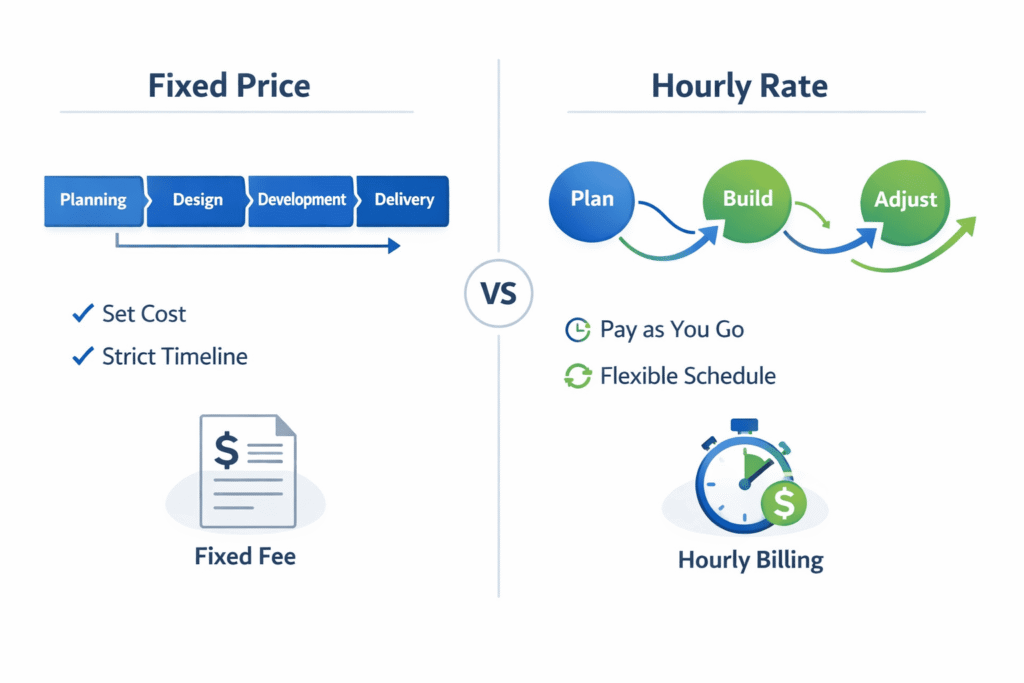
A fixed price model means:
- Scope is defined upfront
- Cost is agreed before work starts
- Timeline is usually pre-estimated
This model feels safe — especially for non-technical clients. It gives a sense of structure and makes internal approvals easier.
Why Clients Prefer Fixed Price
- Clear budget from day one
- No surprises (in theory)
- Easier internal approvals
It creates a sense of control, particularly for businesses working with strict financial planning. Stakeholders feel more confident committing when numbers are locked early.
Where Fixed Price Starts Breaking Down
The problem is simple:
Software projects are rarely as predictable as they seem at the beginning.
Even well-planned projects evolve:
- Requirements change
- Edge cases appear
- Better ideas emerge during development
These changes are natural in real-world development, not exceptions.
When this happens in a fixed model:
- Changes become “out of scope”
- Negotiations begin
- Progress slows down
In many cases, the focus shifts from building the best solution to protecting the contract boundaries, which reduces overall project quality.
Understanding Hourly Model: Flexibility with Responsibility
In an hourly model:
- You pay for actual time spent
- Scope can evolve
- Work is continuous and adaptive
This model aligns more closely with how software development actually works. It allows teams to respond to real situations instead of sticking to assumptions made early.
Why Hourly Feels Risky to Clients
- No fixed total cost
- Fear of inefficiency
- Concern about lack of control
These concerns are valid — especially without transparency. When there is no visibility into work progress, hourly can feel uncertain and difficult to manage.
Where Hourly Model Excels
When managed properly, hourly work offers:
- Flexibility to adapt
- Continuous improvement
- Faster decision-making
Instead of resisting change, the model embraces it, which often leads to a better final product. It also allows developers to suggest improvements without being restricted by scope limitations.
The Core Difference: Risk Distribution
This is the most important insight.
Fixed Price:
- Risk is mostly on the developer
- So developers protect themselves by:
- Limiting scope
- Avoiding extra work
- Adding buffers in pricing
This often results in safer but less optimized outcomes.
Hourly Model:
- Risk is shared
- But control comes from:
- Communication
- Transparency
- Clear priorities
This shifts the relationship from contract enforcement → collaboration, which improves both speed and quality.
Real-World Reality: Why Fixed Price Often Costs More
Ironically, fixed price projects often end up being more expensive in hidden ways.
1. Built-In Safety Margins
Developers estimate worst-case scenarios to protect themselves.
You’re often paying for risk that may never happen, which increases upfront cost.
2. Change Requests Become Expensive
Small changes can trigger:
- Re-estimation
- Delays
- Additional costs
This creates friction in what should be simple improvements and slows down progress.
3. Reduced Innovation
Developers may avoid suggesting improvements because:
- It’s outside scope
- It adds unpaid work
The project becomes about delivery, not excellence, which limits long-term value.
When Fixed Price Actually Makes Sense
Fixed price is not wrong — it’s just context-dependent.
It works best when:
- Requirements are 100% clear
- Scope is small and well-defined
- No major changes are expected
- Timeline is short
These conditions reduce uncertainty and make estimation more accurate.
Good Examples:
- Landing pages
- Simple websites
- Minor feature additions
In these cases, predictability outweighs flexibility.
When Hourly Model Is the Better Choice
Hourly is ideal when:
- Requirements may evolve
- Project complexity is high
- You want ongoing improvements
- You value collaboration over control
These situations benefit from flexibility and continuous thinking.
Good Examples:
- Custom web applications
- SaaS platforms
- Performance optimization
- Long-term maintenance
These projects require adaptability, which fixed models struggle to support.
The Real Protection Layer: Process, Not Pricing
Here’s the truth many clients miss:
No pricing model protects your project without a strong process.
An hourly project without structure can fail.
A fixed project without clarity can collapse.
What actually protects your project:
1. Clear Communication
- Regular updates
- Defined priorities
- Open discussions
This ensures alignment and reduces misunderstandings.
2. Transparent Tracking
- Time logs
- Progress reports
- Task visibility
Visibility builds trust and helps clients stay confident in progress.
3. Milestone-Based Thinking
Even in hourly:
- Break work into phases
- Review frequently
- Adjust direction early
This prevents small issues from becoming major problems.
4. Trust + Accountability
The best projects happen when:
- Developers think beyond tasks
- Clients focus on outcomes
This creates a partnership instead of a transactional relationship.
A Smarter Hybrid Approach (Often the Best Option)
Experienced teams often combine both models.
Example Hybrid Model:
- Fixed price for defined scope (e.g., initial build)
- Hourly for:
- Improvements
- Changes
- Optimization
This gives:
- Predictability where needed
- Flexibility where required
It’s not about choosing one model — it’s about using each where it fits best, based on project stage.
Common Mistakes to Avoid
1. Choosing Fixed Just to “Feel Safe”
Safety without flexibility often leads to frustration later.
2. Choosing Hourly Without Oversight
Lack of structure creates uncertainty and mistrust.
3. Ignoring Scope Clarity
Even hourly projects need direction.
Without it, time gets wasted.
4. Focusing Only on Cost
The cheapest model upfront can become the most expensive in outcome.
Key Takeaways
- Fixed price offers predictability but limits flexibility
- Hourly provides adaptability but requires trust and process
- Most project risks come from unclear scope, not pricing model
- The right choice depends on project complexity and clarity
- Hybrid models often provide the best balance
Conclusion: Protect the Outcome, Not Just the Budget
The goal of any web project is not just to stay within budget —
it’s to deliver something that actually works, scales, and creates value.
Fixed price protects your budget upfront.
Hourly protects your ability to adapt and improve.
The smartest decision is not choosing sides —
it’s understanding your project deeply enough to choose the right approach.
Because in the end,
a successful project is not the one that costs less — it’s the one that delivers more.
References and Further Reading
- Harvard Business Review – Fixed vs Time-Based Contracts
https://hbr.org/2018/04/how-to-negotiate-with-a-contractor - Atlassian – Agile Project Estimation & Pricing
https://www.atlassian.com/agile/project-management/estimation - Smartsheet – Fixed Price vs Time and Materials
https://www.smartsheet.com/content/fixed-price-vs-time-and-materials - Wrike – Project Cost Management Guide
https://www.wrike.com/project-management-guide/faq/what-is-project-cost-management/ - Indeed – Hourly vs Salary vs Contract Work
https://www.indeed.com/career-advice/pay-salary/hourly-vs-salary