
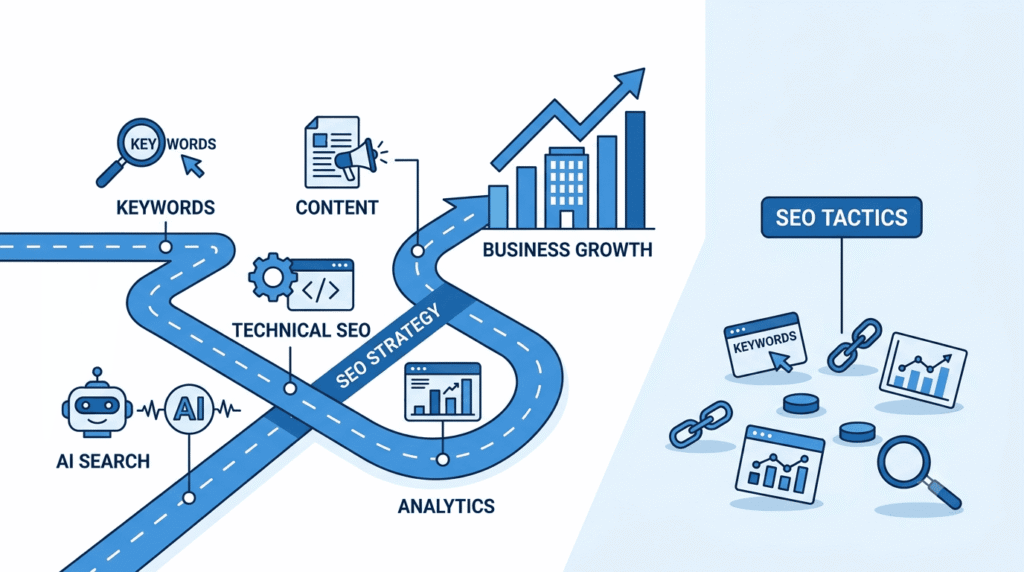
SEO strategy is the long-term plan that defines your business goals, target audience, content priorities, and overall direction for organic growth. SEO tactics are the specific actions—such as keyword research, content creation, technical SEO, and link building—that execute that plan. Simply put, strategy decides what and why to do, while tactics determine how to do it.
Many businesses invest time and money in SEO but struggle to achieve consistent results. They publish blog posts, optimize pages, improve website speed, and build backlinks, yet their organic growth remains slow or unpredictable.
The reason is often simple: they have SEO tactics but not an SEO strategy.
As search engines become smarter and AI-powered search experiences like Google AI Overviews, ChatGPT Search, Gemini, and Perplexity continue to grow, success is no longer determined by completing a checklist of SEO tasks. Instead, websites need a clear strategy that aligns every optimization effort with business goals, user intent, and topical authority.
Understanding the difference between SEO strategy and SEO tactics helps businesses prioritize the right work, avoid wasted effort, and build sustainable visibility in both traditional search engines and AI-powered search.
SEO Strategy vs SEO Tactics
Web Version (Comparison Table)
| SEO Strategy | SEO Tactics |
|---|---|
| Defines the long-term direction | Executes the day-to-day work |
| Focuses on business objectives | Focuses on specific optimization tasks |
| Determines priorities | Implements priorities |
| Built around users and search intent | Built around execution and optimization |
| Changes occasionally | Updated regularly |
| Measures long-term growth | Measures task performance |
| Answers What and Why? | Answers How? |
Key Insight: Strategy provides direction, while tactics provide execution. Sustainable SEO requires both.
The Simple Difference
Strategy tells you where you’re going.
Tactics tell you how you’ll get there.
Without a strategy, tactics become disconnected tasks. Without tactics, strategy remains only an idea.
A Simple Analogy Anyone Can Understand
Imagine you’re planning a road trip.
Before starting the journey, you decide:
- Your destination
- The best route
- Your travel budget
- The places you want to visit
- How you’ll measure a successful trip
This planning represents your SEO strategy.
Now think about the actions you take during the trip:
- Filling the fuel tank
- Following GPS directions
- Booking hotels
- Driving the car
- Taking rest stops
These are your SEO tactics.
Without knowing your destination, even perfect driving won’t guarantee you’ll reach the right place. Likewise, publishing optimized content and building backlinks won’t produce sustainable growth if they’re not guided by a clear strategy.
Key Insight: A strategy gives your SEO purpose, while tactics turn that purpose into measurable results.
What Is an SEO Strategy?
An SEO strategy is a long-term plan that connects your website’s organic search efforts to your overall business goals.
Rather than focusing on individual SEO tasks, a strategy looks at the bigger picture:
- Who are your ideal customers?
- What problems are they want to solve?
- Which topics should your website become an authority on?
- What content will attract, educate, and convert visitors?
- Which pages contribute most to leads or sales?
- How can your website become more trustworthy for both users and AI search engines?
A strong SEO strategy creates a roadmap that helps every optimization effort move in the same direction.
Instead of asking:
“Which keyword should we target next?”
A strategic approach asks:
- Which audience are we trying to reach?
- What information are they searching for?
- What stage of the customer journey are they in?
- Which content will provide the greatest business value?
- How can we demonstrate expertise and authority?
These questions lead to smarter decisions that support long-term organic growth.
What Does an SEO Strategy Typically Include?
Although every business has different goals, most successful SEO strategies include the following components:
1. Business Goals
SEO should support measurable business objectives, such as:
- Generating qualified leads
- Increasing online sales
- Building brand awareness
- Growing newsletter subscribers
- Expanding into new markets
2. Audience Research
Understanding your audience helps you create content that answers real questions instead of simply targeting keywords.
This includes identifying:
- Customer challenges
- Search behavior
- Buying journey
- Frequently asked questions
- Content preferences
3. Search Intent Analysis
Not every keyword has the same purpose.
A strategy identifies whether users are looking to:
- Learn something
- Compare products or services
- Find a specific website
- Make a purchase
- Contact a business
Creating content that matches search intent improves both rankings and user satisfaction.
4. Content Planning
Rather than publishing random blog posts, a strategy organizes content into topic clusters that build authority around important subjects.
For example, if your main topic is SEO Strategy, supporting articles might cover:
- Keyword Research
- Technical SEO
- Content Optimization
- Internal Linking
- AI SEO
- Generative Engine Optimization (GEO)
- Schema Markup
- SEO Reporting
This interconnected approach helps search engines and AI systems better understand your expertise.
5. Performance Measurement
A strategy also defines how success will be measured.
Instead of tracking only keyword rankings, it considers metrics such as:
- Organic traffic quality
- Lead generation
- Conversion rates
- Revenue from organic search
- User engagement
- Brand visibility
- AI search mentions and citations (where measurable)
These indicators provide a more complete picture of SEO performance.
Key Insight: SEO strategy isn’t a list of tasks—it’s a roadmap that aligns every optimization effort with business goals and user needs.
What Are SEO Tactics?
SEO tactics are the specific actions you take to improve your website’s visibility in search engines and AI-powered search platforms. They are the practical tasks that bring your SEO strategy to life.
Think of tactics as the daily, weekly, or monthly activities that move your website toward the goals defined in your strategy.
Common SEO tactics include:
- Conducting keyword research
- Optimizing title tags and meta descriptions
- Writing blog articles
- Improving page speed
- Fixing technical SEO issues
- Building internal links
- Earning high-quality backlinks
- Adding schema markup
- Optimizing images
- Refreshing outdated content
- Improving Core Web Vitals
- Creating FAQ sections
Each of these activities can improve your website. However, their effectiveness depends on why you’re doing them and how they fit into your broader SEO strategy.
For example, publishing four blog posts every month is a tactic. If those articles answer your audience’s most important questions, strengthen topical authority, and support your business goals, they’re contributing to your strategy. If they’re published simply to maintain a schedule, they may generate activity without delivering meaningful results.
Key Insight: SEO tactics create momentum, but strategy ensures that momentum moves in the right direction.
Why Do Businesses Confuse SEO Strategy with SEO Tactics?
One of the biggest reasons businesses struggle with SEO is that tactics are easy to see, while strategy happens behind the scenes.
A monthly SEO report often includes metrics like:
- 10 blog posts published
- 30 technical issues fixed
- 20 new backlinks earned
- 100 keywords tracked
- 15 pages optimized
These numbers demonstrate activity, but they don’t necessarily demonstrate progress.
The more important questions are:
- Did qualified organic traffic increase?
- Did more visitors become customers?
- Did the website build authority in its industry?
- Did the content answer users’ questions more effectively?
- Did SEO contribute to business growth?
If these questions can’t be answered, there’s a good chance the business is focusing on tactics instead of strategy.
Expert Perspective
Many companies believe they have an SEO strategy because they’re consistently publishing content or optimizing pages. In reality, consistency is only one part of SEO. A true strategy defines who you’re trying to reach, what problems you’re solving, why each page exists, and how success will be measured.
Key Insight: Completing SEO tasks isn’t the same as executing an SEO strategy.
A Real-World Example
Let’s compare two fictional businesses that sell project management software.
Company A: Focused Only on SEO Tactics
Every month, they:
- Publish four blog posts.
- Build backlinks.
- Update title tags.
- Fix technical issues.
- Monitor keyword rankings.
After several months, they notice slight traffic growth but very few additional leads or sales.
Why?
Because their SEO activities were driven by routine rather than purpose. They created content without understanding customer intent, ignored content gaps, and measured success mainly through rankings.
Company B: Guided by an SEO Strategy
Before publishing any content, they:
- Identify their ideal audience.
- Research customer pain points.
- Analyze competitors.
- Build topic clusters.
- Prioritize high-converting pages.
- Align content with each stage of the customer journey.
- Define measurable business goals.
Only then do they begin executing SEO tactics.
The result?
Their content attracts more qualified visitors, builds topical authority, supports AI search visibility, and generates more leads over time.
Interestingly, both companies perform many of the same SEO tasks. The difference is that Company B executes those tasks with a clear strategic purpose.
Key Insight: The same tactics can produce completely different results depending on the strategy behind them.
Is Keyword Research a Strategy or a Tactic?
This is one of the most common SEO questions.
The answer is straightforward:
Keyword research is an SEO tactic.
It helps identify the words and phrases your audience uses when searching online.
However, deciding:
- Which keywords align with your business goals,
- Which topics deserve long-term investment,
- Which customer problems to solve first, and
- How keywords fit into your content ecosystem,
is part of your SEO strategy.
For example:
Tactical Thinking
“This keyword has a high search volume, so let’s write an article about it.”
Strategic Thinking
“Our target customers search for educational content before purchasing. We’ll build a topic cluster around those questions to establish authority and guide readers toward our services.”
The second approach creates stronger long-term value because it connects keyword research to business objectives instead of treating it as an isolated task.
Key Insight: Keyword research tells you what people search for. Strategy determines which opportunities matter most.
Which Comes First: SEO Strategy or SEO Tactics?
The answer is simple:
Strategy always comes first.
Imagine building a house.
You wouldn’t start laying bricks before creating architectural plans. Likewise, you shouldn’t begin optimizing pages or publishing content before deciding what your website is trying to achieve.
A typical strategic SEO process looks like this:
- Define business goals.
- Understand your audience.
- Research search intent.
- Analyze competitors.
- Build a content plan.
- Prioritize technical improvements.
- Execute SEO tactics.
- Measure performance.
- Refine the strategy based on results.
Skipping the planning stage often leads to:
- Random content creation
- Keyword cannibalization
- Wasted marketing budget
- Inconsistent messaging
- Weak topical authority
- Poor return on investment
Key Insight: Every SEO tactic should have a clear strategic reason for existing.
Questions to Ask Before Starting Any SEO Activity
Before writing a new article, optimizing a page, or launching a technical SEO project, ask yourself these questions:
- What business goal does this support?
- Which audience is this intended for?
- What search intent am I addressing?
- How does this strengthen my topical authority?
- Will this content still be valuable in a year?
- How will I measure its success?
- Does this improve the user experience?
- Is this likely to help both traditional search engines and AI-powered search understand my expertise?
If you can’t confidently answer these questions, revisit your strategy before moving forward.
How Strategy Determines Which SEO Tactics Matter
Not every SEO tactic deserves the same level of attention.
The right tactics depend on your business goals, target audience, industry, and stage of growth. An effective SEO strategy helps you decide where to invest your time, budget, and resources for the greatest impact.
For example, a local plumbing business and a global SaaS company both need SEO, but their priorities are very different.
A local business may focus on:
- Optimizing its Google Business Profile
- Creating location-specific service pages
- Earning customer reviews
- Building local citations
- Improving local schema markup
A SaaS company may prioritize:
- Building comprehensive topic clusters
- Creating product comparison pages
- Publishing educational resources
- Strengthening technical SEO
- Producing original research and case studies
Both are using SEO tactics, but their strategies determine which tactics matter most.
Key Insight: Good SEO isn’t about doing everything—it’s about doing the right things for your business.
How to Build an Effective SEO Strategy
If you’re creating or improving an SEO strategy, follow these steps.
Step 1: Define Clear Business Goals
Start by asking:
- What should SEO achieve for the business?
- More leads?
- More sales?
- Greater brand awareness?
- Increased newsletter subscribers?
- Better local visibility?
Avoid goals like:
- “Rank #1 on Google.”
- “Publish more blogs.”
Instead, focus on measurable business outcomes.
Step 2: Know Your Audience
Understanding your audience is more valuable than simply knowing search volume.
Research:
- Customer pain points
- Frequently asked questions
- Buying journey
- Search behavior
- Industry terminology
The better you understand your audience, the easier it becomes to create content that genuinely helps them.
Step 3: Build Content Around Topics, Not Just Keywords
Modern SEO rewards topical authority rather than isolated pages.
Instead of publishing unrelated articles, organize your content into connected topic clusters.
Example:
Pillar Topic
SEO Strategy
Supporting Topics:
- Keyword Research
- Technical SEO
- Internal Linking
- On-Page SEO
- AI SEO
- GEO
- Schema Markup
- SEO KPIs
This structure helps users navigate your content while also helping search engines and AI systems understand your expertise.
Step 4: Prioritize Technical SEO
Even excellent content can struggle if your website has technical problems.
Review areas such as:
- Website speed
- Mobile usability
- Core Web Vitals
- Crawlability
- Indexability
- HTTPS security
- XML sitemaps
- Structured data
- Internal linking
Technical SEO creates the foundation that allows great content to perform.
Step 5: Measure What Matters
Many businesses focus on rankings alone.
Instead, measure outcomes that reflect business growth.
Examples include:
- Organic leads
- Qualified traffic
- Conversion rate
- Revenue from organic search
- User engagement
- Returning visitors
- Brand searches
- Content performance
Rankings are important, but they should support business objectives—not replace them.
Key Insight: Successful SEO strategies measure business impact, not just search visibility.
SEO Strategy in the Age of AI Search
Search is changing rapidly.
People increasingly ask conversational questions through AI assistants instead of typing short keyword phrases into search engines.
As a result, websites must optimize not only for Google Search but also for AI-powered search experiences.
Modern SEO strategies should include:
- Direct answers to common questions
- Clear heading structure
- Comprehensive topic coverage
- Practical examples
- Original insights
- Frequently Asked Questions
- Structured data (Schema)
- Strong internal linking
- Regular content updates
These elements help AI systems better understand, summarize, and reference your content.
Remember:
Generative Engine Optimization (GEO) doesn’t replace SEO—it builds upon it.
Common Mistakes to Avoid
Even experienced marketers sometimes focus on the wrong priorities.
Avoid these common mistakes:
❌ Publishing content without understanding search intent.
❌ Choosing keywords based only on search volume.
❌ Measuring success only through rankings.
❌ Ignoring technical SEO.
❌ Creating duplicate or overlapping content.
❌ Treating AI search as separate from SEO.
❌ Producing content for algorithms instead of people.
❌ Never updating older content.
Avoiding these mistakes can significantly improve both search visibility and long-term content performance.
Quick Self-Assessment
Ask yourself these questions:
- Do we have documented SEO goals?
- Does every piece of content support a business objective?
- Are we building topical authority or publishing random articles?
- Are our SEO efforts measured by business outcomes?
- Is our content designed for both users and AI search?
If you answered “No” to several of these questions, your website may need a stronger SEO strategy before investing in more tactics.
People Also Ask
Q1: Is SEO strategy more important than SEO tactics?
Ans: Yes. Strategy provides direction and priorities, while tactics execute the plan. Without strategy, tactics often become disconnected activities.
Q2: Can SEO tactics work without a strategy?
Ans: They may produce temporary improvements, but long-term growth usually requires a clear strategy aligned with business goals.
Q3: How often should an SEO strategy be updated?
Ans: Review your strategy every 6–12 months, or whenever your business goals, audience, or search landscape changes significantly.
Q4: Does AI search require a different SEO strategy?
Ans: Not a completely different strategy, but it does require broader optimization. Businesses should focus on topical authority, structured content, E-E-A-T, and answering user questions clearly.
Q5: Can small businesses benefit from SEO strategy?
Ans: Absolutely. A clear strategy helps smaller businesses prioritize limited resources and compete more effectively with larger competitors.
Frequently Asked Questions
Q1: What is the biggest difference between SEO strategy and SEO tactics?
Ans: SEO strategy defines the long-term direction for achieving business goals through organic search. SEO tactics are the specific activities used to execute that strategy.
Q2: Which comes first: SEO strategy or SEO tactics?
SEO strategy should always come first because it determines which tactics are most valuable.
Q3: Is technical SEO a strategy or a tactic?
Ans: Technical SEO is considered a collection of tactics within an overall SEO strategy.
Q4: Is content marketing part of an SEO strategy?
Ans: Yes. Content planning is an important component of SEO strategy, while writing and optimizing individual articles are tactical activities.
Q5: Why do many SEO campaigns fail?
Ans: Many campaigns focus on completing tasks instead of solving customer problems and achieving measurable business objectives.
Q6: How does AI affect SEO?
Ans: AI search rewards websites that demonstrate expertise, provide comprehensive answers, organize information clearly, and build topical authority.
Final Thoughts
Understanding the difference between SEO strategy and SEO tactics is one of the most important lessons for any business investing in organic search.
SEO tactics are essential because they improve your website one action at a time. However, without a strategy, those actions often become disconnected efforts that fail to produce lasting business results.
A strong SEO strategy aligns every optimization activity with a clear purpose. It helps you understand your audience, prioritize meaningful work, build topical authority, and measure success based on business outcomes rather than individual tasks.
As search continues to evolve with AI-powered experiences, businesses that think strategically—and execute consistently—will be better positioned to earn visibility, trust, and sustainable organic growth.
Remember:
Strategy tells you where to go.
Tactics determine how you’ll get there.
The organizations that succeed in SEO won’t necessarily be those completing the most tasks—they’ll be the ones ensuring every task supports a well-defined strategy.
Key Takeaways
- SEO strategy defines the long-term direction for organic growth.
- SEO tactics are the actions used to implement that strategy.
- Strategy should always come before execution.
- Every SEO activity should support a measurable business objective.
- Building topical authority is more valuable than publishing random content.
- AI-powered search rewards expertise, structure, and comprehensive answers.
- Measuring leads, conversions, and business growth is more valuable than tracking rankings alone.
- The best SEO results come from combining strategic planning with consistent execution.
About the Author
Mirza Hadi Baig is a Full-Stack WordPress Developer and Technical SEO Specialist with 5+ years of hands-on experience building high-performance websites and WordPress solutions. He completed the IBM SEO Mastery: From Fundamentals to GenAI and GEO Strategies Specialization and writes about SEO strategy, WordPress development, AI search, and digital growth.