
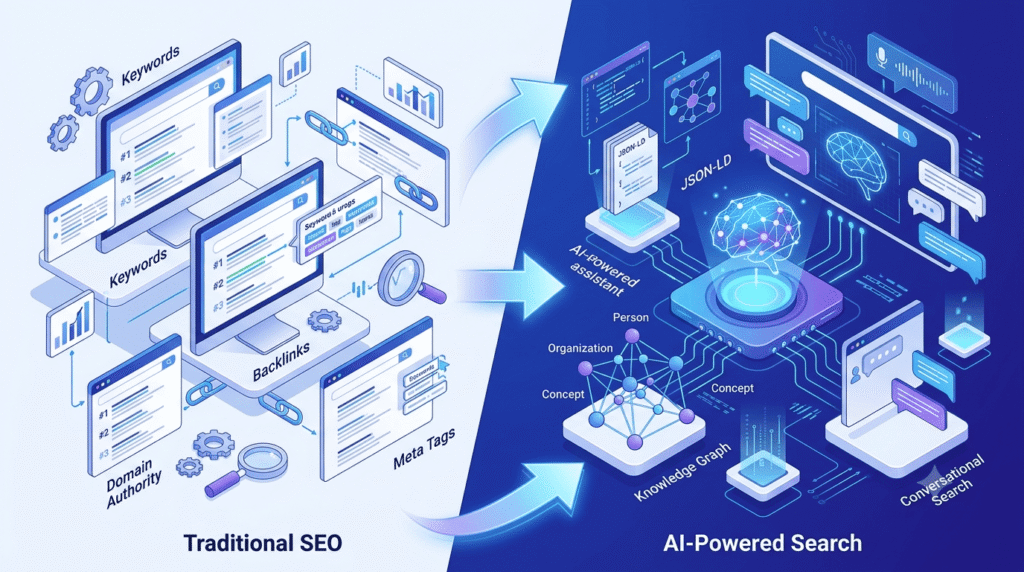
If you’re still optimizing your website only for traditional search engines, you’re already falling behind. AI Search Website Optimization is changing how websites are discovered, understood, and recommended by platforms like Google AI Overviews, ChatGPT, Microsoft Copilot, Gemini, and Perplexity. Instead of simply matching keywords, these AI-powered search systems analyze context, entities, user intent, credibility, and structured information to generate complete answers.
This shift doesn’t mean traditional SEO is dead—it means the rules have expanded. Websites now need to satisfy both search engine algorithms and AI models that summarize, compare, and recommend content. In this guide, you’ll learn how AI search works, how it differs from traditional SEO, and what changes website owners, developers, and marketers should make to stay visible in the next generation of search.
Search Has Entered a New Era
For more than two decades, search engine optimization (SEO) focused on helping webpages rank higher in search engine results pages (SERPs). Website owners researched keywords, built backlinks, improved page speed, optimized metadata, and created content to compete for the coveted first-page rankings.
That strategy still matters.
However, the way people search is rapidly evolving.
Instead of typing short keyword phrases like:
- best WordPress SEO plugin
- website optimization tips
- technical SEO checklist
Users are increasingly asking complete questions such as:
- How can I optimize my website for AI search?
- Which SEO strategy works best for AI Overviews?
- How do I make my website easier for ChatGPT to understand?
Rather than returning ten blue links, AI-powered search engines often generate direct answers by combining information from multiple trusted sources.
This fundamental change means websites are no longer competing only for rankings—they’re competing to become trusted sources that AI systems choose to reference.
What Is Traditional SEO?
Traditional SEO is the process of optimizing a website so that search engines like Google and Bing can crawl, index, and rank its pages for relevant search queries.
For years, successful SEO strategies focused on factors such as:
- Keyword optimization
- Meta titles and descriptions
- Internal linking
- High-quality backlinks
- Page speed
- Mobile responsiveness
- Crawlability
- XML sitemaps
- Technical SEO
- Content quality
The goal was simple:
Rank higher in search results so users click your website.
This approach remains important because AI search systems still rely on high-quality, well-optimized websites as information sources.
Think of traditional SEO as building a strong foundation. Without it, AI optimization becomes much more difficult.
What Is AI SEO?
AI SEO, often referred to as Generative Engine Optimization (GEO) or Answer Engine Optimization (AEO), focuses on making content easier for AI-powered search engines and large language models (LLMs) to understand, interpret, and reference.
Instead of optimizing only for search rankings, AI SEO aims to optimize content for:
- AI-generated answers
- Conversational search
- Entity recognition
- Semantic understanding
- Knowledge retrieval
- Citation by AI assistants
The objective changes from:
“How do I rank #1?”
to
“How do I become a trusted source that AI chooses when answering questions?”
This subtle difference changes how websites should be planned, written, and maintained.
Traditional SEO vs AI SEO
Although they share many best practices, traditional SEO and AI SEO prioritize different outcomes.
Traditional SEO Focuses On
- Ranking webpages
- Targeting individual keywords
- Increasing organic traffic
- Improving click-through rates
- Building backlinks
- Optimizing metadata
- Competing for SERP positions
Success is typically measured by rankings, impressions, and website visits.
AI SEO Focuses On
- Becoming a trusted information source
- Answering user questions directly
- Demonstrating expertise
- Building entity relationships
- Providing structured, factual information
- Supporting AI-generated summaries
- Improving content clarity and context
Success is measured by how well AI systems understand, trust, and reference your content.
Traditional SEO and AI SEO Work Together
One of the biggest misconceptions today is that AI search has replaced traditional SEO.
It hasn’t.
Instead, AI search builds on traditional SEO.
Consider this analogy:
Traditional SEO builds the library.
AI SEO helps the librarian understand which books contain the best answers.
Without technical SEO, search engines may struggle to crawl your website.
Without high-quality content, AI has nothing valuable to reference.
Without structured information, AI may misunderstand your expertise.
The most successful websites combine both approaches rather than choosing one over the other.
Why AI Search Changes Website Optimization
Traditional search engines primarily displayed webpages.
AI search systems generate answers.
That difference changes almost every aspect of website optimization.
Instead of asking:
Which page should rank?
AI systems ask:
- Which source is trustworthy?
- Which content answers the question completely?
- Which explanation is easiest to understand?
- Which information is current?
- Which source demonstrates expertise?
These questions require a different approach to content creation.
Modern websites should no longer focus solely on attracting clicks—they should focus on becoming reliable knowledge sources.
How AI Search Works
Although every AI platform uses different technologies, most follow a similar process.
Step 1: Understand the User’s Intent
Instead of matching exact keywords, AI interprets what the user is actually trying to accomplish.
For example:
Search Query:
“How can I improve my website for ChatGPT?”
AI understands that the user probably wants information about:
- AI SEO
- GEO
- Website optimization
- Structured data
- AI-friendly content
rather than pages containing only the exact phrase.
Step 2: Retrieve Relevant Information
The AI searches trusted sources, indexed webpages, knowledge graphs, structured data, and authoritative content.
Rather than relying on one page, it often compares information from multiple sources.
Step 3: Analyze Context
Instead of reading isolated keywords, AI evaluates:
- Headings
- Paragraphs
- Relationships between topics
- Entities
- Supporting evidence
- Author expertise
- Content structure
This helps it determine whether the information is complete and reliable.
Step 4: Generate an Answer
Finally, AI combines the most useful information into a conversational response.
Some systems also cite or recommend the original sources.
This is why becoming a trusted source matters more than ever.
What AI Search Looks For
Although no company publishes the exact ranking formulas behind AI-generated answers, several content qualities consistently improve the likelihood of being understood and referenced.
AI systems generally prefer content that is:
Direct
Answer the user’s primary question early in the article instead of making readers search for the answer.
Well Structured
Clear headings, logical sections, bullet lists, and concise paragraphs help AI extract information more accurately.
Context Rich
Explain not only what something is but also why, when, and how it should be used.
Factually Accurate
AI systems increasingly evaluate consistency across multiple trusted sources.
Incorrect or outdated information is less likely to be referenced.
Experience Based
First-hand knowledge, practical examples, and real-world insights strengthen credibility.
Google refers to this concept as Experience, Expertise, Authoritativeness, and Trustworthiness (E-E-A-T).
Questions Every Website Owner Should Start Asking
Instead of asking only:
- Which keyword should I target?
- How many backlinks do I need?
- How do I rank higher?
Consider asking:
Can AI easily understand my content?
Does my article answer the main question within the first few paragraphs?
Have I demonstrated real expertise?
Is my content supported by structured data?
Would an AI assistant confidently recommend this page to a user?
These questions better reflect how modern search systems evaluate content quality.
The Biggest Mindset Shift
Perhaps the biggest change isn’t technical at all.
It’s strategic.
For years, websites were written primarily to satisfy search engine algorithms.
Today, successful websites are increasingly written to educate people first while making that information easy for AI systems to interpret.
The goal is no longer to simply rank for keywords.
The goal is to become the most useful, trustworthy, and understandable resource on a topic.
When your content consistently solves real problems, traditional search engines and AI-powered search systems are far more likely to recognize its value.
How to Optimize Your Website for AI Search (GEO)
Understanding how AI search works is only the first step. The real challenge is adapting your website so that AI-powered search engines can easily understand, trust, and recommend your content.
Unlike traditional SEO, where ranking often depended heavily on keywords and backlinks, AI Search Website Optimization requires a broader strategy that combines technical SEO, semantic understanding, structured data, and genuine expertise.
Let’s explore the most important optimization techniques.
How to Optimize Your Website for AI Search
There isn’t a single “AI SEO trick” that guarantees success.
Instead, websites should follow several complementary practices that improve both human experience and machine understanding.
The most successful websites combine:
- Strong technical SEO
- Helpful content
- Clear structure
- Entity optimization
- Structured data
- Real expertise
- Consistent topical authority
Together, these create a website that both search engines and AI systems can confidently interpret.
1. Focus on Solving Questions, Not Just Targeting Keywords
Traditional SEO often started with a keyword.
AI Search starts with a question.
Instead of creating articles around short phrases like:
- AI SEO
- WordPress SEO
- Schema markup
Think about the actual questions users ask.
Examples include:
- How does AI search work?
- What is Generative Engine Optimization?
- Why is schema markup important for AI search?
- How can I optimize my WordPress website for AI Overviews?
- Does ChatGPT use structured data?
When your content answers complete questions naturally, AI systems are more likely to retrieve and summarize it.
Best Practices
- Answer the primary question within the first 100 words.
- Use question-based headings.
- Include “How,” “Why,” “What,” and “When” sections.
- Add FAQ sections where appropriate.
- Provide complete answers instead of short definitions.
2. Build Content Around Entities, Not Just Keywords
One of the biggest differences between traditional SEO and AI SEO is the importance of entities.
An entity is a clearly identifiable person, place, organization, product, technology, or concept.
For example, an article about AI SEO naturally relates to entities such as:
- Google AI Overviews
- ChatGPT
- Gemini
- Microsoft Copilot
- Perplexity
- Schema.org
- WordPress
- JSON-LD
- Technical SEO
AI systems understand relationships between these entities.
Instead of repeating the same keyword, build meaningful connections between related concepts.
Why Entity SEO Matters
Entity-rich content helps AI understand:
- Context
- Relationships
- Topic depth
- Subject expertise
This produces a stronger knowledge graph around your website.
3. Demonstrate Real Experience (E-E-A-T)
Google emphasizes four important quality signals:
Experience
Have you actually worked with the topic?
Share:
- Real projects
- Case studies
- Lessons learned
- Practical examples
Expertise
Show technical understanding.
Instead of writing:
Schema improves SEO.
Explain:
- How it works
- When to use it
- Which schema types matter
- Common implementation mistakes
Authoritativeness
Build authority through:
- Comprehensive articles
- Consistent publishing
- Topic clusters
- Professional profiles
- Quality references
Trustworthiness
Trust is built by:
- Accurate information
- Honest recommendations
- Transparent authorship
- Updated content
- Secure websites (HTTPS)
Developer Insight
As a Full Stack Developer, I’ve found that articles based on actual implementation experience consistently provide more value than content rewritten from existing blogs. Sharing practical workflows, technical decisions, and real challenges not only builds reader trust but also creates stronger signals of expertise for AI systems evaluating your content.
4. Structure Content for AI Readability
AI systems don’t simply scan pages—they analyze structure.
Well-organized articles are easier to understand.
Use:
- One H1
- Logical H2 sections
- Supporting H3 headings
- Short paragraphs
- Numbered steps
- Bullet lists
- Tables (where appropriate)
- Definitions
- Examples
Avoid:
- Huge blocks of text
- Vague headings
- Long introductions
- Hidden answers
Think of every section as answering one specific question.
5. Create Topical Authority Instead of Isolated Articles
Publishing one article about AI SEO isn’t enough.
AI systems evaluate your expertise across an entire topic.
Instead of writing:
- One AI SEO article
Build a knowledge hub covering:
- AI SEO
- GEO
- AEO
- Technical SEO
- Schema Markup
- Entity SEO
- WordPress SEO
- AI Content Optimization
- Structured Data
- Website Architecture
The more comprehensive your coverage, the stronger your topical authority becomes.
7. Use Structured Data Wherever Appropriate
Structured data helps search engines understand your content more accurately.
Common schema types include:
- Article
- FAQ
- Organization
- Product
- Service
- Local Business
- Person
- Breadcrumb
- Review
- Event
Schema doesn’t guarantee rankings.
Instead, it reduces ambiguity by clearly identifying what your content represents.
For AI systems, structured data acts like additional context that supports content interpretation.
Recommendation
Always validate schema using trusted testing tools before publishing.
Optimize for Semantic Search
Semantic SEO focuses on meaning rather than repetition.
Instead of repeating:
AI Search Website Optimization
Twenty times, naturally discuss related concepts.
Examples include:
- AI-powered search
- Answer engines
- Large Language Models
- Search intent
- Structured data
- Knowledge graphs
- Semantic relationships
- Information retrieval
This creates richer content without keyword stuffing.
8. Write Like You’re Teaching Someone
AI systems prefer content that explains.
Compare these approaches.
Weak
Schema improves SEO.
Better
Schema markup provides structured information that helps search engines understand the purpose and relationships of your content. While it isn’t a direct ranking factor, it improves eligibility for rich results and supports better interpretation by AI-powered search systems.
Notice the second version answers:
- What
- Why
- How
all together.
9. Improve Internal Linking Strategy
Internal links help both users and AI understand your website.
Instead of randomly linking pages, build logical relationships.
For example:
AI SEO Guide
↓
Schema Markup
↓
Entity SEO
↓
Technical SEO
↓
WordPress Optimization
↓
Core Web Vitals
Each article strengthens the others.
This creates topical clusters that improve website understanding.
10. Optimize Images for AI Search
Images are becoming increasingly important.
Instead of uploading:
image123.jpg
Use descriptive filenames:
ai-search-website-optimization-guide.jpg
Also include:
- Descriptive alt text
- Relevant captions
- Proper image compression
- Context around images
AI systems increasingly analyze visual content alongside text.
11. Keep Information Fresh
AI systems prefer updated information.
Review older articles regularly.
Update:
- Statistics
- Examples
- Screenshots
- Plugin recommendations
- Search features
- AI platform capabilities
Fresh content demonstrates ongoing expertise.
Common AI SEO Mistakes to Avoid
Many websites still optimize using outdated SEO habits.
Avoid these common mistakes.
Keyword Stuffing
Writing the same keyword repeatedly reduces readability.
Write naturally.
Publishing Thin Content
A 500-word article rarely answers complex questions completely.
Aim for depth rather than word count alone.
Ignoring Search Intent
Always ask:
Why is someone searching for this?
Answer that need directly.
No Structured Data
Missing schema makes content harder for search engines to classify.
Weak Headings
Avoid generic headings such as:
- Introduction
- Overview
- Summary
Use descriptive headings that reflect real user questions.
No Author Experience
Content lacking first-hand knowledge often feels generic.
Share:
- Examples
- Results
- Lessons
- Practical recommendations
Writing Only for Search Engines
The best AI-optimized content is written primarily for people.
AI rewards content that genuinely helps users.
A Practical Example
Imagine two articles about schema markup.
Article A
- 700 words
- Keyword repeated frequently
- No examples
- No schema
- No FAQs
- No author experience
Article B
- Comprehensive guide
- Direct answers
- Real implementation examples
- FAQ section
- Schema markup
- Internal links
- Developer insights
- Structured headings
- Semantic coverage
- Updated regularly
Which article is more likely to become an AI reference?
Almost certainly the second.
Not because it’s longer.
Because it’s more complete, trustworthy, and easier for AI systems to understand.
Questions to Audit Your Website
Before publishing your next article, ask yourself:
Does the introduction answer the main question immediately?
Would an AI assistant understand what this page is about?
Have I demonstrated real expertise?
Does every heading answer a specific question?
Is my content supported with structured data?
Have I linked to related resources?
Would I confidently recommend this article to someone learning the topic?
If the answer is “yes” to most of these questions, you’re already moving toward AI-friendly website optimization.
The Future of AI Search, Action Plan & Final Recommendations
The rise of AI-powered search is not a temporary trend—it represents one of the biggest shifts in how information is discovered online since the introduction of modern search engines.
Businesses that continue optimizing only for traditional search rankings may still attract visitors, but those that also optimize for AI understanding will be better positioned as search continues to evolve.
The goal is no longer just to appear in search results.
The goal is to become a trusted source that AI systems confidently recommend.
The Future of AI Search
Search is becoming increasingly conversational.
Instead of browsing multiple webpages, users are beginning to ask AI assistants complex questions and expect complete, trustworthy answers.
Examples include:
- Which WordPress SEO plugin should I use?
- How do I optimize my website for AI Overviews?
- Compare Rank Math and Yoast for local SEO.
- What is the best schema plugin for WooCommerce?
AI systems attempt to answer these questions immediately while referencing the most reliable sources available.
As this behavior grows, websites that consistently publish well-structured, experience-driven content will have a significant advantage.
Where AI Search Is Heading
Although no one can predict every change, several trends are becoming increasingly clear.
More Conversational Search
Search queries are becoming longer and more natural.
Instead of typing:
AI SEO
People now ask:
How can a small business optimize its website for AI-powered search?
Content should be written to answer complete questions rather than isolated keywords.
Greater Emphasis on Expertise
AI systems increasingly evaluate:
- Author expertise
- Practical experience
- Topical authority
- Content accuracy
- Consistency
This makes original insights more valuable than rewritten summaries.
Better Entity Understanding
Future AI systems will become even better at understanding relationships between:
- Companies
- Products
- Technologies
- Industries
- Authors
- Organizations
Building a strong entity presence across your website will become increasingly important.
Greater Use of Structured Data
Schema markup will continue helping AI understand:
- Products
- Businesses
- Articles
- Services
- FAQs
- Events
- Reviews
Structured data reduces ambiguity and improves machine understanding.
More Personalized Search
AI-generated answers will increasingly consider:
- User intent
- Previous interactions
- Location
- Device
- Context
This means creating genuinely helpful content becomes even more important than chasing individual keywords.
AI Search Optimization Checklist
Use this checklist before publishing every important page.
Technical Foundation
✅ Fast website
✅ Mobile friendly
✅ Secure HTTPS
✅ Clean URL structure
✅ XML Sitemap
✅ Robots.txt configured
✅ Good Core Web Vitals
Content Quality
✅ Answer the main question immediately.
✅ Cover the topic comprehensively.
✅ Use descriptive headings.
✅ Include examples.
✅ Explain why and how.
✅ Keep information current.
AI Readability
✅ Short paragraphs
✅ Bullet points
✅ Question-based headings
✅ Definitions
✅ Step-by-step explanations
✅ Logical content flow
Semantic SEO
✅ Use related entities.
✅ Cover supporting concepts.
✅ Build topical clusters.
✅ Link related articles.
Structured Data
✅ Article Schema
✅ Organization Schema
✅ FAQ Schema
✅ Breadcrumb Schema
✅ Product or Service Schema where appropriate
E-E-A-T
✅ Real experience
✅ Technical expertise
✅ Author transparency
✅ Trustworthy recommendations
✅ Regular updates
Frequently Asked Questions
An: AI Search Website Optimization is the process of improving website content so AI-powered search engines can understand, trust, and reference it when generating answers.
An: No.
Traditional SEO remains the foundation of website optimization. AI SEO builds upon it by focusing on semantic understanding, structured data, user intent, and content quality.
An: Generative Engine Optimization (GEO) is the practice of optimizing content so generative AI systems can retrieve, understand, and reference it in AI-generated responses.
An: Answer Engine Optimization focuses on creating content that directly answers user questions, making it easier for AI assistants and search engines to generate accurate responses.
An: Yes.
Schema markup provides structured information that helps search engines and AI systems understand entities, relationships, and page content more accurately.
An: Very important.
Content demonstrating genuine experience, expertise, authoritativeness, and trustworthiness is generally more likely to be considered reliable by both search engines and AI-powered search systems.
An: No.
Only add FAQ Schema when the page contains genuine questions and answers that are visible to users.
An: Backlinks still contribute to authority, but AI systems also evaluate content quality, semantic relationships, expertise, and overall trustworthiness rather than relying only on link popularity.
An: Yes.
However, keywords should now be combined with user intent, semantic relevance, and comprehensive topic coverage rather than being the sole focus.
An: Review important evergreen content regularly, especially when technologies, search features, or industry best practices change.
Developer Insight
After working on WordPress websites, SEO projects, and custom plugin development, I’ve noticed that successful optimization is becoming less about “gaming” search engines and more about helping machines understand information correctly.
Whether I’m building structured data solutions like Schema Genie Pro, optimizing technical SEO, or improving website architecture, the underlying objective remains the same: make information accurate, well-organized, and easy for both humans and AI systems to understand.
In my experience, the websites that consistently perform well are those that combine strong technical foundations with genuinely useful content. AI may change how search results are delivered, but it doesn’t change the importance of expertise, clarity, and solving real user problems.
Final Recommendations for Website Owners
If you’re planning your SEO strategy for the next several years, focus less on chasing algorithm updates and more on building a website that deserves to be recommended.
Prioritize:
- Writing comprehensive content instead of publishing dozens of thin articles.
- Creating topic clusters rather than isolated posts.
- Demonstrating real experience instead of repeating generic advice.
- Implementing structured data wherever appropriate.
- Building a recognizable brand and author identity.
- Updating evergreen content regularly.
- Answering users’ questions clearly and honestly.
- Designing content for both people and AI systems.
These practices are valuable regardless of how search technology evolves.
Conclusion
Artificial intelligence is changing the way websites are discovered, evaluated, and recommended. While traditional SEO continues to provide the technical foundation for visibility, AI-powered search introduces a new layer of optimization centered on context, credibility, semantic understanding, and user value.
The most successful websites in the coming years will not simply target keywords—they will become trusted knowledge resources. By combining technical SEO, structured data, entity optimization, E-E-A-T principles, and genuinely helpful content, you can position your website for success across both traditional search engines and AI-powered search platforms.
Rather than viewing AI Search Website Optimization as a replacement for SEO, treat it as the natural evolution of search. Businesses and developers who embrace this shift today will be better prepared for the future of online discovery.
Key Takeaways
- Traditional SEO remains essential, but AI SEO expands the optimization strategy.
- AI systems prioritize context, entities, expertise, and trustworthy information.
- Directly answering user questions improves visibility in AI-generated results.
- Strong content structure makes information easier for AI to interpret.
- Entity SEO and semantic relationships are increasingly important.
- Schema markup supports better machine understanding.
- E-E-A-T strengthens both traditional and AI search performance.
- Topic clusters build long-term authority.
- AI-friendly content should educate people first while remaining easy for machines to understand.
- The future belongs to websites that consistently demonstrate expertise and solve real user problems.