
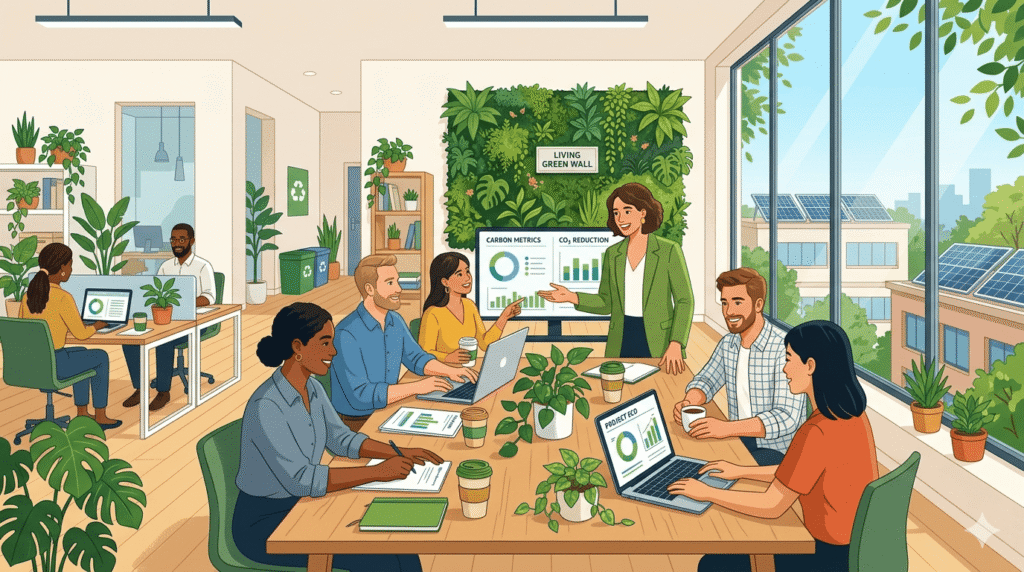
The organisations still treating sustainability as a nice-to-have are losing talent to the ones that figured this out two years ago.
There was a time — not long ago — when a company’s sustainability programme meant a recycling bin in the kitchen, a pledge on the website, and a mention in the annual report that nobody read. It was background noise. A PR gesture dressed up as a value. Employees noticed, and said nothing, because it was not their place to expect more.
That time is over.
Today, on World Environment Day 2026, it is worth pausing to name something that has shifted fundamentally in the relationship between employees and the organisations they choose to work for. Sustainability is no longer a differentiator that progressive companies offer. It is a baseline expectation that every company is increasingly being measured against — by the people they are trying to hire, the people they are trying to keep, and the generation that will define the workforce of the next twenty years.
Almost half — 46% — of office workers now say they want the company they work for to demonstrate genuine green credentials. IBM found that 71% of employees and job seekers say environmentally sustainable companies are more attractive employers, and 78% say they would be more likely to stay with a sustainable company long term. A ManpowerGroup survey found that 50% of workers would change jobs for an employer that prioritises sustainability.
These are not the numbers of a niche preference. They are the numbers of a market shift — and organisations that have not yet felt it will.
From Perk to Prerequisite: How the Shift Happened
The transition did not happen overnight. It accumulated gradually, driven by three overlapping forces that are now impossible to separate.
The generational transfer of power
Millennials and Gen Z will comprise approximately 75% of the global workforce by 2025 — and their influence is already reshaping the expectations every organisation must meet. These are not generations that treat environmental values as abstract political positions. They are generations that have grown up with climate change as a lived reality — with wildfires, floods, and extreme weather as the backdrop of their adult lives. For them, an employer’s environmental stance is not a bonus. It is a signal about whether this is an organisation that shares their understanding of the world they are inheriting.
One in three workers aged 18 to 24 has rejected a job offer based on a prospective employer’s weak ESG credentials — a trend KPMG has named “climate quitting.” This is not activism. It is a values-based employment decision made by people who have options and are choosing to use them.
The collapse of the separation between personal and professional values
For decades, there was an implicit understanding that what someone believed at home and what they accepted at work were two separate things. That separation has dissolved. Employees — particularly younger ones — increasingly refuse to spend forty hours a week working for an organisation whose values conflict with their own. Two-thirds of employees globally now say they want their work to contribute positively to society. When an employer’s environmental practices contradict that desire, the friction is no longer acceptable — it is a reason to leave.
The growing credibility gap between sustainability claims and reality
As sustainability has become a competitive necessity, it has also become fertile ground for what employees increasingly recognise as greenwashing — the gap between what organisations say about their environmental commitments and what they actually do. Research by KPMG found that an employer’s commitment to ESG values directly impacts how employees view the company, with many acting on that view if the organisation fails to align with their own values. Employees are not passive consumers of corporate communications. They notice when the sustainability page on the company website bears no relationship to how decisions are made, how suppliers are chosen, or how the office operates on a Tuesday morning.
Sustainability cannot live in the marketing department and die at the boardroom door. Employees see the distance between the two — and they judge organisations by it.
What “Green at Work” Actually Means to Employees
The mistake many organisations make is treating workplace sustainability as a physical question — solar panels on the roof, recycling in the office, electric car charging points in the car park. These things matter. But they are the surface layer of a much deeper expectation.
When employees say they want to work for a sustainable employer, they mean several things simultaneously:
Environmental operations
— how the physical workplace is run. Energy sources, waste management, supply chain choices, commuting support, carbon reporting. In 2026, 74% of organisations now have formal sustainability programmes integrated into their real-estate strategy to meet net-zero targets. The physical dimension of workplace sustainability is becoming infrastructure — expected rather than exceptional.
Strategic alignment
— whether sustainability is embedded in how the organisation makes decisions, not just how it describes itself. Employers globally now expect climate-change mitigation (47%) and adaptation (41%) trends to transform their businesses within the next five years. Employees want to work for organisations that see this clearly and are responding seriously — not ones that are waiting to see how the regulation landscape develops before committing.
Personal contribution
— whether employees are given the opportunity to participate in and contribute to the organisation’s sustainability goals. This is the dimension most organisations miss entirely. Sustainability as a spectator sport — something the facilities team manages while everyone else just sorts their waste — generates far less engagement and retention value than sustainability as a shared responsibility. Encouraging employee involvement in sustainability efforts through workshops, green teams, and employee-led environmental projects can significantly increase both engagement and retention.
Honest reporting
— whether the organisation communicates transparently about its environmental performance, including where it is falling short. Employees are far more trusting of organisations that acknowledge the gap between current performance and stated goals than of those that project only success. Honesty about imperfection is more credible — and more valued — than the appearance of seamless progress.
The Talent Consequences of Getting This Wrong
For organisations still treating sustainability as optional or aspirational, the talent data is a warning that deserves to be taken seriously.
Companies offering ESG-focused benefits retain 41% more employees than those that do not. That is not a marginal retention advantage. It is a structural one — the kind that compounds over time as the organisations getting it right accumulate experience, culture, and institutional knowledge, while those getting it wrong cycle through the cost and disruption of continuous turnover.
About 40% of millennials and Gen Z professionals actively choose to work at companies with strong sustainability credentials. Companies that excel in ESG performance report employee satisfaction scores 14% higher than bottom-quartile companies — and organisations where employees actively participate in sustainability initiatives show 21% higher profitability.
The green skills gap compounds this further. LinkedIn’s Green Skills Report 2025 shows that employers are hiring green talent faster than workers are acquiring green skills — green hiring grew approximately twice as fast as green skills development between 2021 and 2025. The organisations that have embedded sustainability into their culture and built internal green capability are not just more attractive to talent — they are increasingly rare, which makes them more competitive for exactly the professionals the market most urgently needs.
The organisations that treated sustainability seriously five years ago are not competing for the same talent pool as those that are starting today. The gap is already structural — and it is widening.
The Six Things Employees Actually Want From Sustainable Employers
Based on the research and on what employees consistently report when asked directly, here is what genuine workplace sustainability looks like from the employee’s perspective:
1. Visible, specific environmental commitments — not vague language
“We are committed to sustainability” means nothing. “We will reach net-zero scope 1 and 2 emissions by 2028, here is our current baseline, and here is what we are changing this year to get there” means something. Employees — particularly those with any professional exposure to ESG — can distinguish between genuine strategy and PR language. Specificity builds credibility. Vagueness erodes it.
2. Leadership that models the behaviour it expects
When executives fly business class to sustainability conferences while asking employees to reduce their carbon footprint, the message is not sustainability. It is hierarchy. Genuine sustainable culture requires leadership that applies the same standards to itself that it applies to the organisation — and is transparent when it falls short.
3. Meaningful employee participation
HR teams that organise sustainability workshops, create green employee teams, and support employee-led environmental projects report significantly stronger engagement and commitment to the organisation’s environmental goals. Employees do not want to be told about sustainability. They want to be part of building it. The organisations that understand this use sustainability as a source of purpose and engagement — not as a top-down communication exercise.
4. Green benefits that are practical, not performative
Sustainable commuting support — public transport subsidies, cycling infrastructure, electric vehicle charging — matters to employees not as a perk but as a signal that the organisation has thought seriously about the environmental impact of how people get to work. Green transport benefits including electric charging stations, bike storage, and transit subsidies are among the most valued sustainability-related employee benefits — precisely because they are practical and directly reduce individual environmental impact.
5. Investment in green skills and career development
The global share of workers with at least one green skill on LinkedIn rose from 15.2% to 17.6% between 2021 and 2025 — but employer demand is growing faster than supply. Employees who want to build sustainability competence are actively looking for employers who will invest in that development. Organisations that offer ESG training, sustainability certifications, and structured development pathways are not just building internal capability — they are building loyalty among the professionals most committed to working in this space long term.
6. Honest, transparent reporting — including the gaps
PwC’s Global Workforce ESG Preferences Study found that transparency and accountability are among the most valued dimensions of employer ESG commitment — with employees placing significant weight on whether organisations demonstrate genuine commitment beyond surface-level claims. The organisations earning the most trust are not the ones projecting perfection. They are the ones publishing honest assessments of where they are, acknowledging what is harder than expected, and communicating clearly about what they are changing.
Greenwashing: The Risk That Cuts Both Ways
If sustainability done genuinely builds loyalty and attracts talent, sustainability done cynically does the opposite — and at speed.
Employees are the most credible detectors of greenwashing precisely because they see the organisation from the inside. They know whether the sustainability values on the website match the decisions made in the boardroom. They know whether the environmental goals survive the first budget cut. They know whether the recycling bins are theatre or the first step in something genuine.
Research consistently shows that employees who perceive a gap between their organisation’s stated ESG values and its actual behaviour are significantly more likely to disengage — and to leave. The damage of greenwashing is not primarily reputational, though that too is real. It is cultural — it signals to every employee paying attention that the organisation’s values are instruments of brand management rather than genuine commitments, and that everything else the organisation says about its values should be read the same way.
The standard for organisations is therefore not perfection. It is honesty. Employees can accept that sustainability is a journey. What they cannot accept — and increasingly will not accept — is being asked to believe in a journey the organisation is not actually taking.
What Leaders and HR Teams Must Do Now
The shift from sustainability as perk to sustainability as expectation is not a future trend. It is the present reality — and the organisations responding to it as if it were still optional are already behind.
Here is where to focus:
Audit the gap between policy and practice.
Walk through your organisation’s sustainability claims with fresh eyes — or better, ask your employees to. Where does the stated commitment diverge from the operational reality? That gap is where trust erodes, and closing it is the highest-priority action available.
Make sustainability everyone’s responsibility — not just the facilities team’s.
Build it into how teams make decisions, how projects are scoped, how suppliers are selected, how travel is approved. When sustainability is embedded in daily decision-making rather than delegated to a dedicated function, it becomes culture rather than programme.
Give employees a genuine role.
Green teams, innovation challenges, sustainability input into strategy — these are not soft initiatives. They are retention tools, engagement drivers, and sources of real ideas from the people closest to the operational realities of the organisation.
Be transparent about progress — including the parts that are hard.
Regular, honest communication about environmental performance builds more trust than polished annual reports. Employees who feel they are being given an accurate picture of where the organisation stands are far more likely to be part of the solution than those who feel they are being managed with curated messaging.
Invest in green skills development.
The employees who care most about sustainability are also the ones most likely to leave for an employer that takes it more seriously. Giving them the training, the tools, and the career pathway to develop as sustainability professionals within your organisation is both a retention strategy and a capability investment.
A Note on World Environment Day 2026
Today’s theme is a reminder that environmental responsibility is not a corporate initiative — it is a human one. The decisions organisations make about how they operate, what they consume, and what they commit to reducing are not separate from the broader ecological challenge. They are part of it.
The employees asking more of their employers on sustainability are not asking for something unreasonable. They are asking organisations to take seriously what the evidence has been saying for decades — and to act as if the next generation of workers, customers, and citizens are watching. Because they are.
Every organisation gets to choose what kind of employer it wants to be. Increasingly, that choice includes whether sustainability is real or cosmetic — and employees are making their own choices accordingly.
Green credentials are no longer a recruitment advantage. They are a retention necessity. The organisations that build genuine sustainability cultures today are not just doing the right thing. They are building the only kind of organisation that the next generation of talent will choose to stay in.
— Workplace Wisdom Herald
Insights for thoughtful leaders & teams · World Environment Day, 5 June 2026
—
References & Further Reading
For deeper reading on the ideas covered in this article, these resources are worth your time:
- World Economic Forum — Employees Value the Green Transition but Leaders Must Balance Cost, Capability and Impact (2026)
- GreenBiz — Younger Job Seekers Drive “Climate Quitting” — KPMG Survey
- PwC — Global Workforce ESG Preferences Study 2024
- IBM Institute for Business Value — Sustainability as a Corporate Purpose
- inFeedo — The Hidden Truth: Why ESG Employee Programs Actually Work (2025 Data)
- Green Careers Hub — Top Sustainability Hiring Trends for 2026
- HR Grapevine — Avoid Green Quitting with Sustainable Staff Benefits
- Ronspot — The 2026 Workplace Statistics and Benchmarks Report