Motivation is one of the most discussed — and most misunderstood — elements of professional life. In many workplaces, it is treated as an emotional state: something employees either have or lack. Leaders are encouraged to “motivate the team,” as if performance were primarily a matter of enthusiasm.
But decades of research in psychology and organizational behavior suggest something more structured.
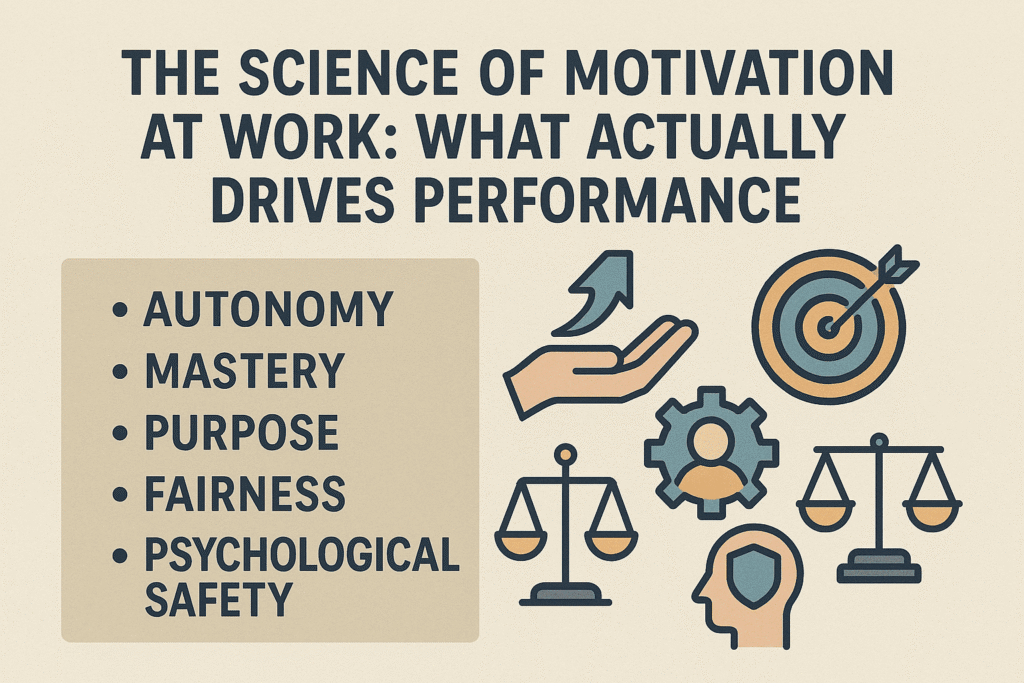
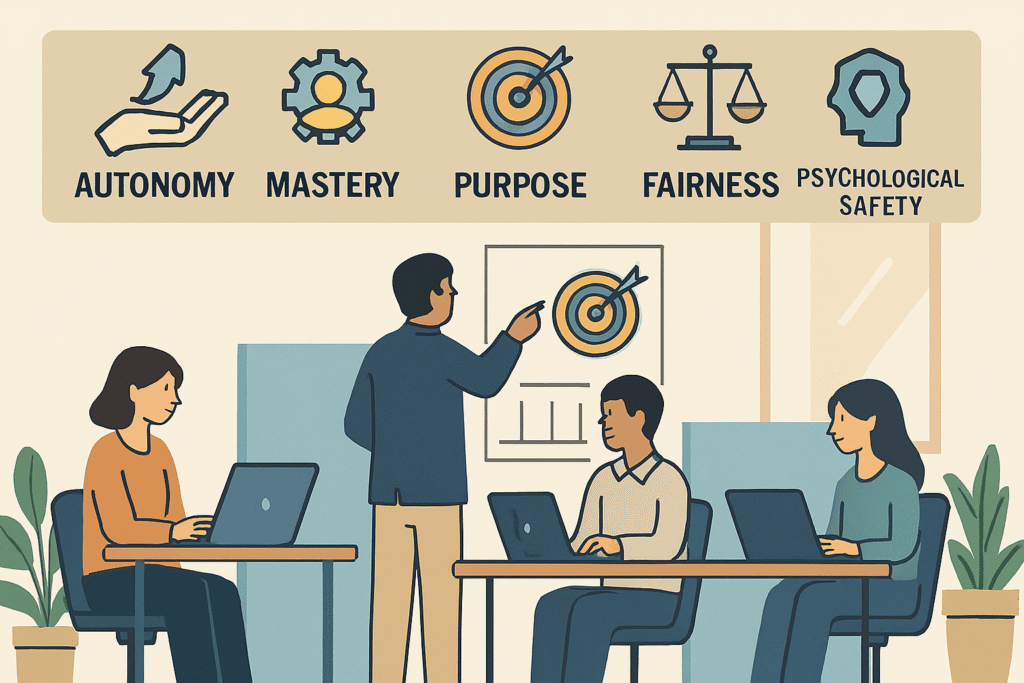
Performance is not driven by surface enthusiasm. It is shaped by deeper psychological mechanisms — autonomy, mastery, purpose, fairness, and meaningful progress. When these elements are present, motivation becomes sustainable. When they are absent, no amount of external pressure or short-term incentives can compensate for long.
Understanding the science of motivation shifts the conversation from personality to system design.
Intrinsic vs. Extrinsic Motivation
One of the foundational distinctions in motivation research is between intrinsic and extrinsic motivation. Intrinsic motivation refers to doing work because it is inherently interesting or meaningful. Extrinsic motivation refers to doing work in exchange for rewards or to avoid negative consequences.
Extrinsic drivers — salary, bonuses, promotions — are not irrelevant. They provide structure and fairness. However, research consistently shows that beyond a baseline of adequate compensation, external rewards alone do not sustain high performance.
Intrinsic drivers tend to produce deeper engagement because they connect work to personal growth and internal satisfaction. When professionals experience genuine interest in their tasks or alignment with values, effort becomes more self-directed and resilient.
Workplaces that rely exclusively on external pressure may achieve short bursts of output, but long-term performance requires internal alignment.
Key points:
- Intrinsic motivation arises from interest and meaning
- Extrinsic motivation is driven by rewards and consequences
- Compensation ensures fairness but does not guarantee engagement
- Sustainable performance depends on internal drivers
The Role of Autonomy
Research by psychologists such as Edward Deci and Richard Ryan highlights autonomy as a central motivational driver. Autonomy does not mean the absence of structure. It means having meaningful choice within clear expectations.
When professionals feel trusted to make decisions, prioritize tasks, and contribute ideas, motivation increases. Conversely, excessive control, micromanagement, or rigid processes can diminish engagement — even if compensation is competitive.
Autonomy supports accountability because individuals feel ownership over outcomes. When people perceive their work as self-directed rather than imposed, commitment strengthens.
In distributed and hybrid work environments, autonomy has become even more central. Performance is increasingly measured by results, not presence.
Key points:
- Autonomy enhances ownership and accountability
- Micromanagement reduces intrinsic motivation
- Structured flexibility supports engagement
- Trust reinforces performance
Mastery and the Need for Growth
Human motivation is closely tied to progress. Professionals are more engaged when they feel they are improving — acquiring new skills, solving more complex problems, or expanding their capability.
Mastery does not happen automatically. It requires challenge balanced with support. Work that is too simple leads to boredom. Work that is overwhelming leads to anxiety. Sustainable motivation exists in the space where tasks stretch competence without exceeding it entirely.
Organizations that invest in learning pathways, feedback systems, and skill development strengthen long-term performance. Growth is not merely a career benefit; it is a psychological necessity.
Without opportunities to develop, even well-compensated professionals may disengage.
Key points:
- Progress reinforces motivation
- Balanced challenge sustains engagement
- Skill development supports long-term performance
- Growth opportunities prevent stagnation
Purpose and Meaning
Motivation strengthens when professionals understand how their work contributes to something larger than immediate tasks. Purpose does not require grand mission statements. It requires clarity about impact.
When individuals see the connection between their effort and meaningful outcomes — whether organizational success, client benefit, or team advancement — effort gains direction.
Purpose also supports resilience. During periods of difficulty or high workload, understanding the broader value of work can sustain persistence.
Organizations that communicate impact clearly tend to cultivate more stable engagement.
Key points:
- Purpose connects effort to impact
- Meaning strengthens resilience
- Clear communication reinforces contribution
- Impact awareness increases persistence
Fairness and Psychological Safety
Motivation is deeply affected by perceptions of fairness. When reward systems, recognition practices, or workload distribution appear inequitable, engagement declines. Even highly autonomous roles lose appeal if fairness is questioned.
Similarly, psychological safety — the ability to express ideas, ask questions, or admit mistakes without fear — influences performance. Teams that feel safe to experiment and learn are more innovative and adaptive.
Motivation is not only about individual drive. It is shaped by the social and ethical environment in which work occurs.
Without fairness and safety, other motivational strategies lose effectiveness.
Key points:
- Perceived fairness influences engagement
- Recognition equity supports trust
- Psychological safety enables innovation
- Ethical environments strengthen performance
The Limits of Short-Term Incentives
Many organizations attempt to boost performance through temporary incentives — bonuses, competitions, or public rankings. While these methods can produce short-term spikes, they rarely sustain momentum.
When motivation becomes tied exclusively to reward cycles, effort may fluctuate accordingly. Professionals may prioritize visible outcomes over meaningful contribution.
Sustainable motivation requires stable systems rather than episodic stimulation. Clear expectations, ongoing feedback, growth pathways, and respectful culture create more durable engagement than intermittent pressure.
Performance driven by structure is steadier than performance driven by urgency.
Key points:
- Short-term incentives create temporary spikes
- Reward cycles can distort priorities
- Stable systems outperform episodic pressure
- Long-term engagement requires consistency
Designing Motivating Work Systems
Understanding the science of motivation shifts responsibility from individuals alone to organizational design.
Effective motivational systems integrate:
- Fair compensation structures
- Autonomy within defined boundaries
- Continuous skill development
- Clear purpose and communication
- Psychological safety and respect
When these elements align, motivation becomes less dependent on personality and more embedded in structure.
Leaders cannot “inject” motivation. They can, however, design conditions that allow it to emerge naturally.
Closing Reflection
The science of motivation reveals a consistent insight: performance is not driven primarily by pressure or personality. It is shaped by environment.
Autonomy fosters ownership.
Mastery reinforces growth.
Purpose gives direction.
Fairness sustains trust.
When these dimensions are present, motivation becomes self-reinforcing. When they are absent, even talented professionals may struggle to maintain engagement.
In modern workplaces, sustainable performance is less about pushing harder and more about designing better systems.
Motivation, at its core, is structural. And when structure supports human psychology, performance follows.
References and Further Reading:
- Deci, E. L., & Ryan, R. M. — Self-Determination Theory https://selfdeterminationtheory.org/theory/
- Daniel H. Pink — Drive: The Surprising Truth About What Motivates Us https://www.danpink.com/books/drive/
- Harvard Business Review — The Power of Small Wins https://hbr.org/2011/05/the-power-of-small-wins
- Gallup — Employee Engagement Research https://www.gallup.com/workplace/
- Amy Edmondson — Psychological Safety Research https://www.hbs.edu/faculty/Pages/profile.aspx?facId=6451