A client can now describe a website to an AI tool and receive a polished design in minutes.
A homepage appears. The colors look professional. Sections are already arranged. Buttons, cards, animations, navigation, and responsive layouts may all be included.
Sometimes AI can even generate the HTML, CSS, JavaScript, or framework code behind the design.
Then the client sends it to a developer and says:
“The website is already designed. Just make it live.”
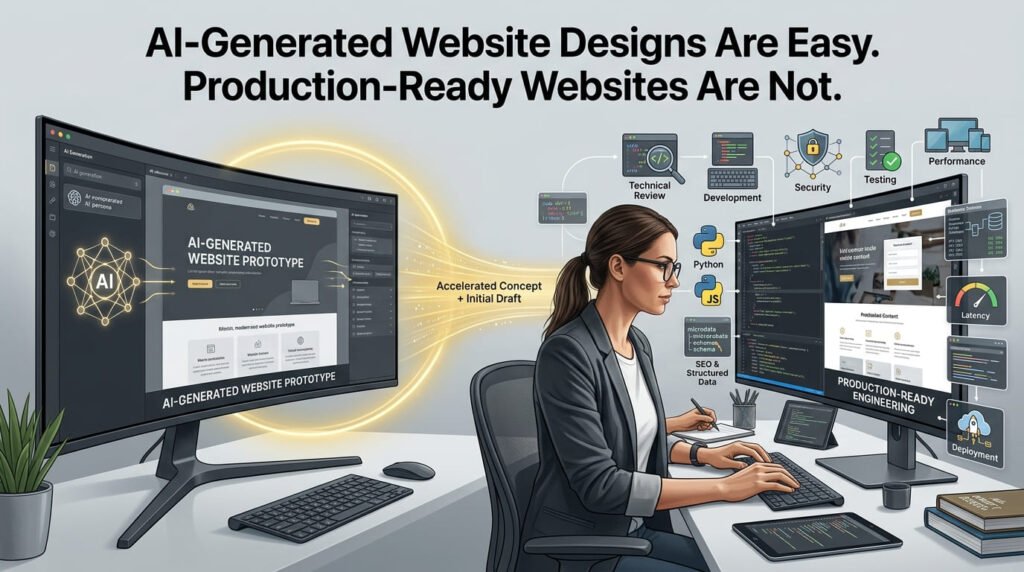
This is where the difference between an AI-generated website design and a production-ready website becomes clear.
AI has made website design and prototyping dramatically faster. But a production website has to do much more than look good.
It needs to work with real content, real users, real business requirements, real data, real browsers, real hosting, search engines, APIs, security requirements, and future maintenance.
AI can create the starting point. Production engineering turns that starting point into a reliable website.
An AI-Generated Design Is a Starting Point
AI can generate an impressive visual result from a relatively simple prompt.
For example, a prompt might ask for:
“Create a modern SaaS website with a hero section, pricing cards, testimonials, feature sections, a navigation menu, and a contact form.”
The result can look remarkably complete.
But the visual output does not necessarily answer the technical questions behind the interface.
Where does the content come from?
How does the contact form work?
Where are submissions stored?
How is spam prevented?
How are user permissions handled?
How does the pricing system work?
What happens when an API fails?
How is the website managed by the client?
How will search engines discover the pages?
How will the site perform on slower devices?
What happens six months after launch when the client wants a new feature?
These questions exist outside the visual design.
That is why design completion does not equal development completion.
A Beautiful Interface Is Not a Production Website
A production website has multiple layers.
The visible interface is only one of them.
A useful way to understand the difference is:
Design → Content → Functionality → Data → Integration → Security → Performance → SEO → Accessibility → Testing → Deployment → Maintenance
AI can assist with almost every stage.
But assistance is not the same as responsibility.
A production website must connect these layers into one working system.
For example, a booking website may have a beautiful booking form generated by AI.
But the production implementation also needs to determine:
- How available dates are calculated
- Where bookings are stored
- How duplicate bookings are prevented
- How payments are processed
- How confirmation emails are sent
- What happens when payment fails
- How cancellations work
- Who can access customer information
- How booking data is protected
The interface is only the visible part of the problem.
The developer builds the system behind the interface.
AI Does Not Automatically Understand the Client’s Business
One of the biggest limitations of AI-generated website designs is context.
AI can generate a design based on the information it receives.
But a real business often contains requirements that are not visible in a design brief.
Consider a simple e-commerce website.
The design may include:
Product → Add to Cart → Checkout
But the production system may need to handle:
- Inventory
- Product variations
- Taxes
- Shipping
- Coupons
- Payment gateways
- Order status
- Refunds
- Customer accounts
- Email notifications
- Failed payments
- Stock synchronization
The developer has to translate business requirements into technical behavior.
This is why development is not simply converting a design into code.
Development is converting requirements into a functioning system.
AI-Generated Code Still Needs Review
When AI generates the actual website code, the situation becomes even more interesting.
The developer may not need to write every component from scratch.
That can save considerable time.
But generated code still needs to be understood and reviewed.
A developer should ask:
- Is the code logically correct?
- Is the structure appropriate?
- Does it follow the project’s architecture?
- Are dependencies necessary?
- Is the code secure?
- Is it maintainable?
- Does it handle errors?
- Does it work with the existing environment?
- Could it create performance problems?
- Will another developer understand it later?
AI can produce code that looks convincing.
That does not mean every implementation decision is correct.
Readable code is not automatically good code, and working code is not automatically production-ready code.
Integration Is Where the Real Website Begins
An AI-generated prototype may work perfectly by itself.
Real websites rarely exist by themselves.
They often need to connect with:
- WordPress
- Databases
- APIs
- Payment gateways
- Email platforms
- CRM systems
- Analytics
- Authentication systems
- Third-party services
- Existing plugins
- Existing themes
- Client databases
- External webhooks
This is where the developer needs to understand the existing environment.
For example, an AI-generated frontend may need to become a WordPress website.
The developer now needs to determine:
- Which content should become editable in WordPress
- Whether custom post types are required
- How custom fields should be structured
- How templates should be organized
- How plugins interact with the site
- How dynamic content is loaded
- How the frontend communicates with backend functionality
The design may remain exactly the same.
But the engineering underneath it changes completely.
Production Websites Need Security
Security is another area where visual quality means very little.
A website may look perfect while containing serious security weaknesses.
This becomes particularly important when AI generates:
- Login systems
- User registration
- Contact forms
- File uploads
- Database operations
- Payment functionality
- Administrative features
- API integrations
Developers need to review areas such as:
- Input validation
- Sanitization
- Output escaping
- Authentication
- Authorization
- CSRF protection
- XSS protection
- SQL injection prevention
- File-upload security
- API credentials
- Access control
- Sensitive data exposure
AI can assist with security reviews.
But production responsibility still requires verification.
The correct question is not:
“Did AI generate the security code?”
It is:
“Has the implementation been properly reviewed and tested for this application?”
Performance Is Part of Production Readiness
An AI-generated website can look excellent in a preview while performing poorly in real conditions.
A production website may contain:
- Large images
- Unnecessary JavaScript
- Too many third-party scripts
- Heavy animations
- Excessive fonts
- Unused CSS
- Large dependencies
- Inefficient database queries
- Poor caching
- Slow API requests
A developer needs to measure the actual website and identify real bottlenecks.
Performance work can involve:
- Image optimization
- Asset management
- Caching
- Code optimization
- Database optimization
- Lazy loading
- Reducing unnecessary requests
- Improving server response
- Optimizing JavaScript execution
The important principle is:
Do not assume a website is fast because the AI-generated preview loads quickly.
Production performance needs to be measured in the real environment.
Responsive Design Requires Real Testing
AI can generate responsive layouts very effectively.
But responsive design is more than generating a desktop and mobile screenshot.
Real users have different:
- Screen sizes
- Browsers
- Devices
- Input methods
- Network conditions
- Accessibility needs
A developer needs to test:
- Navigation
- Forms
- Buttons
- Images
- Tables
- Cards
- Modals
- Menus
- Typography
- Touch interactions
A layout that looks perfect on one device can still fail on another.
AI can suggest responsiveness. Testing proves it.
Accessibility Cannot Be an Afterthought
Production websites should also be usable by people with different abilities and interaction methods.
Developers need to consider:
- Semantic HTML
- Keyboard navigation
- Focus states
- Form labels
- Color contrast
- Accessible buttons and links
- Meaningful alternative text
- Screen-reader compatibility
- Appropriate ARIA usage
An AI-generated interface may visually communicate that something is a button.
The developer still needs to make sure the underlying HTML actually behaves like an accessible button.
This is another example of the difference between visual correctness and technical correctness.
SEO Starts With the Website’s Technical Foundation
A website does not become search-friendly simply because AI generated its content and design.
Technical SEO needs to be considered during development.
Important areas include:
- Crawlable URLs
- Semantic HTML
- Logical heading hierarchy
- Page titles
- Meta descriptions
- Canonical URLs
- Internal linking
- XML sitemaps
- Robots directives
- Image optimization
- Page performance
- Mobile usability
- Structured data
- Indexability
This is especially important when AI generates large amounts of content or pages.
The developer needs to ensure that the website has a structure that search engines can discover, crawl, interpret, and index appropriately.
AI Search Requires More Than Traditional SEO
Search is also expanding beyond traditional search-result pages.
AI systems increasingly need to understand webpages, entities, relationships, topics, products, organizations, authors, and other structured information.
This makes clear information architecture increasingly important.
A production website should communicate clearly:
- What the organization is
- What the page represents
- Who created the content
- What products or services are offered
- How different pages relate to one another
- Which information is primary
- What entities are being discussed
Structured data can help machines interpret important information when it accurately represents the visible content.
For example, appropriate structured data may help describe:
- Articles
- Organizations
- Products
- Events
- FAQs
- Breadcrumbs
- Local businesses
- Reviews
The objective is not to add schema simply because it is available.
The objective is to provide accurate, useful machine-readable context.
That is an important part of building websites for an environment where both search engines and AI systems need to understand web content.
AI-Generated Content Also Needs Editorial Judgment
AI can generate website copy quickly.
But publishing generated content without review can create another problem.
Website content needs to be:
- Accurate
- Relevant
- Original
- Useful
- Clearly structured
- Appropriate for the intended audience
- Consistent with the business
- Supported by reliable information where necessary
Search visibility should not be treated as a reason to generate more content simply for the sake of having more pages.
A production website should answer real user questions and provide useful information.
For AI search and modern search systems, clarity and usefulness matter more than simply producing large quantities of machine-generated text.
Clear Content Structure Helps Both Users and AI Systems
A production website should make its information easy to understand.
This means using:
- Descriptive headings
- Short, focused sections
- Direct answers
- Meaningful links
- Logical page relationships
- Consistent terminology
- Clear entity references
- Structured information where appropriate
This helps multiple audiences at once.
A human visitor can scan the page more easily.
A search engine can interpret the page structure.
An AI system can more easily identify the topic, entities, relationships, and important answers.
This is where good content architecture becomes valuable.
The goal is not to write for AI instead of people. The goal is to make information clear enough for both.
Testing Turns a Prototype Into a Product
Once development is complete, testing begins.
A production website needs to be tested against real requirements.
Developers may need to verify:
Functionality
Does every important feature work?
Compatibility
Does the website work across relevant browsers and devices?
Security
Can users access only what they are supposed to access?
Performance
Does the website remain responsive under realistic conditions?
SEO
Can important pages be crawled, understood, and indexed appropriately?
Accessibility
Can users navigate and interact with the website effectively?
Error handling
What happens when something fails?
Edge cases
What happens when users do something unexpected?
This is one of the biggest differences between an AI-generated demonstration and a production system.
A prototype demonstrates an idea. Testing determines whether that idea is ready for real users.
Maintenance Is Part of Production
A website does not stop being a software project after launch.
Production websites evolve.
Clients change content.
Browsers change.
PHP versions change.
WordPress changes.
Plugins receive updates.
APIs change.
Security vulnerabilities are discovered.
Business requirements evolve.
New features are requested.
Performance issues appear.
Search engines change how they interpret websites.
Someone needs to maintain the system.
That means production-ready development also requires thinking about:
- Code organization
- Documentation
- Updates
- Backups
- Version control
- Error logging
- Monitoring
- Compatibility
- Future extensions
A website that works today but becomes impossible to maintain tomorrow is not necessarily a successful production solution.
What the Developer Actually Adds
This brings us back to the central question.
If AI can generate the design and much of the code, what does the developer actually add?
The answer is engineering judgment.
The developer connects the pieces.
Business requirement → Technical architecture
AI-generated code → Reviewed implementation
Design → Functional interface
Prototype → Tested product
Content → Search-friendly information architecture
Website → Secure production system
First version → Maintainable software
This is where the role of the developer changes.
The developer does not necessarily need to compete with AI at generating code line by line.
The developer needs to become better at understanding, evaluating, integrating, testing, and improving what AI produces.
What Clients Should Expect From Developers in the AI Era
Clients should absolutely use AI.
AI can reduce development time and help turn ideas into prototypes much faster.
But clients should also understand the difference between:
“AI generated my website.”
and
“My website is ready for production.”
Those are not the same statement.
A professional development process still needs to answer questions about:
- Requirements
- Architecture
- Functionality
- Security
- Performance
- SEO
- Accessibility
- Testing
- Hosting
- Maintenance
The better question is not:
“Can AI build my website?”
It is:
“Can this website reliably serve my users and business in the real world?”
That is a much more useful question.
The New Website Development Workflow
The modern workflow does not have to be:
Human writes everything → Website
It can be:
Business Requirement
↓
AI-Assisted Design / Prototype
↓
Developer Technical Review
↓
Architecture
↓
Development & Integration
↓
Security Review
↓
SEO & Accessibility
↓
Testing
↓
Performance Optimization
↓
Deployment
↓
Monitoring & Maintenance
AI can participate throughout this process.
The developer remains responsible for making sure the complete system works.
Developer Verdict
AI has changed the starting point of website development.
A developer may no longer begin with a blank screen.
There may already be a design, prototype, codebase, content draft, or component library waiting for review.
That is an advantage.
But production websites are not judged by how quickly they can be generated.
They are judged by whether they work, perform, remain secure, can be discovered and understood, provide a good user experience, and can be maintained over time.
AI can generate a beautiful website.
The developer turns that generated idea into a reliable production system.
That is why AI-generated website designs may be easy.
Production-ready websites are not.
About the Author
Mirza Hadi Baig is a Full-Stack WordPress Developer, Technical Problem Solver, product builder, and AI learner with 5+ years of hands-on web development experience. His work spans WordPress, PHP, JavaScript, technical SEO, structured data, AI search, GEO, and AI-assisted development.
As a product builder, Hadi develops practical tools that solve real-world web and SEO problems, including Schema Genie Pro, an LLMs.txt and AI Content Index plugin, Button Craft Generator, and an SEO Audit Tool plugin.
His technical journey includes IBM’s Full Stack Software Developer and JavaScript Backend Development programs, SEO Mastery: From Fundamentals to GenAI and GEO Strategies, and DevOps Culture and Mindset from the University of California, Davis.
Hadi believes AI should assist developers, not replace understanding. His vision is to combine development, technical SEO, AI search, and practical problem-solving to build better, more useful, and future-ready web solutions.