
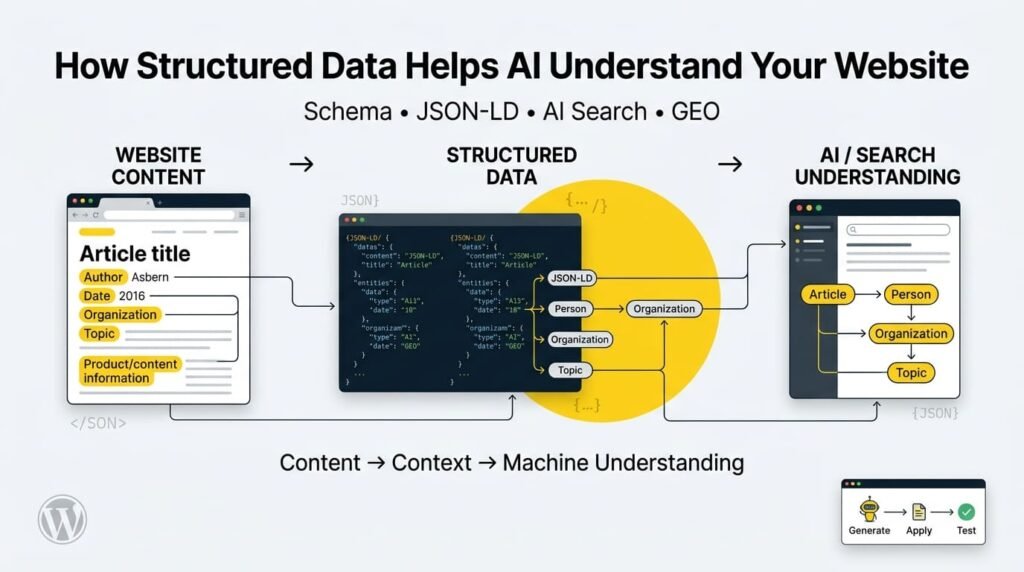
A website can contain all the right information and still leave machines with questions.
A human visitor can look at an article and immediately understand:
- what the page is about,
- who wrote it,
- when it was published,
- which organization published it,
- what topics it discusses,
- and how the page relates to the rest of the website.
Search engines and other machine systems have to interpret those relationships from the information available to them.
This is where structured data becomes useful.
Structured data gives machines additional, standardized information about the meaning and properties of content. Schema.org describes structured data as a way to make information on web pages more understandable to search engines and other applications. (Schema.org)
But there is an important distinction to make from the beginning:
Structured data can help machines understand your content. It does not guarantee rankings, AI citations, or visibility in AI search.
That distinction matters even more as search increasingly includes AI-generated answers.
What Is Structured Data?
At its simplest, structured data is machine-readable information that describes what the content on a page represents.
Consider a page that contains:
How Structured Data Helps AI Understand Your Website
Written by Mirza Hadi Baig
Published August 18, 2026
A human understands those relationships naturally.
But structured data can make the relationships explicit.
For example, the page could describe itself as an:
Article
with:
- a headline,
- an author,
- a publication date,
- a modification date,
- an image,
- a publisher,
- and other relevant properties.
Google describes structured data as a standardized format for providing information about a page and classifying its content. (Google for Developers)
That is the fundamental idea:
Your page contains information.
Structured data describes that information in a standardized way.
Structured Data Is Not the Same as Schema
These terms are often used interchangeably, but they describe different things.
Structured data
This is the broader concept of representing information in a machine-readable format.
Schema.org
Schema.org provides a shared vocabulary of types and properties for describing things such as:
- Person
- Organization
- Article
- Product
- Event
- Place
- Review
Schema.org explains that its vocabulary can be used with formats such as Microdata, RDFa, and JSON-LD. (Schema.org)
JSON-LD
JSON-LD is one of the formats used to implement structured data.
For example:
{
  "@context": "https://schema.org",
  "@type": "Article",
  "headline": "How Structured Data Helps AI Understand Your Website"
}
So a simple way to remember the relationship is:
Schema.org = vocabulary
JSON-LD = implementation format
Structured data = machine-readable description
Google generally recommends JSON-LD for structured data implementations because it is easier to implement and maintain. (Google for Developers)
Why Machines Need More Context
Humans are very good at understanding context.
Imagine a website contains the word:
Apple
A person can usually determine from surrounding information whether the page is discussing:
- a fruit,
- Apple Inc.,
- an Apple product,
- or something else.
Machines have to interpret that context from the information available to them.
This is one reason semantic structure matters.
Schema.org itself uses a similar concept when explaining that ordinary HTML can identify a piece of text without necessarily explaining what that text means. (Schema.org)
Compare:
Applewith a structured description that identifies the entity as an organization.
The second provides considerably more context.
That doesn’t mean structured data magically makes a machine understand everything.
It means you’re giving the machine additional explicit clues rather than expecting it to infer every relationship from raw page content.
Think in Entities, Not Just Keywords
Traditional SEO often encourages us to think about:
keywords → pages → rankings
Modern search understanding requires a broader perspective.
Think about:
entities → attributes → relationships → context
For example, an article might be connected to:
Article
   ↓
author
   ↓
Person
and:
Article
   ↓
publisher
   ↓
Organization
and:
Article
   ↓
about
   ↓
Topic
The page isn’t simply a collection of keywords.
It represents things and relationships between those things.
That is where structured data becomes particularly useful.
How Structured Data Helps Search Engines
The most established benefit is search-engine understanding.
Google says it uses structured data to understand content on a page and can use supported structured data to make pages eligible for richer search appearances. (Google for Developers)
For example, depending on the content and eligibility requirements, structured data can describe:
- Articles
- Breadcrumbs
- Products
- Events
- Organizations
- Local businesses
- Reviews
- Recipes
- Videos
- Job postings
- Profile pages
The important phrase is “depending on the content.”
You shouldn’t add a schema type simply because it exists.
The markup should describe what is actually on the page.
Structured Data Doesn’t Replace Good Content
This is one of the most important points in the entire article.
Adding schema does not turn weak content into useful content.
You cannot write a poor article, add ten schema types, and expect search engines or AI systems to suddenly consider it authoritative.
Structured data is a supporting layer.
Think of a website as having several layers:
Useful Content
      +
Clear Information Architecture
      +
Technical Accessibility
      +
Structured Data
      ↓
Better Machine Understanding
Structured data can help explain the content.
It cannot compensate for content that is:
- inaccurate,
- unhelpful,
- poorly organized,
- misleading,
- inaccessible,
- or irrelevant to the user’s question.
Google’s structured-data guidance also requires markup to represent the content on the page accurately. (Google for Developers)
So, Does Structured Data Help AI Understand Websites?
Potentially, yes—but the answer needs nuance.
AI-powered search systems need to interpret information from websites too.
They may need to determine:
- What is this page about?
- Who wrote it?
- What organization published it?
- What entity is being discussed?
- What information belongs to which entity?
- What relationships exist between entities?
- What type of content is this?
Structured data provides explicit machine-readable information that can help describe those concepts.
But we should not turn that into an exaggerated claim such as:
“Schema makes ChatGPT rank your website.”
There is no universal rule that says adding schema guarantees visibility in an AI answer.
A better way to understand it is:
Structured data is a semantic signal that can provide machines with clearer information about your content. It is not an AI-ranking switch.
This distinction is especially important for GEO — Generative Engine Optimization.
Structured Data and GEO: Where They Connect
GEO is not simply “SEO with schema.”
Optimizing content for AI-driven discovery requires thinking about how information can be:
- discovered,
- understood,
- retrieved,
- interpreted,
- and presented.
Structured data can contribute to the understanding part of that process.
But it works alongside other factors.
A useful GEO-oriented framework is:
1. Clear Content
Tell the reader and machines exactly what the page is about.
2. Clear Entities
Identify important people, organizations, products, topics, and other entities.
3. Clear Relationships
Explain how those entities relate to the page.
4. Consistent Information
Keep names, dates, descriptions, URLs, and other important information consistent.
5. Accurate Structured Data
Represent the visible content accurately in machine-readable form.
6. Crawlable Website
Make sure search engines and other systems can actually access the content.
Structured data is therefore one part of an AI-readable website, not the entire GEO strategy.
A Better Way to Think About Article Schema
Take a normal article.
A reader sees:
Title
↓
Author
↓
Publication date
↓
Article content
↓
Publisher
↓
Related information
A structured representation can make some of those relationships explicit.
For example:
Article
 ├── headline
 ├── author → Person
 ├── publisher → Organization
 ├── datePublished
 ├── dateModified
 ├── image
 └── mainEntityOfPage → WebPage
This doesn’t replace the article.
It adds a machine-readable description of what the article represents.
Google’s Article structured-data documentation specifically notes that Article markup can help Google understand information such as an article’s title, images, dates, and author. (Google for Developers)
One Page Can Describe Multiple Related Entities
A modern webpage is rarely about only one thing.
Consider a page about a software product.
It could contain:
WebPage
   ↓
Product
   ↓
Brand
   ↓
Organization
Or an article:
Article
   ↓
Person
   ↓
Organization
Or an article discussing a product:
Article
   ↓
about
   ↓
Product
This is why structured data becomes more powerful when you think about relationships, rather than simply asking:
“Which schema should I add?”
The better question is:
“What entities and relationships does this page actually contain?”
The Problem With “Add More Schema”
More schema is not automatically better.
Imagine an article page.
You could theoretically generate markup for many different types.
But if the page isn’t actually describing those things, you’re adding unnecessary or potentially misleading information.
The objective should be:
Accurate structured data, not maximum structured data.
Schema.org advises marking up information that is relevant to the content and warns against relying on hidden content that visitors cannot see. (Schema.org)
Google likewise requires structured data to represent the page content accurately. (Google for Developers)
So the right question isn’t:
“How much schema can I add?”
It’s:
“What information should I explicitly describe?”
The WordPress Schema Implementation Problem
Understanding structured data is one challenge.
Actually implementing it across a WordPress website is another.
A typical workflow for an SEO professional might look like this:
Collect page information
↓
Choose schema type
↓
Use a schema generator
↓
Generate JSON-LD
↓
Copy the code
↓
Find somewhere to implement it
↓
Add it to theme files or use another code-insertion method
↓
Test the result
↓
Return and fix problems if necessary
For one page, that may be manageable.
For a website with hundreds of pages, it can become a repetitive process.
It can also create unnecessary developer dependency.
An SEO specialist may know exactly what structured data a page needs but still have to send the generated code to a developer for implementation.
And manually editing theme files just to insert schema introduces another maintenance consideration.
This is the practical problem I wanted to solve when building Schema Genie Pro.
Schema Genie Pro: Solving the Full Schema Workflow
Schema Genie Pro is a WordPress schema markup plugin I built around a simple idea:
Generating schema should not be the end of the workflow.
The user also needs a practical way to apply and test it.
The plugin’s current workflow is designed to bring those steps together inside WordPress.
Instead of:
Generate → Copy → Find implementation method → Apply → Open another tool → Test
the workflow can be:
Enter data → Generate → Apply → Validate
The plugin provides a visual, code-free workflow, supports multiple schema types, includes a central schema dashboard, and provides one-click links for testing with the Google Rich Results Test and Schema.org Validator. (Hadi Mirza)
Learn more about Schema Genie Pro
Why Avoid Unnecessary Theme-File Editing?
A common way of implementing custom JSON-LD is to add code through theme-related files or other code-injection mechanisms.
That can work, particularly when developers control the entire implementation.
But it isn’t always the most convenient workflow for an SEO team.
Consider a site where an SEO specialist needs to update structured data.
Without a dedicated workflow, the process can become:
SEO team
→ creates schema
→ sends code to developer
→ developer modifies implementation
→ site is tested
→ future changes repeat the process
A plugin-based workflow can reduce that handoff for routine schema tasks.
Schema Genie Pro is designed to generate and apply structured data without requiring the user to directly modify theme files. Its stated purpose is to provide a code-free WordPress workflow for schema implementation. (Hadi Mirza)
This doesn’t mean developers become unnecessary.
Quite the opposite.
Developers should still handle situations involving:
- custom application logic,
- complex integrations,
- conflicts,
- unusual data structures,
- performance concerns,
- custom schema requirements,
- or security-sensitive implementation decisions.
The goal is to remove unnecessary manual work, not to eliminate development.
Generate, Apply and Test in One Workflow
There is another problem with schema implementation:
testing often happens somewhere else.
A user may generate JSON-LD in one tool, copy it into WordPress, then open a separate browser tab to test it.
If something needs changing, the process starts again.
Schema Genie Pro addresses this workflow by providing one-click validation links to the Google Rich Results Test and Schema.org Validator from its dashboard. (Hadi Mirza)
This matters because structured data shouldn’t be treated as:
Generate once and forget it.
A better process is:
Create
↓
Implement
↓
Test
↓
Fix
↓
Re-test
↓
Maintain
Schema.org itself recommends testing schema markup to ensure it has been implemented correctly. (Schema.org)
Google also recommends validating structured data and fixing critical errors before deployment. (Google for Developers)
Schema Genie Pro Is a Workflow Solution, Not a Ranking Shortcut
This distinction is important.
Schema Genie Pro can help solve the implementation problem.
It doesn’t promise:
- automatic Google rankings,
- guaranteed rich results,
- guaranteed AI citations,
- or guaranteed visibility in generative search.
Those outcomes depend on much more than schema.
The value of a schema tool is more practical:
Create accurate markup
→ implement it consistently
→ test it
→ manage it
That is the problem a good implementation workflow should solve.
Why Multiple Schemas Can Sometimes Make Sense
A page doesn’t necessarily have to be represented by one isolated schema object.
For example, an article page might contain an Article entity and an FAQ section.
The relationship between those entities should still reflect what actually exists on the page.
Schema Genie Pro supports multiple schemas on a page, which can be useful when a page legitimately contains multiple types of structured information. (Hadi Mirza)
But again:
Multiple schemas should represent real content.
Don’t add FAQ schema because you want another markup type.
Don’t add Product schema because you want a product result.
Don’t add Review schema because reviews sound useful.
The page should justify the markup.
Common Structured Data Mistakes
1. Adding Schema Without Understanding the Page
Choosing a schema type should begin with the content, not the available dropdown options.
2. Using the Wrong Entity Type
A person is not an organization.
An article is not a product.
A product page is not automatically a review page.
Semantic accuracy matters.
3. Marking Up Information That Isn’t Actually There
Structured data should correspond to the page content.
Don’t create machine-readable claims that the visitor cannot find on the page.
4. Generating Duplicate Schema
Multiple SEO plugins, themes, and custom implementations can sometimes produce overlapping structured data.
Before adding another schema solution, check what your site already outputs.
5. Assuming Validation Means Ranking Success
A valid JSON-LD implementation means the markup can be technically valid.
It does not mean:
“Google will rank this page higher.”
Nor does it mean:
“An AI search engine will cite this page.”
Validation and ranking are different things.
6. Treating Schema as an AI Shortcut
Schema is not a magic GEO technique.
AI-readable content still needs:
- useful information,
- clear structure,
- accurate facts,
- identifiable entities,
- logical relationships,
- and accessible content.
A Practical Structured Data Workflow
Whether you’re implementing schema manually or using a WordPress solution, the process should look something like this:
Step 1 — Understand the page
What is the page actually about?
Step 2 — Identify the entities
Who or what is being described?
Step 3 — Select the appropriate schema
Choose markup that accurately represents the content.
Step 4 — Complete relevant properties
Use information that genuinely applies to the page.
Step 5 — Implement it
Add the structured data to the page.
Step 6 — Validate it
Test the implementation.
Step 7 — Compare it with visible content
Make sure the structured data agrees with what visitors see.
Step 8 — Monitor it
Revisit the implementation when the content or website architecture changes.
This workflow is more valuable than simply memorizing schema types.
Structured Data, SEO and AI Search: How They Fit Together
It helps to separate the three concepts.
SEO
Helps search engines discover, understand, and evaluate pages for search.
Structured Data
Provides standardized machine-readable information about page content and entities.
GEO / AI Search Optimization
Focuses more broadly on making information useful, understandable, discoverable, and retrievable in AI-driven search experiences.
They overlap, but they aren’t interchangeable.
A website can have excellent structured data and poor content.
It can have excellent content and weak structured data.
It can have both and still not appear in a particular AI answer.
That’s why structured data should be treated as one layer of a larger technical and content strategy.
The Bigger Idea: Make Your Website Easier to Understand
The future of search isn’t simply about getting machines to recognize keywords.
The deeper challenge is helping systems understand:
What is this?
Who is involved?
What does this information describe?
How are these entities connected?
What is the source of the information?
Structured data can help answer some of those questions explicitly.
But the strongest implementation combines structured data with clear writing, logical information architecture, consistent entities, crawlable content, and trustworthy information.
Think of it this way:
Your content provides the information.
Your structure organizes it.
Your structured data makes selected meaning explicit to machines.
That is a much more useful way to think about schema than simply treating it as another SEO checkbox.
Frequently Asked Questions
Q: What is structured data on a website?
Structured data is machine-readable information that describes the meaning, properties, and relationships of content on a webpage using standardized vocabularies and formats.
Q: How does structured data help search engines?
Structured data provides explicit information about page content and can help search engines understand entities and page types. For supported markup, it can also make pages eligible for certain richer search appearances. (Google for Developers)
Q: Does structured data help AI understand a website?
It can provide AI and other machine systems with additional structured context about entities and relationships on a webpage. However, there is no guarantee that structured data alone will make a website appear in AI-generated answers.
Q: Does schema markup improve Google rankings?
Structured data is not a direct guarantee of higher rankings. Google states that structured data can help it understand content and make pages eligible for certain search features, but eligibility does not guarantee that a rich result will appear.
Q: What is the difference between Schema.org and JSON-LD?
Schema.org is a vocabulary of types and properties used to describe entities and content. JSON-LD is a format used to represent that structured information in code.
Q: Should every webpage have structured data?
Not necessarily. Structured data should be used when it accurately represents the content and provides useful information about the page. The goal should be accuracy and relevance rather than adding as many schema types as possible.
Q: Can WordPress users add structured data without editing theme files?
Yes. Structured data can be implemented through WordPress plugins and other implementation methods. A dedicated plugin such as Schema Genie Pro can provide a workflow for generating and applying schema without requiring direct theme-file editing.
Q: How should structured data be tested?
Validate the markup using appropriate testing tools, check for errors, and compare the structured information with the actual visible content. Google recommends validating structured data before deployment.
Final Takeaway
Structured data isn’t a secret instruction that tells Google or an AI system:
“Rank this website.”
It is better understood as a way of giving machines clearer, standardized information about what your content represents.
The strongest approach is therefore not:
More schema = better SEO
or:
Schema = better AI visibility
Instead:
Useful content
Clear structure
Accurate entities and relationships
Correct structured data
Accessible website
=
A website that is easier for machines to interpret.
And that is ultimately the goal.
Don’t add schema simply because you can.
Add structured data because you understand what the page represents—and you want to describe that meaning clearly.
References & Further Reading
- Google Search Central — Understand structured data
- Google Search Central — Article structured data
- Google Search Central — Structured data supported by Google Search
- Schema.org — Getting Started
- Schema Genie Pro — WordPress Schema Markup Plugin
About the Author
Mirza Hadi Baig is a Full-Stack WordPress Developer and Technical SEO Specialist with 5+ years of hands-on experience building WordPress solutions and working with modern SEO and AI-search concepts. He completed the IBM SEO Mastery: From Fundamentals to GenAI and GEO Strategies Specialization and writes about WordPress development, technical SEO, structured data, AI search, GEO, and digital growth.
He also builds practical tools and WordPress solutions, including Schema Genie Pro, developed to simplify the generation, implementation, management, and testing of structured data on WordPress websites.