Many website owners experience the same frustrating situation.
You publish a new article.
Google Search Console shows that Googlebot has crawled it.
Days—or even weeks—pass, yet your page remains invisible in search results.
Your first thought is often:
“Why isn’t Google ranking my page if it has already crawled it?”
The answer lies in understanding how Google’s search system actually works.
Crawling is only one step in a much larger process.
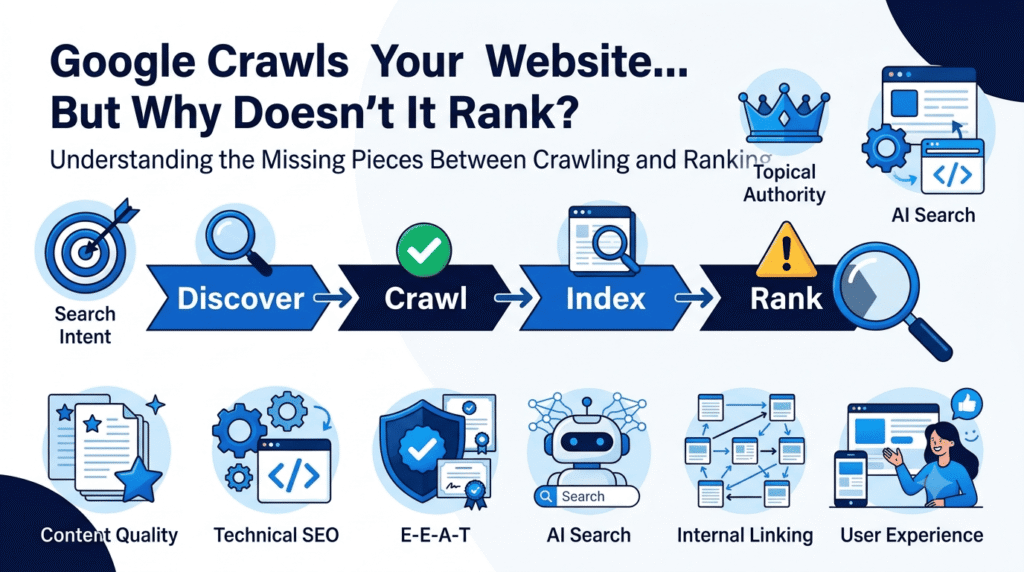
A page must first be discovered, then crawled, evaluated, indexed, compared against thousands of competing pages, and finally considered worthy of appearing for relevant search queries.
In 2026, this process has become even more competitive. Google no longer evaluates pages based only on keywords or backlinks. It increasingly considers helpfulness, originality, topical authority, user experience, and signals that also influence AI-powered search systems such as Google AI Overviews, ChatGPT Search, Gemini, and Perplexity.
Understanding the difference between being crawled and earning rankings is essential if you want your website to achieve sustainable organic visibility.
Crawl Does Not Mean Rank
One of the biggest misconceptions in SEO is believing that once Google visits a page, rankings will naturally follow.
Unfortunately, that’s not how search works.
Imagine applying for a job.
Submitting your résumé means the company has received your application.
It doesn’t mean you’ve been shortlisted—or hired.
Google works in a similar way.
When Googlebot crawls your page, it is simply collecting information.
Google still needs to decide:
- Is this page helpful?
- Is it original?
- Does it satisfy search intent?
- Is it better than existing results?
- Can users trust this information?
- Does it deserve visibility for relevant searches?
Only after answering these questions does Google decide whether—and where—to rank your content.
Key Insight: Crawling confirms discovery. Ranking must be earned through quality, relevance, authority, and usefulness.
How Google Decides Whether to Rank a Page
Understanding Google’s workflow makes the problem much easier to diagnose.
Every page generally moves through four stages.
Stage 1: Discovery
Google first discovers your page through:
- Internal links
- XML sitemaps
- External backlinks
- Social mentions
- Previously crawled pages
If Google doesn’t know your page exists, it can’t crawl it.
Stage 2: Crawling
Googlebot visits your page.
During this stage, Google reads:
- HTML
- Images
- Structured data
- Internal links
- JavaScript (when possible)
- Metadata
Crawling simply means Google collected information.
It is not a quality judgment.
Stage 3: Indexing
Next, Google decides whether the page deserves to be stored in its search index.
Sometimes a page is crawled but never indexed because Google determines it has little value or duplicates existing content.
Search Console often reports statuses such as:
- Crawled – Currently Not Indexed
- Discovered – Currently Not Indexed
- Duplicate Without User-Selected Canonical
- Soft 404
These are indexing decisions—not ranking decisions.
Stage 4: Ranking
Only after indexing does Google compare your page with competing pages.
At this point it evaluates hundreds of signals, including:
- Relevance
- Search intent
- Content quality
- Topical authority
- Freshness
- User experience
- Page experience
- Internal linking
- External authority
Only pages that provide meaningful value earn prominent positions in search results.
Why Google Crawls Your Website but Doesn’t Rank It
There isn’t usually one single reason.
Instead, multiple small issues combine to reduce a page’s competitiveness.
Let’s explore the most common causes.
1. Your Content Doesn’t Fully Match Search Intent
One of the biggest reasons pages fail to rank is that they answer a different question than the user is asking.
For example, imagine someone searches:
“Why Google crawls my website but doesn’t rank it.”
They expect practical explanations, troubleshooting steps, and solutions.
If your article only explains what crawling is without helping readers diagnose the problem, Google may prefer competing pages that provide more complete answers.
Modern SEO isn’t about matching keywords.
It’s about satisfying intent.
Ask yourself:
- What problem is the reader trying to solve?
- What follow-up questions might they have?
- What information would help them take action?
Content that thoroughly satisfies search intent generally performs better than content optimized only around keywords.
AI Search Insight: AI-powered search systems favor comprehensive answers that solve a user’s complete problem rather than isolated keyword matches.
2. Your Content Doesn’t Offer Anything New
Google has already indexed billions of pages.
If your article repeats information available everywhere else, it gives Google very little reason to rank it.
Instead of asking:
“Did I optimize my keywords?”
Ask:
“What unique value does this article provide?”
That value could include:
- Original examples
- Real-world experience
- Step-by-step frameworks
- Case studies
- Visual explanations
- Expert opinions
- Actionable checklists
Originality is becoming increasingly important—not only for Google Search but also for AI systems looking for trustworthy sources.
3. Your Website Lacks Topical Authority
Publishing one article about SEO doesn’t automatically make your website an authority on SEO.
Google increasingly evaluates websites based on how comprehensively they cover a subject.
For example, a website about SEO should ideally contain related content such as:
- Technical SEO
- Keyword Research
- Search Intent
- Internal Linking
- Schema Markup
- AI SEO
- Generative Engine Optimization (GEO)
- Google Search Console
- Core Web Vitals
Together, these articles create a connected knowledge base.
This is known as topical authority.
The stronger your topical authority, the easier it becomes for new content to earn visibility.
4. Your Internal Linking Is Weak
Internal links help Google understand:
- Which pages are most important
- How topics relate to one another
- The overall structure of your website
Without internal links, even high-quality content can remain isolated.
Every important article should naturally connect to related resources.
For example, this article could internally link to:
- Search Intent Guide
- Technical SEO Checklist
- AI SEO Fundamentals
- GEO Guide
- Schema Markup Explained
- Google Search Console Tutorial
These connections improve both user experience and Google’s understanding of your site’s expertise.
Key Insight: Internal links don’t just distribute authority—they help search engines and AI systems understand the relationships between your content.
5. Your Content Is Too Thin or Doesn’t Fully Solve the Problem
One of the most common reasons a crawled page fails to rank is that it doesn’t provide enough value compared to competing content.
This doesn’t necessarily mean the article is short. A concise article can rank well if it completely answers the user’s question.
The real issue is helpfulness.
Ask yourself:
- Does the article answer the main question?
- Does it address follow-up questions?
- Does it provide practical examples?
- Does it help readers take the next step?
- Is it more useful than the pages already ranking?
Google’s goal is to recommend the most helpful result—not simply the longest one.
For example, an article titled “Why Google Crawls Your Website but Doesn’t Rank It” should go beyond definitions. It should explain the entire ranking process, identify common causes, provide solutions, and help readers diagnose their own websites.
Key Insight: Helpful content solves problems. Thin content only introduces them.
6. Technical SEO Problems Prevent Strong Rankings
Even high-quality content can struggle if technical issues make it difficult for Google to understand or trust your website.
Some common technical problems include:
- Incorrect robots.txt rules
- Noindex tags
- Broken internal links
- Poor Core Web Vitals
- Slow page speed
- Duplicate URLs
- Canonical tag issues
- Mobile usability problems
- JavaScript rendering issues
- Poor site architecture
These issues don’t always stop Google from crawling your pages, but they can reduce their ability to compete in search results.
Regular technical SEO audits help identify these problems before they affect your organic visibility.
7. Your Website Has Weak E-E-A-T Signals
Google evaluates more than keywords and backlinks.
It also looks for signals that demonstrate:
- Experience
- Expertise
- Authoritativeness
- Trustworthiness
Together, these are known as E-E-A-T (Experience, Expertise, Authoritativeness, and Trustworthiness).
Ways to strengthen E-E-A-T include:
- Publishing accurate, well-researched content
- Citing reliable sources where appropriate
- Including author information
- Maintaining an updated website
- Demonstrating real-world experience
- Creating original insights rather than repeating existing information
AI-powered search systems also benefit from these signals because they help determine whether content is trustworthy enough to reference.
8. Your Content Doesn’t Stand Out from Competing Pages
Google compares your content with thousands of other pages targeting the same topic.
If your article offers essentially the same information as existing results, Google has little reason to rank it above established competitors.
Instead of asking:
“How can I write another article on this topic?”
Ask:
“How can I create the most useful resource on this topic?”
Ways to differentiate your content include:
- Sharing original experience
- Explaining concepts more clearly
- Including diagrams or infographics
- Adding practical frameworks
- Answering overlooked questions
- Updating information regularly
Being different often matters more than being longer.
9. Your Website Is Still Building Authority
New websites frequently experience this situation.
Google may crawl every page but remain cautious about ranking them until the site demonstrates consistent quality over time.
Authority is built through:
- Publishing helpful content consistently
- Earning quality backlinks
- Building topical authority
- Improving user engagement
- Maintaining technical health
- Demonstrating expertise
SEO is a long-term investment, not an overnight result.
How AI Search Changes the Ranking Equation
Traditional SEO focused heavily on keywords and backlinks.
Modern search—including AI-powered experiences—places greater emphasis on understanding topics, relationships, and user intent.
Whether your content is referenced in Google AI Overviews, ChatGPT Search, Gemini, or Perplexity depends on factors such as:
- Comprehensive topic coverage
- Semantic relevance
- Logical content structure
- Original insights
- Topical authority
- Trustworthy information
- Clear answers to common questions
- Well-organized headings
- Internal content relationships
This is where Generative Engine Optimization (GEO) becomes increasingly important.
Rather than optimizing solely for rankings, GEO focuses on making content easier for AI systems to understand, summarize, and reference.
GEO Insight: AI doesn’t just retrieve information—it evaluates how well your content explains a topic.
A Practical Checklist for Pages That Don’t Rank
If Google has crawled your page but it isn’t ranking, review the following checklist:
Content Quality
✔ Does the page fully answer the user’s question?
✔ Is the information original?
✔ Are practical examples included?
✔ Is the content easy to understand?
Search Intent
✔ Does the page match what users expect?
✔ Have you answered related questions?
✔ Does the title accurately reflect the content?
Technical SEO
✔ Is the page indexable?
✔ Are there canonical issues?
✔ Is the page mobile-friendly?
✔ Does it load quickly?
Website Authority
✔ Does your site cover the topic comprehensively?
✔ Is the page internally linked?
✔ Have you earned relevant backlinks?
AI Search Readiness
✔ Are headings descriptive?
✔ Are FAQs included?
✔ Is the content well structured?
✔ Does it demonstrate expertise?
✔ Would an AI assistant confidently reference this page?
If several answers are “No,” you’ve identified opportunities for improvement.
Common Myths About Crawling and Ranking
Myth 1: Crawled means ranked.
Reality: Crawling only means Google has visited the page.
Myth 2: More keywords guarantee rankings.
Reality: Search intent and content quality matter far more than keyword repetition.
Myth 3: Publishing more articles always improves SEO.
Reality: A few comprehensive, authoritative articles often outperform dozens of low-value posts.
Myth 4: Ranking depends only on backlinks.
Reality: Backlinks remain important, but relevance, topical authority, technical SEO, and user experience also play significant roles.
Myth 5: AI Search replaces SEO.
Reality: AI search builds on strong SEO foundations. Websites with high-quality, well-structured content are better positioned for both traditional and AI-powered search.
People Also Ask
Q: Why does Google crawl my site but not index it?
Ans: Google may determine that the page provides insufficient value, duplicates existing content, or doesn’t meet its quality standards for indexing.
Q: How long does it take Google to rank a new page?
Ans: Some pages begin ranking within days, while others may take weeks or months depending on competition, authority, content quality, and search demand.
Q: Does submitting a sitemap improve rankings?
Ans: No. A sitemap helps Google discover pages but doesn’t influence ranking directly.
Q: Can poor internal linking affect rankings?
Ans: Yes. Weak internal linking makes it harder for Google to understand your site’s structure and the importance of individual pages.
Q: Can AI-generated content rank?
Ans: Yes, provided it is original, accurate, genuinely helpful, and demonstrates expertise. Google evaluates content quality rather than the method used to create it.
Frequently Asked Questions
Q1: Does Google crawling guarantee rankings?
Ans: No. Crawling simply means Google has visited your page. Ranking depends on many additional quality and relevance signals.
Q2: What is the difference between crawling, indexing, and ranking?
Ans: Crawling is Google’s discovery process, indexing is storing the page in Google’s database, and ranking is determining where the page appears in search results.
Q3: Why is my page indexed but still not ranking?
Ans: An indexed page may still struggle if competing pages better satisfy search intent, demonstrate greater authority, or provide more valuable information.
Q4: How can I improve pages that aren’t ranking?
Ans: Focus on search intent, originality, topical authority, internal linking, technical SEO, and overall user experience rather than simply adding more keywords.
Q5: Should I update old articles?
Ans: Yes. Refreshing outdated content helps maintain accuracy, improve relevance, and strengthen your website’s authority over time.
Q6: Is topical authority important for Google?
Ans: Absolutely. Websites that comprehensively cover a subject are more likely to earn consistent visibility than those publishing isolated articles.
Q7: Does page speed affect rankings?
Ans: Page speed is one of many ranking factors. Faster websites generally provide a better user experience, which supports stronger SEO performance.
Q8: How can I optimize content for AI-powered search?
Ans: Create structured, comprehensive, trustworthy content that answers user questions directly, demonstrates expertise, includes descriptive headings, and connects related topics through internal links.
Final Thoughts
Many website owners become discouraged when Google crawls their pages but fails to rank them. However, crawling is only the beginning of the search journey—not the destination.
The real challenge is creating content that deserves visibility.
That means understanding user intent, publishing original insights, building topical authority, maintaining technical excellence, and consistently improving the overall user experience.
As search continues to evolve, the same principles also prepare your content for AI-powered search platforms. Websites that combine strategic SEO with helpful, well-structured, and trustworthy content will be better positioned to earn visibility—whether users search through Google, AI assistants, or the next generation of search experiences.
Remember:
Google doesn’t rank pages because they exist.
It ranks pages because they provide the best answer for the user.
Key Takeaways
- Crawling does not guarantee indexing or rankings.
- Ranking depends on relevance, quality, authority, and user satisfaction.
- Matching search intent is more important than repeating keywords.
- Original, comprehensive content is more competitive than generic content.
- Strong internal linking improves both SEO and AI understanding.
- Technical SEO provides the foundation for visibility.
- Building topical authority increases the likelihood of consistent rankings.
- GEO and AI search reward well-structured, trustworthy, and genuinely helpful content.
- Focus on solving users’ problems—not simply getting Google’s attention.
- Sustainable rankings come from continuous improvement, not one-time optimization.
Author Bio
Mirza Hadi Baig is a Full-Stack WordPress Developer, Technical SEO Specialist, and Product Builder with 5+ years of hands-on experience in WordPress, WooCommerce, technical SEO, and website performance optimization. Supported by more than 17 years of broader IT experience, he specializes in developing scalable web solutions, solving complex technical challenges, and improving search visibility. He completed the IBM SEO Mastery: From Fundamentals to GenAI and GEO Strategies Specialization, gaining expertise in modern SEO, Generative AI, and Generative Engine Optimization (GEO). Through his articles, he shares practical strategies, technical insights, and real-world experience to help businesses achieve sustainable online growth.