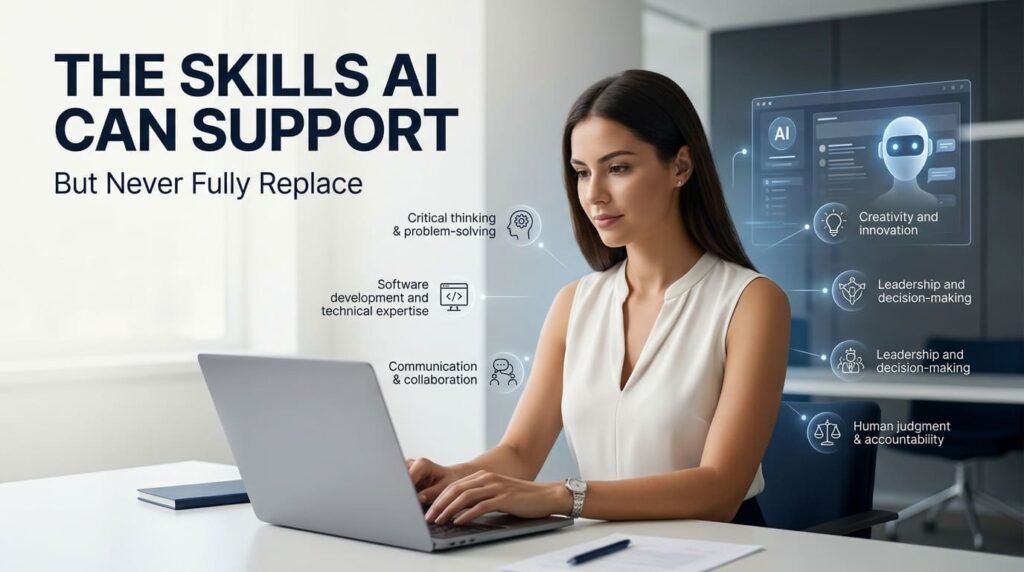
Artificial intelligence is changing how people work, communicate, solve problems, and make decisions. From writing reports and analysing data to generating code and preparing presentations, AI can now support tasks that once required considerable time and professional experience.
But the skills AI can support are not necessarily the skills it can replace.
A professional does more than complete individual tasks. They understand the situation, recognise what matters, communicate with others, make decisions under uncertainty, and take responsibility for the results. AI can contribute to many of these activities, but professional competence requires more than generating a convincing answer.
The challenge for today’s workforce is not simply learning how to use AI. It is developing the technical and human capabilities that make people effective when working alongside it.
1. Critical Thinking and Problem-Solving
Critical thinking is one of the most important professional skills in an AI-supported workplace.
AI can analyse information, suggest explanations, compare options, and generate possible solutions. However, its output still needs to be evaluated against the actual situation.
Consider a developer investigating a website performance problem. An AI tool might identify several possible causes, such as inefficient database queries, excessive JavaScript, poorly configured caching, or large images.
But the developer must determine:
- Which explanation is supported by the available evidence?
- What should be investigated first?
- Could the proposed fix create another problem?
- Does the solution address the root cause or only the visible symptom?
The same principle applies to office environments. AI can summarise a business report, but a manager must decide whether the findings are relevant, whether the assumptions are reasonable, and what action should follow.
AI can suggest possible answers. Critical thinking helps professionals determine which answers deserve attention.
This is why analytical thinking remains a highly valued workforce capability. The World Economic Forum’s Future of Jobs Report 2025 identifies it as the leading core skill among employers surveyed.
2. Technical Judgment, Troubleshooting, and System Understanding
AI is becoming increasingly useful in software development, IT operations, data analysis, and technical support. It can explain code, generate functions, suggest database queries, prepare documentation, and help investigate errors.
However, technical work involves more than producing code or following instructions.
Professionals need to understand how systems behave, how components interact, and what can happen when a change reaches a real environment.
Consider these examples:
Software development
- AI can generate a function, but developers must evaluate its architecture, security, performance, and maintainability.
- AI can suggest tests, but developers must determine whether those tests cover meaningful requirements and real failure conditions.
- AI can explain an error, but developers must verify the root cause using logs, debugging tools, and actual system behaviour.
Cybersecurity and IT operations
- AI can identify suspicious activity, but security professionals must assess its severity and business impact.
- AI can recommend configuration changes, but administrators must understand access permissions, dependencies, and operational risks.
- AI can assist with incident reports, but experienced professionals must coordinate investigation, recovery, and communication.
Data and technical analysis
- AI can process information and identify patterns, but analysts must examine data quality, missing context, misleading correlations, and the implications of their findings.
The value of a technical professional is not limited to knowing how to perform a task. It also involves understanding when a proposed solution is appropriate and when it could introduce risk.
3. Communication, Collaboration, and Human Understanding
Communication is not simply writing a clear email or producing a well-structured report.
In professional environments, effective communication involves understanding the audience, recognising concerns, explaining complex information, listening carefully, and adjusting the message to achieve a shared understanding.
AI can help prepare presentations, draft emails, summarise meetings, and improve written communication. These are useful capabilities, but workplace communication often involves situations that require human awareness.
For example:
- A project manager must explain a delay without damaging trust between teams.
- A technical professional must translate a complicated issue into language a non-technical client can understand.
- A team member must recognise when a colleague needs clarification rather than another instruction.
- A manager must listen to different perspectives before resolving a disagreement.
Collaboration also requires negotiation, patience, trust, and an understanding of different working styles.
AI can help people prepare for conversations, but it cannot automatically create genuine trust between colleagues. That develops through consistent behaviour, mutual respect, and shared responsibility.
In increasingly distributed and international workplaces, these abilities become particularly important because teams may have different communication styles, professional expectations, and cultural contexts.
4. Creativity, Adaptability, and Continuous Learning
AI can generate ideas, suggest designs, produce drafts, and explore alternative approaches. It can make creative work faster and help professionals move beyond the first obvious solution.
However, creativity is not only about generating possibilities. It also involves recognising meaningful opportunities, understanding people, challenging assumptions, and deciding which ideas are worth developing.
A product builder might use AI to explore possible features, but must still understand the users’ actual problems and decide what should be built first.
A marketing professional might ask AI for campaign ideas, but must determine whether the message fits the audience, brand, and business objectives.
A developer might use AI to explore several implementation approaches, but must select one that fits the existing architecture and long-term maintenance requirements.
Adaptability is equally important. Tools, processes, customer expectations, and technical environments continue to change. Professionals who depend entirely on one tool or established workflow can struggle when circumstances change.
Continuous learning helps people remain capable of working through those changes. It includes learning new technologies, understanding unfamiliar business processes, improving existing skills, and recognising when previous knowledge needs updating.
The goal is not to compete with AI at generating information. It is to become better at learning, evaluating, applying, and improving knowledge.
5. Leadership, Decision-Making, and Accountability
AI can support decision-making by organising information, comparing scenarios, identifying possible risks, and preparing recommendations.
But a recommendation is not the same as a decision.
In an organisation, decisions can affect employees, customers, budgets, security, reputation, and long-term business priorities. Someone must understand the consequences and accept responsibility for the outcome.
Consider a manager deciding whether to introduce an AI-powered workflow. AI might help estimate efficiency gains and identify implementation options, but the manager must also consider:
- Whether the workflow solves a genuine business problem.
- Whether employees have the necessary training.
- Whether sensitive information is being handled appropriately.
- Whether the system can be monitored and corrected.
- Who is responsible if the process produces an incorrect result.
Leadership also involves motivating people, managing disagreements, setting priorities, supporting professional development, and making difficult decisions when there is no perfect answer.
These responsibilities cannot be reduced to generating a recommendation.
The same principle applies to individual contributors. A developer remains responsible for the code they approve. An analyst remains responsible for how they interpret and communicate findings. A team member remains responsible for the accuracy of the work they submit.
AI can inform decisions, but professional accountability must remain clear.
6. Building a Stronger Skill Set Alongside AI
The future of work is unlikely to reward people simply for using the largest number of AI tools. It will increasingly reward professionals who combine technical knowledge, human capabilities, and responsible AI use.
A practical approach is to develop skills in three connected areas.
Technical and digital capabilities
- AI literacy and responsible tool usage.
- Data analysis and information evaluation.
- Cybersecurity and data protection awareness.
- Software development, system understanding, and troubleshooting.
- Quality assurance and technical verification.
Human and professional capabilities
- Critical thinking and problem-solving.
- Communication and active listening.
- Collaboration and conflict resolution.
- Leadership and decision-making.
- Creativity, adaptability, and emotional awareness.
AI-supported working capabilities
- Giving AI clear context and requirements.
- Reviewing generated information and outputs.
- Identifying limitations, uncertainty, and potential errors.
- Protecting confidential and sensitive information.
- Knowing when to use AI and when a task needs independent human attention.
These areas should not be treated as separate skills. They reinforce one another.
For example, a developer who understands programming, communicates requirements clearly, and evaluates AI-generated code is better equipped to deliver reliable software than someone who only knows how to generate code.
Similarly, an office professional who understands business processes, communicates effectively, and verifies AI-generated reports can use automation without surrendering professional judgment.
The World Economic Forum and OECD both highlight the importance of combining technological capabilities with analytical, interpersonal, and adaptable skills. The direction is not simply toward more AI knowledge, but toward a stronger combination of human and technical competence.
Final Thought: Become Better at Working With AI
AI will continue to change professional tasks. Some activities will become automated, others will become faster, and entirely new responsibilities will emerge. The exact capabilities of AI will also continue to evolve.
That makes it unwise to assume that any particular task or skill will remain untouched by automation.
A more useful approach is to strengthen the capabilities that help us understand problems, evaluate information, work with people, adapt to change, and take responsibility for outcomes.
Learn to use AI. Understand its limitations. Develop your technical knowledge. Improve your communication. Keep questioning results rather than accepting them automatically.
The objective is not to prove that humans can do everything better than AI. It is to become professionals who can use AI effectively without losing the judgment and responsibility that make their work valuable.
AI CAN SUPPORT YOUR WORK. YOUR SKILLS GIVE IT DIRECTION. YOUR JUDGMENT MAKES THE DIFFERENCE.
About the Author
Mirza Hadi Baig is a Full-Stack Web Developer, Technical Problem Solver, Product Builder, and AI SEO & GEO Strategist with over 17 years of experience in the technology industry. His professional journey spans computer education, healthcare IT and administrative information systems, WordPress and WooCommerce development, and independent digital product building.
Through his work, he explores how technology and AI are changing the way people develop, communicate, solve problems, and work. As a contributor to Workplace Wisdom Herald, he shares practical insights and thoughtful guidance on professional development, workplace skills, effective collaboration, continuous learning, and adapting to an AI-driven world.
His perspective combines technical experience with a belief that successful professionals should remain curious, responsible, adaptable, and willing to learn. He encourages people to use technology to improve their capabilities while strengthening the human judgment and professional values that make their work meaningful.
Workplace Wisdom Herald explores the skills, decisions, and professional habits shaping modern workplaces. Follow the newsletter for practical perspectives on technology, people, and the changing nature of work.