Before AI could generate hundreds of lines of code from a simple instruction, developers were already receiving help from machines.
Autocomplete suggested what to type next. IDEs highlighted syntax errors. Snippets provided reusable patterns. Linters identified potential problems. Search engines and developer communities helped developers find solutions.
So AI didn’t suddenly introduce coding assistance.
What changed was the intelligence, scale, context, and autonomy of that assistance.
A useful way to understand this evolution is:
IA → AI → AI Agents
From helping developers write code to increasingly helping them build software.
What Was IA? Intelligent Assistance Before Generative AI
The term IA, or Intelligent Assistance, can describe the broader idea of tools helping developers make programming easier before today’s generative AI era.
Developers have relied on many forms of assistance for years:
- Syntax highlighting
- Code completion
- Autocomplete
- Code snippets
- IDE suggestions
- IntelliSense
- Static analysis
- Linters
- Documentation
- Stack Overflow
- GitHub examples
- Libraries and frameworks
- Code templates and scaffolding
These tools reduced repetitive work and helped developers avoid common mistakes.
But there was an important limitation.
Most assistance operated around code the developer was already writing.
The developer generally knew what they wanted to build and used tools to write it faster.
The machine helped with implementation.
The developer remained responsible for the idea.
When Coding Assistance Became More Intelligent
Development environments gradually became better at understanding context.
Instead of simply completing a word or function name, modern IDEs could consider surrounding code, types, available methods, project structure, and potential errors.
Static analysis tools could identify suspicious patterns.
Debugging tools could provide increasingly useful information.
Code search made it easier to locate examples across large projects.
This was an important transition:
Assistance was becoming contextual.
The machine wasn’t merely saying:
“Here is the next word.”
It could increasingly say:
“Given the code around you, this is probably what you mean.”
That was a significant improvement—but it still wasn’t the same as modern generative AI.
From Code Completion to Code Generation
The next major shift was the move from completion to generation.
AI coding assistants could take a natural-language description and produce code.
Instead of writing:
function...
and receiving a completion, a developer could describe:
“Create a function that validates an email address and returns an error message when the format is invalid.”
The system could generate the implementation.
This changed the developer’s interaction with coding tools.
The interface increasingly became:
Intent → Code
rather than:
Code → Completion
AI coding assistants could also generate:
- Functions
- Classes
- Tests
- Documentation
- SQL queries
- Regular expressions
- API integrations
- Refactoring suggestions
- Explanations of unfamiliar code
The amount of assistance increased dramatically.
Then Came Generative AI
Generative AI changed the scale of coding assistance even further.
Large language models can process natural-language instructions and generate code across many programming languages and frameworks.
A developer can ask for a feature, explain an error, provide existing code, or describe a desired behavior.
The system can then generate or transform code accordingly.
This is different from traditional autocomplete because the developer doesn’t necessarily need to provide the implementation structure first.
The developer can provide the intent.
That is one of the most important changes in AI-assisted software development.
Programming increasingly becomes a conversation.
Instead of only asking:
“What syntax should I write?”
developers can ask:
“How should I implement this?”
“Why is this failing?”
“Can you refactor this?”
“Can you explain this code?”
“Can you write tests for this?”
The machine becomes more than a completion engine.
It becomes an interactive development assistant.
From AI Assistants to AI Coding Agents
The latest evolution goes beyond generating code.
AI coding agents can increasingly work through multi-step development tasks.
Depending on the tools and environment, an agent may be able to:
Inspect files
↓
Understand the task
↓
Modify code
↓
Run tests
↓
Analyze errors
↓
Make changes
↓
Test again
This introduces another major shift:
Assistance → Generation → Execution
Traditional tools mostly helped developers write code.
Generative AI can produce substantial amounts of code.
AI agents increasingly attempt to complete development tasks across multiple steps.
That doesn’t mean software development has become fully autonomous.
Agents can still misunderstand requirements, introduce bugs, make incorrect assumptions, or produce insecure implementations.
But the direction of development assistance is clear: more context, more capability, and more autonomy.
So, What’s Actually New About AI Coding?
It is tempting to summarize the entire transformation with:
“AI can write code.”
But that’s not the most useful explanation.
Developers have been reusing and generating code in different forms for decades.
The bigger change is the combination of several capabilities.
1. Natural-language intent
Developers can describe what they want instead of translating every requirement into syntax first.
2. Larger-scale generation
AI can produce entire functions, components, files, tests, and sometimes substantial portions of applications.
3. Context awareness
Modern systems can work with surrounding code, project files, documentation, and other contextual information.
4. Code transformation
AI can explain, refactor, translate, optimize, and modify existing code.
5. Iterative problem solving
AI systems can increasingly respond to errors and feedback rather than stopping after producing the first answer.
6. Greater developer leverage
One developer can potentially accomplish more with the same amount of time.
That last point may be the most important.
AI isn’t simply making code generation faster. It’s increasing the leverage of developers who know how to use it effectively.
What AI Still Doesn’t Replace
More powerful coding assistance doesn’t eliminate the need for programming knowledge.
In fact, the more code AI can generate, the more important it becomes to evaluate that code.
A developer still needs to understand:
- Architecture
- Logic
- Security
- Performance
- Databases
- APIs
- Dependencies
- Testing
- Debugging
- Maintainability
AI can produce code that looks correct without actually being correct.
A developer who understands the underlying technology can ask better questions, identify problems, test assumptions, and decide whether generated code belongs in production.
This creates an important distinction:
AI can reduce the amount of code developers manually write without reducing the importance of developers who understand the code.
The Evolution in One Picture
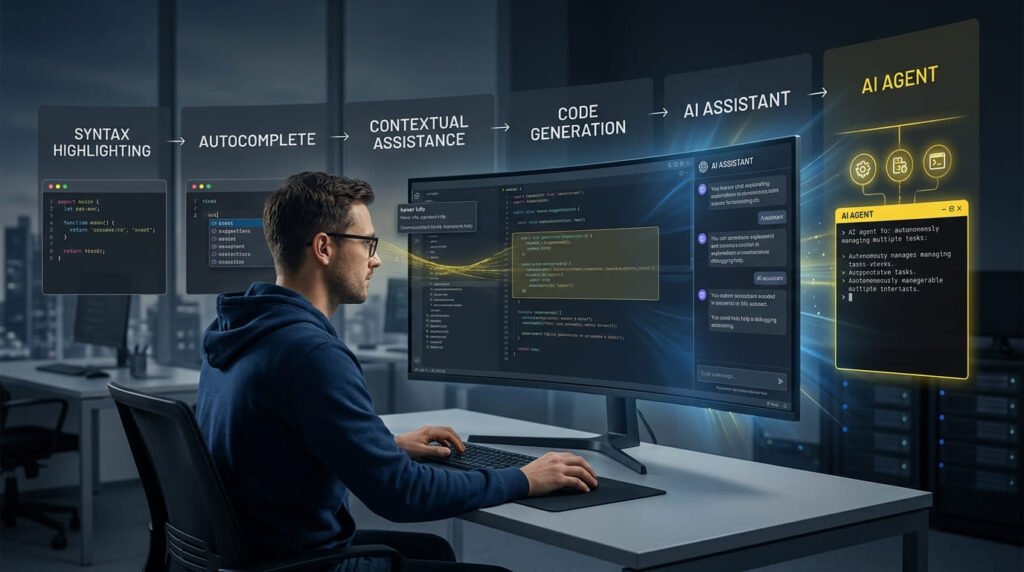
The history of coding assistance can be simplified into a progression:
Syntax Assistance
“Here is the correct syntax.”
↓
Code Completion
“Here is what you might type next.”
↓
Contextual Assistance
“Based on your code, here is what probably fits.”
↓
Code Generation
“Describe what you need, and I’ll generate it.”
↓
AI Assistant
“Let’s work through the problem together.”
↓
AI Coding Agent
“Give me the task, and I’ll work through multiple development steps.”
The fundamental relationship is changing.
But the developer remains part of the loop—especially where judgment, architecture, security, and responsibility matter.
Final Thought
AI didn’t invent coding assistance.
It expanded it.
Developers have always used tools to avoid unnecessary repetition and increase productivity. What changed with modern AI is the ability to communicate intent in natural language and receive increasingly sophisticated assistance in return.
The evolution is therefore not:
No assistance → AI
It is:
Assistance → Intelligent Assistance → Generative AI → AI Agents
And perhaps the most important lesson is this:
The future of software development may require developers to write less code—but it will still require them to understand more about the code they choose to ship.
AI can help us build faster.
Understanding still determines what we should build.
Frequently Asked Questions
Q: What is the difference between traditional coding assistance and AI coding?
Traditional coding assistance primarily helped developers complete, search, analyze, or structure code. Modern AI can understand natural-language requirements and generate, explain, transform, and increasingly execute multi-step coding tasks.
Q: Was coding assistance available before generative AI?
Yes. Developers have used autocomplete, IntelliSense, snippets, IDE suggestions, linters, static analysis, documentation, Stack Overflow, libraries, frameworks, and code examples for many years.
Q: What changed with generative AI coding tools?
The major change is that developers can communicate requirements using natural language and receive substantial amounts of generated code, explanations, tests, refactoring, and other development assistance.
Q: What are AI coding agents?
AI coding agents are systems designed to perform multi-step software-development tasks. Depending on their environment and permissions, they can inspect code, modify files, run tests, analyze errors, and iterate on their work.
Q: Will AI make coding knowledge unnecessary?
No. AI can reduce manual coding work, but understanding programming remains important for reviewing generated code, debugging, security, architecture, testing, and maintaining software.
Q: Is AI-assisted coding the same as code completion?
No. Code completion generally predicts or suggests what comes next in existing code. AI-assisted coding can operate at a much larger level, generating functions, components, explanations, tests, and other software based on natural-language intent.
About the Author
Mirza Hadi Baig is a Full-Stack WordPress Developer | Technical Problem Solver | AI SEO & GEO Strategist with a practical interest in how AI can enhance development, search, and digital workflows.
He works across WordPress development, technical SEO, structured data, AI SEO, Generative Engine Optimization (GEO), and AI-assisted development. Rather than viewing AI as a replacement for technical knowledge, he explores how developers and digital professionals can use AI to work smarter, solve problems faster, and expand their capabilities.
Mirza is also an active AI learner and practical product builder, developing tools and WordPress solutions to address real-world problems. His projects include Schema Genie Pro, designed to simplify structured-data implementation, and HS3Dev AI Content Index for llms.txt, developed to help websites prepare their content for emerging AI-oriented discovery.
His approach is straightforward:
Learn the technology. Understand the problem. Use AI where it adds value. Build practical solutions.