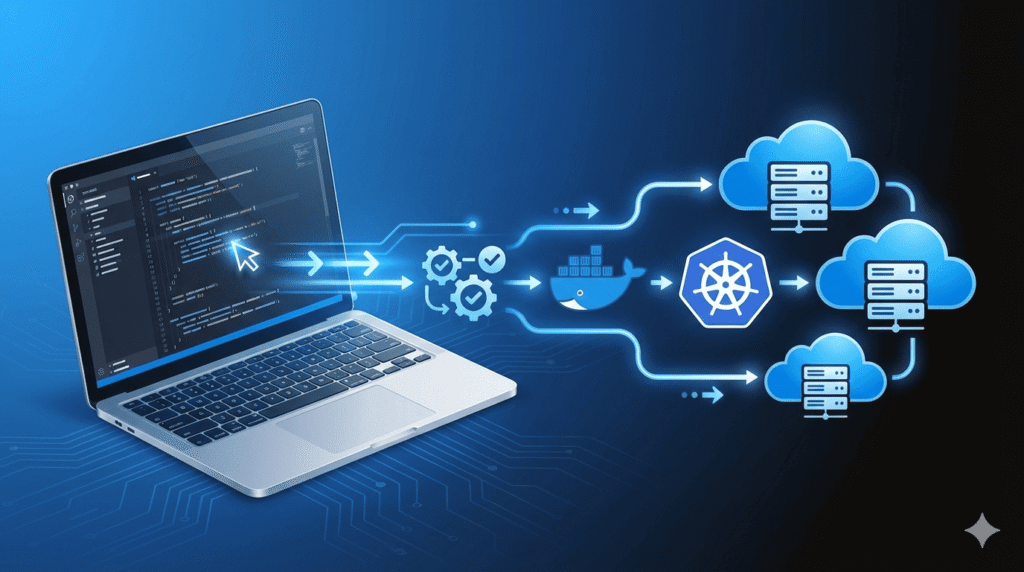
Deployment knowledge as a core developer skill was once considered optional. Developers were expected to write clean, functional code, while deployment and infrastructure were handled by operations teams. But in today’s cloud-driven ecosystem, that separation no longer exists. Writing code is only part of the responsibility — understanding how that code is built, deployed, scaled, and secured in production has become fundamental to modern software development.
That model no longer reflects modern software delivery.
Today, applications are built for cloud environments, deployed multiple times a day, and expected to scale instantly under unpredictable traffic. In this environment, understanding deployment is not an optional skill — it is a core competency. Developers are no longer evaluated solely on how well they write code, but also on how effectively that code performs in production.
This shift from isolated coding to full lifecycle ownership has redefined what it means to be a modern developer.
The Shift: From Traditional Ops to DevOps Culture
The separation between development and operations created friction for decades. Developers optimized for features and deadlines, while operations teams prioritized stability and uptime. This misalignment often caused deployment delays, production incidents, and blame cycles.
The rise of DevOps transformed this model into one focused on collaboration, automation, and shared accountability. Developers began participating in infrastructure discussions, while operations teams embraced automation and code-driven configuration.
This cultural shift means developers must now understand:
- How their code is built and packaged
- How environments differ between staging and production
- How deployments are automated
- How rollbacks are handled
When developers understand deployment workflows, they write code that aligns with production realities rather than theoretical development environments.
Code That Works Locally Is Not Production-Ready
Many deployment failures occur because local development environments differ significantly from production. Local systems often have unrestricted resources, flexible configurations, and relaxed security policies. Production systems do not.
Production environments introduce:
- Strict memory and CPU constraints
- Security firewalls and access control
- Load balancing and traffic routing
- Real-world concurrency
Without deployment awareness, developers may overlook scalability, dependency management, and configuration isolation. Understanding deployment forces developers to think about environment variables, build processes, runtime configurations, and performance constraints before code ever reaches users.
Production readiness is a mindset — and deployment knowledge cultivates it.
Cloud Platforms Changed the Rules
Cloud platforms such as Amazon Web Services, Microsoft Azure, and Google Cloud transformed infrastructure from physical servers into programmable services.
Infrastructure is no longer static hardware installed in data centers. It is dynamic, scalable, and managed through APIs. Developers can provision databases, configure networking, deploy containers, and scale workloads with configuration files.
This transformation means developers must understand:
- How compute instances scale
- How managed databases differ from self-hosted systems
- How load balancers distribute traffic
- How storage and CDN services affect performance
Cloud literacy allows developers to design systems that are scalable, cost-efficient, and resilient. Without this understanding, architectural decisions can lead to unnecessary complexity and financial waste.
CI/CD Pipelines: Automation as a Standard
Continuous Integration and Continuous Deployment (CI/CD) have become foundational to modern software development. Platforms like GitHub Actions, GitLab, and Jenkins automate testing, building, and deployment processes.
CI/CD pipelines are not just technical tools; they shape how developers write code. When developers understand pipeline mechanics, they structure projects to support automated testing, modular builds, and safe deployments.
Deployment automation introduces several benefits:
- Faster release cycles
- Reduced human error
- Consistent build environments
- Immediate feedback through automated tests
More importantly, CI/CD encourages incremental improvement. Instead of deploying large updates infrequently, teams release smaller, manageable changes. Developers who understand CI/CD pipelines build systems that integrate seamlessly into automated workflows.
Automation is not a luxury — it is an operational baseline.
Containers & Orchestration: The New Deployment Standard
Containerization has standardized how applications move between environments. Tools like Docker package applications with their dependencies, ensuring consistent execution regardless of the underlying infrastructure.
However, modern applications rarely run as a single container. They operate as distributed systems requiring orchestration platforms like Kubernetes.
Container orchestration handles:
- Automatic scaling
- Service discovery
- Load balancing
- Self-healing mechanisms
- Rolling updates
Understanding containers changes how developers design software. Applications must be stateless, configurable via environment variables, and resilient to restarts. Developers must consider how services communicate and how failures are handled.
Container literacy ensures that software behaves predictably in scalable, distributed environments.
Security & Reliability Are Deployment Concerns
Security and reliability are often misunderstood as purely coding responsibilities. In reality, they are deeply influenced by deployment architecture.
Deployment environments determine:
- How secrets and credentials are stored
- How network traffic is secured
- How services authenticate with each other
- How data is encrypted in transit and at rest
A developer unfamiliar with deployment may inadvertently expose environment variables, misconfigure access controls, or rely on insecure default settings.
Reliability also depends on deployment awareness. Developers must understand:
- Health checks and readiness probes
- Logging and monitoring systems
- Rollback strategies
- Disaster recovery mechanisms
Applications do not fail only because of bugs. They fail due to infrastructure misconfigurations, scaling limitations, and deployment errors. Developers who understand deployment can design systems that anticipate and mitigate these risks.
Security and reliability begin at the code level — but they are enforced at the deployment level.
The Business Impact of Deployment Knowledge
Deployment knowledge directly affects business outcomes. Downtime, slow performance, and failed releases impact revenue, brand reputation, and customer trust.
When developers understand deployment environments, they:
- Reduce production incidents
- Accelerate release cycles
- Optimize infrastructure costs
- Improve system uptime
Cloud platforms charge based on usage. Inefficient architecture or misconfigured scaling policies can significantly increase operational expenses. Developers who understand infrastructure economics design systems that balance performance with cost efficiency.
Deployment knowledge also shortens feedback loops. Faster deployments mean faster innovation, quicker bug fixes, and better responsiveness to market changes.
From a business perspective, developers who understand deployment are strategic assets. They bridge technical execution with operational impact.
The Modern Developer Profile
The modern developer is no longer defined solely by programming language proficiency. Technical excellence now includes infrastructure awareness, automation literacy, and system-level thinking.
A well-rounded developer today understands:
- Application architecture
- Cloud deployment models
- CI/CD automation
- Containerization workflows
- Security best practices
- Monitoring and observability tools
This does not mean every developer must become a full-time DevOps engineer. Rather, they must understand how their code behaves in real-world systems.
The modern developer thinks holistically. They anticipate production constraints during development. They design for scalability from the beginning. They write code with deployment pipelines in mind.
The boundary between “developer” and “operations engineer” continues to blur. The professionals who thrive are those who embrace this convergence rather than resist it.
Final Insight: Development Doesn’t End at Deployment
Software development does not end when code is pushed to a repository. True completion occurs when software runs reliably, securely, and efficiently in production environments.
Understanding deployment reshapes the development mindset. Developers begin to consider infrastructure during design, automation during implementation, and monitoring during release planning. They move from writing isolated features to delivering operational systems.
The journey from code to cloud represents professional growth. It reflects a transition from task-oriented programming to system-oriented engineering.
In today’s cloud-native world, deployment knowledge is not an advanced specialization — it is foundational literacy.
Because building software is only half the equation.
Delivering it reliably, securely, and at scale is what defines a modern developer.
References & Further Reading
For deeper exploration into deployment and cloud-native practices:
- Amazon Web Services Documentation – Cloud architecture and deployment models
https://docs.aws.amazon.com/ - Microsoft Azure Architecture Center
https://learn.microsoft.com/azure/architecture/ - Google Cloud Cloud Architecture Framework
https://cloud.google.com/architecture - Docker Official Documentation
https://docs.docker.com/ - Kubernetes Official Documentation
https://kubernetes.io/docs/ - GitHub Actions Documentation
https://docs.github.com/actions
Let’s Build Something Great Together
Have a project in mind or need help optimizing your website?
Reach Out →