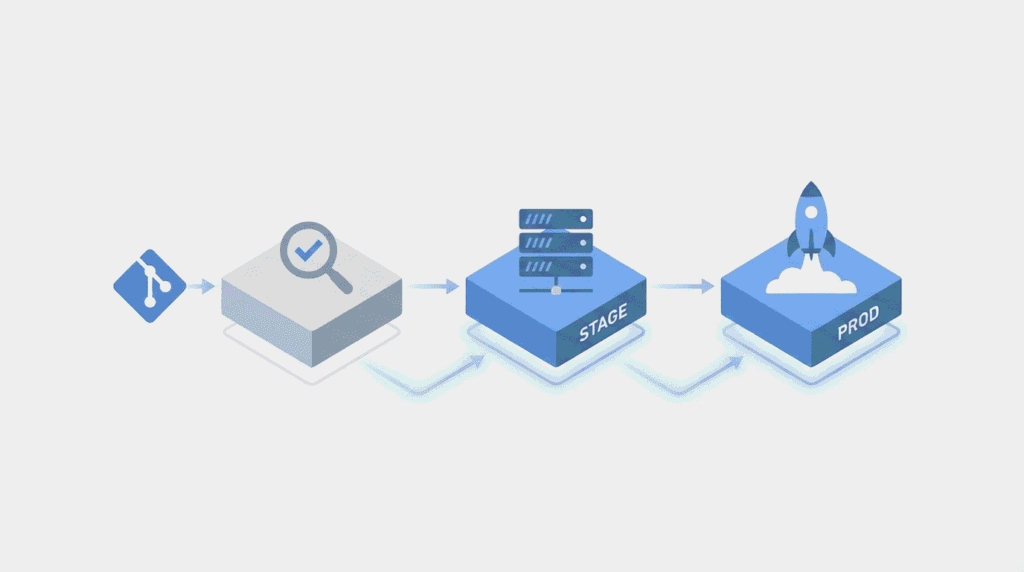
Modern software is no longer judged solely by code quality or architectural elegance. It is judged by how reliably and consistently it reaches production. In today’s environment of rapid iteration, distributed teams, and AI-assisted development, delivery speed and stability are not competing goals — they must coexist.
CI/CD pipelines are what make that coexistence possible.
They are not just automation scripts. They are structured delivery systems that define how software moves from idea to production with control, visibility, and repeatability.
The Core Problem: Deployment as a High-Risk Event
In many organizations, deployment is still treated as a special operation. A release window is scheduled. A senior engineer supervises. Multiple checklists are reviewed. Everyone watches logs in real time.
This approach signals one thing: deployment is considered dangerous.
The risk increases when:
- Code accumulates without integration
- Testing is manual or inconsistent
- Environments differ subtly
- Rollbacks are unclear
Large batch releases create uncertainty. Manual processes introduce variability. And variability is the enemy of reliability.
CI/CD pipelines exist to transform deployment from a risky event into a controlled, repeatable process.
Instead of fearing change, teams normalize it.
Continuous Integration: Enforcing Discipline Early
Continuous Integration (CI) is often described simply as “automatically testing code on every commit.” But its real value lies deeper.
CI changes developer behavior.
When every commit triggers automated builds and tests, developers are forced to:
- Merge changes frequently
- Keep branches short-lived
- Resolve conflicts early
- Maintain test discipline
Frequent integration reduces uncertainty. Problems are discovered when they are small and isolated — not weeks later when they are intertwined with other changes.
Over time, CI reduces integration friction and builds a culture of incremental improvement.
The pipeline becomes the first line of quality enforcement.
Continuous Delivery and Deployment: Making Release Routine
Continuous Delivery (CD) ensures that every successful build is production-ready. Continuous Deployment goes further by automatically pushing validated changes into production.
The key shift here is cultural, not technical.
Instead of asking, “Are we ready to release?”
The system answers, “This is always releasable.”
This changes the delivery model in fundamental ways:
- Releases become smaller and more frequent
- Rollbacks become manageable
- Hotfixes become predictable
- Operational stress decreases
When releases are routine, innovation accelerates. The organization spends less energy preparing for launches and more energy improving the product.
Why Pipelines Are Structural Infrastructure
A CI/CD pipeline is not just a convenience tool. It is infrastructure.
Without pipelines:
- Deployments rely on tribal knowledge
- Steps are documented informally
- Environments drift over time
- Human error becomes a recurring factor
With pipelines:
- Builds are reproducible
- Tests are standardized
- Environments are version-controlled
- Artifacts are traceable
- Deployment steps are codified
The difference is structural consistency.
Consistency allows teams to scale systems without increasing chaos. When processes are encoded into pipelines, delivery no longer depends on memory or individual experience.
It depends on systems.
A Practical Case: From Manual Release to Automated Flow
In one project I worked on, deployment involved manual SSH access:
- Pulling the latest code
- Installing dependencies
- Running migrations manually
- Restarting services
- Clearing caches
The process “worked” — until traffic grew.
One missed migration caused downtime.
A dependency mismatch broke staging.
A forgotten cache clear created inconsistent behavior.
The issue wasn’t poor development skills. It was fragile delivery architecture.
After implementing a structured CI/CD pipeline:
- Code pushes triggered automated builds
- Unit and integration tests executed automatically
- Static analysis validated quality
- Artifacts were generated and versioned
- Staging deployments ran automatically
- Production releases required controlled approval
The outcome:
- Deployment time reduced significantly
- Rollbacks became simple and reliable
- Incident frequency dropped
- Confidence across the team increased
Nothing about the product logic changed.
The delivery system did.
And that transformation strengthened the entire engineering operation.
The Psychological Impact of Reliable Pipelines
An often-overlooked benefit of CI/CD pipelines is psychological safety.
When developers know that:
- Automated tests catch regressions
- Deployments are reproducible
- Rollbacks are fast and safe
- Monitoring is integrated
They work differently.
They experiment more responsibly.
They commit smaller changes.
They refactor with confidence.
Fear-based environments slow innovation.
System-supported environments accelerate it.
A mature pipeline reduces emotional friction in engineering teams.
Common Misconceptions About CI/CD
“We Use a Tool, So We Have CI/CD”
Using platforms like Jenkins, GitHub Actions, GitLab CI/CD, or CircleCI does not automatically create a CI/CD culture.
Tools enable pipelines. They do not guarantee discipline.
True CI/CD requires:
- Reliable automated testing
- Infrastructure as Code practices
- Clear environment parity
- Monitoring integration
- Defined rollback strategies
Without these, pipelines become automated scripts — not delivery systems.
“CI/CD Is Only for Large Teams”
Smaller teams arguably benefit more.
When there is no dedicated QA team or release manager, automation becomes your safety net. A well-designed pipeline compensates for limited manpower by embedding safeguards into the system.
Automation reduces reliance on heroic effort.
“CI/CD Slows Us Down”
Initial setup introduces friction. Writing tests and configuring environments requires time.
But long-term velocity increases because:
- Fewer emergency fixes are required
- Integration conflicts reduce
- Releases require less coordination
- Confidence increases
Short-term investment creates long-term speed.
CI/CD in an AI-Accelerated Development Era
AI coding assistants are increasing development output. More code is being generated faster than ever before.
But accelerated coding without structured delivery increases instability.
As code velocity increases, validation must increase proportionally.
CI/CD pipelines become critical because they:
- Automatically validate AI-generated changes
- Enforce testing standards
- Prevent unreviewed code from reaching production
- Maintain system stability amid rapid iteration
AI accelerates writing.
Pipelines protect delivery.
The combination defines modern engineering maturity.
Building a Practical Pipeline Foundation
For teams starting or refining CI/CD, focus on layered implementation:
- Strong version control discipline
- Automated build processes
- Foundational test coverage
- Environment consistency
- Automated staging deployment
- Controlled production release process
- Integrated monitoring and rollback mechanisms
Perfection is not required at the beginning.
Reliability is.
Once reliability is established, optimization follows naturally.
Conclusion: Delivery Defines Modern Engineering
CI/CD pipelines are not an optional enhancement. They are foundational infrastructure for modern software systems.
They reduce deployment risk.
They enforce quality standards.
They enable scale.
They create psychological safety.
They align engineering velocity with operational stability.
In a world where software is continuously evolving, the ability to deliver safely and consistently becomes a competitive advantage.
Strong pipelines transform deployment from a stressful event into a predictable routine.
And when delivery becomes routine, innovation becomes sustainable.
Key Takeaways
- Deployment risk decreases when processes are automated and standardized.
- Continuous Integration enforces disciplined, incremental development.
- Continuous Delivery transforms releases into routine operations.
- Pipelines provide structural consistency across environments and time.
- Reliable delivery systems increase both technical and psychological stability.
- In AI-accelerated development, CI/CD becomes even more essential.
Modern software is not defined only by what you build.
It is defined by how reliably you deliver it.
References & Further Reading
• Continuous Integration overview from Martin Fowler
https://martinfowler.com/articles/continuousIntegration.html
• CI/CD concepts from Atlassian
https://www.atlassian.com/continuous-delivery/ci-vs-ci-vs-cd
• DevOps practices documentation from AWS
https://aws.amazon.com/devops/what-is-devops/
• Official documentation of Jenkins
https://www.jenkins.io/doc/
• CI/CD documentation from GitHub Actions
https://docs.github.com/actions
If you’re looking for structured, reliable web development — from architecture to deployment — you can connect with me here: https://hadi-mirza.com/contact/