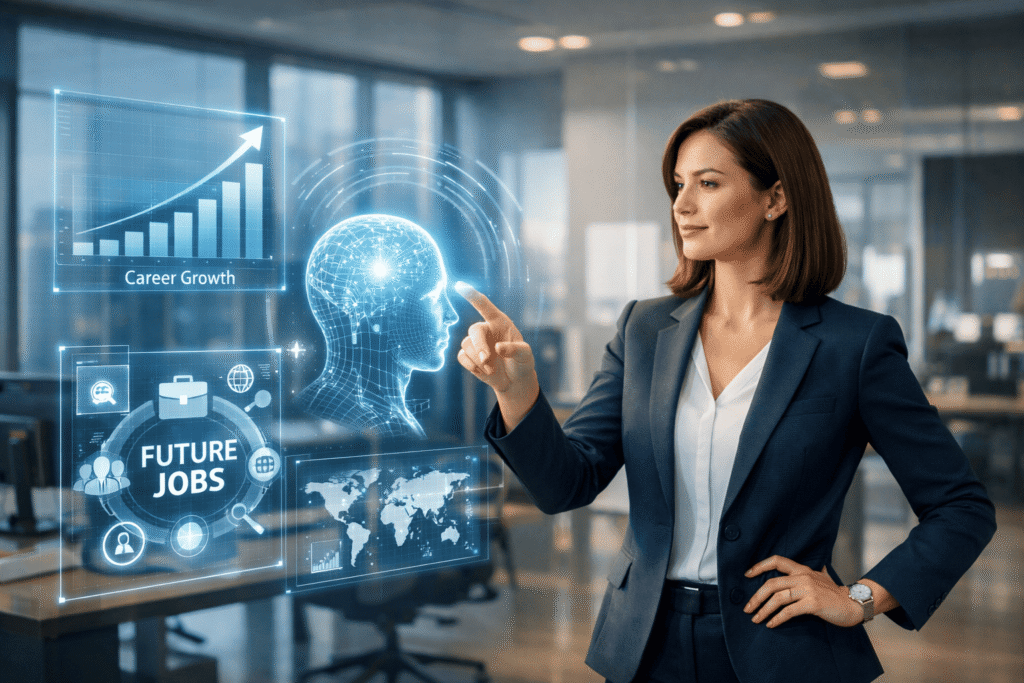
The idea of career resilience: preparing for roles that don’t exist yet is no longer a futuristic concept—it’s a present-day necessity. Across industries, artificial intelligence is not just automating tasks; it is reshaping entire job categories. Roles are evolving faster than traditional education and corporate training systems can keep up.
For professionals, this creates a quiet but pressing challenge: how do you prepare for a career path that hasn’t been defined yet? The uncertainty is not just about job security—it’s about relevance.
In the AI era, career resilience is less about holding onto a role and more about continuously adapting your capabilities, mindset, and value. The professionals who thrive will not be the ones who resist change, but those who learn how to navigate it strategically.
Understanding Career Resilience in the AI Era
Career resilience today goes beyond adaptability—it is the ability to anticipate change, respond proactively, and reposition your skills continuously. In an AI-driven workplace, stability no longer comes from a fixed job title but from transferable value.
Artificial intelligence is accelerating shifts in how work is performed. Tasks are being automated, decision-making is becoming data-driven, and human roles are increasingly centered around creativity, judgment, and complex problem-solving. This transformation requires a new definition of professional strength.
Career resilience, therefore, is not reactive. It is a forward-looking approach where professionals actively prepare for shifts before they are forced to respond to them.
Key Points:
- Career resilience means staying relevant, not just employed
- AI is transforming tasks, not just eliminating jobs
- Long-term value lies in adaptability and foresight
- Stability now comes from skills, not job titles
The Shift from Job Security to Skill Security
One of the most significant changes in the modern workplace is the decline of traditional job security. Organizations are restructuring rapidly, and roles are being redesigned around technology capabilities. In this environment, relying on a single expertise is increasingly risky.
Skill security—having a diverse and evolving set of competencies—is becoming the new foundation of career stability. Professionals must think in terms of skill portfolios rather than job descriptions.
This includes combining technical awareness (like understanding AI tools) with human-centric skills such as communication, critical thinking, and adaptability. The professionals who succeed will be those who can bridge technology with human insight.
Key Points:
- Job security is being replaced by skill security
- A single specialization is no longer sufficient
- Hybrid skill sets are more valuable than narrow expertise
- Continuous learning is essential for long-term relevance
Building Adaptive Learning Habits for Continuous Growth
Preparing for roles that don’t exist yet requires a shift in how learning is approached. Traditional education focuses on static knowledge, while the AI era demands continuous, self-driven learning.
Adaptive learning is about developing the habit of updating your knowledge regularly, experimenting with new tools, and staying informed about industry trends. It is not about mastering everything, but about learning how to learn efficiently and consistently.
Professionals who invest in ongoing learning create a buffer against uncertainty. They are able to transition more smoothly as roles evolve because they are already aligned with emerging demands.
Key Points:
- Learning must be continuous, not occasional
- Focus on learning agility rather than perfection
- Stay updated with AI tools and industry changes
- Build a habit of curiosity and experimentation
Strengthening Human-Centric Skills in an Automated World
As AI takes over repetitive and data-heavy tasks, uniquely human skills are becoming more valuable. These include emotional intelligence, ethical judgment, creativity, leadership, and collaboration.
While technology enhances efficiency, it cannot replace the human ability to understand context, build relationships, and navigate complex social dynamics. This creates an opportunity for professionals to differentiate themselves.
Career resilience in the AI era depends on balancing technical awareness with strong interpersonal capabilities. The future workforce will not be defined by humans versus machines, but by how effectively humans can work alongside intelligent systems.
Key Points:
- Human skills are becoming a competitive advantage
- Emotional intelligence and communication are critical
- Creativity and problem-solving cannot be fully automated
- Collaboration between humans and AI is the future
Developing a Future-Oriented Career Strategy
Preparing for the unknown requires a strategic approach to career planning. Instead of asking “What job should I aim for?”, professionals need to ask “What value can I create across changing environments?”
A future-oriented strategy includes identifying emerging trends, understanding how your industry is evolving, and aligning your skills with future needs. It also involves being open to non-linear career paths, where lateral moves and skill shifts are part of growth.
This mindset allows professionals to remain flexible while still moving forward with purpose. It transforms uncertainty from a threat into an opportunity.
Key Points:
- Focus on value creation, not fixed roles
- Track industry trends and AI impact
- Embrace non-linear career paths
- Align skills with future demands, not past roles
Creating a Personal System for Career Resilience
Career resilience is not built through isolated efforts—it requires a structured personal system. This includes setting learning goals, tracking skill development, and regularly evaluating your career direction.
A personal system ensures consistency and prevents stagnation. It also helps professionals stay intentional about their growth rather than reacting only when disruption occurs.
This system can include regular skill audits, learning schedules, networking strategies, and exposure to new ideas. Over time, it becomes a framework that supports long-term career sustainability.
Key Points:
- Build a structured approach to career growth
- Regularly assess and update your skills
- Stay connected with industry networks
- Treat career development as an ongoing system
Closing Reflection
Career resilience in the AI era is not about predicting the future—it is about preparing yourself to navigate it, regardless of how it unfolds. The roles that will define the next decade may not yet have names, but they will demand individuals who are adaptable, self-aware, and continuously evolving.
In this shifting landscape, the most valuable professionals will not be those who follow predefined paths, but those who build the capacity to create new ones.
The real question is no longer “Will AI change your career?”—that answer is already clear. The question is whether you are building the resilience to grow with that change, or waiting to react to it.
References and Further Reading
- Harvard Business Review – Future of Work and AI transformation insights: https://hbr.org
- McKinsey Global Institute – Jobs lost, jobs gained research: https://www.mckinsey.com/mgi
- World Economic Forum – Future of Jobs Report: https://www.weforum.org/reports
- American Psychological Association – Workplace adaptability and resilience studies: https://www.apa.org