
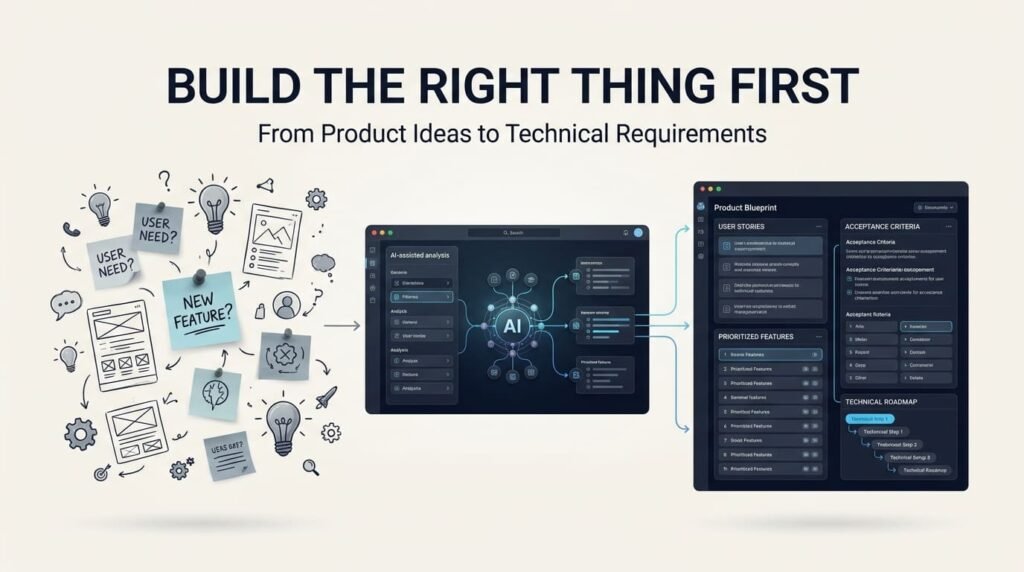
Every successful digital product begins with an idea. However, having a good idea does not automatically mean knowing what to build, how it should work, or what users actually need.
A common mistake in software development is moving directly from an idea to implementation. Developers start writing code, selecting frameworks, designing interfaces, or asking AI to generate components before properly understanding the problem.
This approach can create unnecessary features, unclear functionality, technical rework, and products that solve the wrong problem.
AI can help reduce this gap, but generating code should not be the first step. One of its more valuable applications is helping developers transform early-stage ideas into structured requirements that can guide the entire development process.
The principle is straightforward: understand the problem, define the requirements, control the scope, and then build the solution.
AI can support product discovery, organize user needs, draft user stories, suggest acceptance criteria, and identify missing information. However, developers must evaluate its suggestions, challenge assumptions, and make the final technical decisions.
This is where AI-assisted development becomes more than code generation.
1. Start with product discovery, not implementation
Product discovery is the process of understanding what needs to be built and why it matters before committing to a particular solution.
An idea usually begins with a broad statement:
“I want to build an application that helps small businesses manage customer enquiries.”
That sounds clear, but it leaves many questions unanswered.
- Who will use the application: business owners, employees, or customers?
- What problem are they currently experiencing?
- How do they manage enquiries today?
- What information needs to be collected?
- Do they need automated notifications?
- Should enquiries be assigned to employees?
- Is reporting required?
- Does the application need to integrate with an existing CRM?
These questions help distinguish the actual problem from the proposed solution.
AI can assist by analyzing the idea, identifying possible user groups, organizing assumptions, and generating questions that deserve further investigation.
For example, a developer could ask:
Analyze this product idea from a product discovery perspective. Identify the target users, their potential problems, the main business objective, assumptions, missing information, and questions that should be answered before development begins. Do not propose implementation yet.
The instruction not to propose implementation immediately is important. Otherwise, AI may jump into recommending frameworks, database tables, plugins, and features before understanding the requirements.
The objective of discovery is not to produce a long document. It is to develop a reliable understanding of the problem.
Identify functional and non-functional requirements
Once the problem is understood, requirements can be organized into two important categories.
Functional requirements describe what the system should do.
Examples:
- Users can register and log in.
- Business owners can create customer enquiries.
- Employees can update enquiry statuses.
- Administrators can assign enquiries.
- Users can search and filter records.
Non-functional requirements describe how the system should perform and the constraints it must satisfy.
Examples:
- User information must be protected.
- Administrative functions must require appropriate permissions.
- Pages should load efficiently.
- The application should support mobile devices.
- Database operations should remain reliable as records increase.
- The system should provide meaningful error messages.
AI can help identify both categories, but the developer must check whether the suggested requirements are relevant, measurable, and technically realistic.
This distinction is particularly important because a product can satisfy its functional requirements while still failing because of poor security, performance, accessibility, or reliability.
2. Convert requirements into user stories
After identifying the users and their needs, the next step is translating those needs into manageable development tasks.
User stories provide a useful way to describe functionality from the user’s perspective.
A commonly used format is:
As a [type of user], I want [an action or capability], so that [a benefit or outcome].
Consider the customer enquiry application.
Instead of writing:
“Create an enquiry management module.”
A more meaningful user story would be:
As a business owner, I want to view all customer enquiries in one dashboard so that I can monitor incoming requests and manage follow-ups.
This explains three things:
- Who needs the functionality?
- What do they need to accomplish?
- Why does it matter?
AI can convert a collection of requirements into user stories and group related stories into larger features or epics.
However, developers should avoid accepting every generated story without reviewing it.
A useful story should describe a meaningful user outcome rather than simply representing a technical component.
For example, “Create a database table” is a development task, not necessarily a user story.
The database table may be required to deliver a feature, but the user story should explain the value that feature provides.
The Agile Alliance guide to user stories provides additional context on how stories support incremental product development and communication between customers and development teams.
Example: Breaking down a feature
Suppose the product requires customer enquiry management.
The larger feature could be divided into these stories:
- Business owners can create new enquiries.
- Employees can view enquiries assigned to them.
- Administrators can assign enquiries to employees.
- Employees can update enquiry statuses.
- Business owners can filter enquiries by status.
Each story represents a distinct capability that can be discussed, prioritized, implemented, and tested.
AI can help organize this breakdown, but the development team should ensure that the stories cover the actual user journey without introducing unnecessary functionality.
3. Define acceptance criteria before coding
A user story explains what someone wants to achieve. Acceptance criteria define the conditions that must be satisfied for the functionality to be accepted.
Without acceptance criteria, different people may interpret the same requirement differently.
Consider this user story:
As a business owner, I want to create a customer enquiry so that I can record and manage incoming requests.
What should happen when the user submits the form?
- Are customer name and email required?
- What happens if the email format is invalid?
- Should duplicate enquiries be allowed?
- Does the system display a confirmation message?
- Where should the enquiry be stored?
- Who can access the submitted information?
These details turn a general requirement into something developers and testers can evaluate.
Use Given–When–Then scenarios
A useful format for acceptance criteria is:
- Given: The initial situation or condition.
- When: The user performs an action.
- Then: The expected result.
For example:
Scenario: Successful enquiry submission
- Given a logged-in business owner is viewing the enquiry form.
- When the owner enters valid customer information and submits the form.
- Then the system saves the enquiry and displays a confirmation message.
Scenario: Invalid email address
- Given the user is completing the enquiry form.
- When the user enters an invalid email address.
- Then the system displays a validation message and prevents submission.
Scenario: Unauthorized access
- Given an employee does not have administrative permissions.
- When the employee attempts to access the administration area.
- Then the system denies access to that restricted functionality.
These scenarios give developers a clearer implementation target and testers a practical verification method.
AI can generate initial acceptance criteria from user stories, identify missing scenarios, and suggest edge cases.
However, every criterion should be checked against actual business rules and expected user behavior.
The Scrum Alliance guide to acceptance criteria explains the distinction between user stories and acceptance criteria, including the importance of making criteria clear, concise, and testable.
4. Use AI to control product scope
One of the biggest challenges in product development is controlling scope.
A simple product idea can quickly become a much larger project.
For example, an enquiry management application might initially require:
- Customer enquiry submission
- An administrative dashboard
- Enquiry assignment
- Status management
During planning, additional ideas may appear:
- Email notifications
- SMS notifications
- Customer portals
- Advanced analytics
- Automated follow-ups
- AI-powered enquiry classification
- CRM integrations
- Mobile applications
- Subscription management
Some of these features may be valuable, but they do not necessarily belong in the first release.
This is where the Minimum Viable Product (MVP) approach becomes useful.
An MVP is not simply an incomplete application. It is the smallest practical product that can deliver meaningful value and help validate the underlying idea.
AI can help classify proposed features into three groups:
Essential for the first release: Features required to solve the primary problem.
Potential future improvements: Features that add value but are not necessary initially.
Outside the current scope: Features that introduce complexity without supporting the immediate product objective.
A useful prompt is:
Review these proposed product features. Identify the essential functionality required for the first release, separate optional improvements, identify features that should be postponed, and explain the impact of each decision on development complexity, maintenance, security, and user value.
The developer should also establish a change-control process.
When a new feature is proposed, ask:
- Does it solve the primary problem?
- Is it necessary for the first release?
- Does it introduce new dependencies?
- Will it increase development or maintenance costs?
- Can it be delivered in a later phase?
A product backlog can help maintain this separation. The Agile Alliance explanation of product backlogs describes how potential work can be recorded and prioritized without assuming every item must be delivered.
The important principle is that an idea being possible to implement does not mean it should be implemented immediately.
5. Ask clarifying questions before making technical decisions
AI is good at producing suggestions from incomplete information. However, incomplete information also creates opportunities for incorrect assumptions.
Imagine asking AI to design a database for a customer management application.
It may suggest tables for users, customers, enquiries, and activity logs.
That structure might be reasonable, but several important questions remain:
- Can one customer create multiple enquiries?
- Can multiple employees manage the same enquiry?
- Should enquiry history be retained?
- Can customers delete their information?
- Are there different permission levels?
- Does the application integrate with an existing system?
The answers can significantly change the database structure and application architecture.
Developers should therefore use AI to identify uncertainty rather than allowing it to silently fill every gap.
A useful prompt is:
Review these product requirements. Identify ambiguous statements, missing business rules, technical uncertainties, security concerns, and assumptions. Ask the most important clarifying questions before suggesting an implementation.
Not every question needs to be answered immediately. Some decisions can remain open during early discovery.
However, questions affecting architecture, data structure, security, privacy, integrations, and core functionality should be resolved before implementation depends on them.
This is also an important communication skill when working with clients. Developers should be able to explain why a requirement needs clarification instead of simply making assumptions to move the project forward.
6. Turn the requirements into a technical development plan
Once discovery, user stories, acceptance criteria, and scope are sufficiently clear, developers can move toward technical planning.
AI can help organize the requirements into a practical technical specification.
For example, the specification might include:
- Product objective and target users
- Core features and functional requirements
- Non-functional requirements
- User roles and permissions
- User stories and acceptance criteria
- Data requirements
- API and third-party integrations
- Security and privacy considerations
- Performance expectations
- Testing requirements
- MVP boundaries
- Future development possibilities
For a WordPress-based project, this could also involve identifying whether the solution requires custom post types, custom database tables, user roles, capabilities, REST API endpoints, scheduled tasks, or third-party integrations.
For a standalone application, the technical plan may cover application architecture, backend services, database relationships, authentication, API contracts, and deployment requirements.
AI can suggest possible architectures and explain trade-offs, but the final decision must consider the existing environment, available resources, technical constraints, and long-term maintenance.
This connects with an earlier discussion in my article, AI Can Build the First Draft — So What Does the Developer Do Now?, where the developer’s role extends beyond generating code to understanding requirements, evaluating solutions, and taking responsibility for the finished product.
The goal is to create a development plan that developers can actually follow, not simply a document filled with technical terminology.
7. Consider SEO and GEO during product planning
SEO and Generative Engine Optimization (GEO) are often considered after a website or application has been developed.
However, for public-facing digital products, discovery and information architecture should be considered much earlier.
If the product includes a public website, documentation, knowledge base, service pages, or product content, these elements should be part of the initial requirements discussion.
Consider the following areas:
Information architecture: Define how pages, categories, documentation, and resources relate to one another.
Search intent: Understand what problems potential users are searching for and ensure that important public pages address those needs.
Semantic structure: Plan meaningful headings, descriptive page titles, clear content sections, and accessible HTML.
Technical SEO: Consider crawlability, indexability, canonical URLs, internal linking, performance, and mobile usability.
Structured data: Identify appropriate Schema.org types for genuine entities and content, such as Organization, SoftwareApplication, Product, Article, or BreadcrumbList.
AI search readiness: Make important information understandable, clearly attributed, and supported by relevant context and evidence.
These decisions can influence URL structures, content models, templates, metadata, and relationships between different parts of the website.
My article, Structured Data for AI Search: What Website Owners Actually Need to Know, explores why accurate structured information matters and why Schema markup should not be treated as a shortcut to AI visibility.
For additional guidance, Google’s official AI Search Optimization Guide explains how foundational SEO practices remain relevant to generative search experiences.
An important distinction: GEO does not mean adding AI-specific markup everywhere or guaranteeing AI citations. It means developing useful, well-organized, technically accessible information that people and search systems can understand.
For products with no public-facing content, these SEO and GEO requirements may not be relevant to the core application. They should be included where they serve an actual discovery or communication objective.
8. A practical AI-assisted requirements workflow
The entire process can be organized into a repeatable workflow:
01 — DISCOVER
Understand the problem, target users, business objective, and existing constraints.
02 — CLARIFY
Use AI to identify missing information, assumptions, and questions that need answers.
03 — DEFINE
Document functional and non-functional requirements.
04 — STRUCTURE
Create user stories, acceptance criteria, and a prioritized product backlog.
05 — CONTROL
Separate MVP functionality from optional improvements and future features.
06 — PLAN
Prepare the technical specification, architecture considerations, testing strategy, and relevant SEO/GEO requirements.
07 — VALIDATE
Review the requirements with stakeholders before implementation begins.
The process is iterative. New information may change the requirements, and that is normal. The objective is not to predict every detail perfectly but to reduce avoidable uncertainty before it becomes expensive rework.
Final Thoughts: Better Requirements Lead to Better Products
AI is changing how developers approach software development, but its value should not be measured only by how quickly it generates code.
One of its most useful roles is helping developers think through product ideas before implementation begins.
It can organize discussions, identify missing requirements, draft user stories, suggest acceptance criteria, highlight scope risks, and prepare technical planning documents.
However, AI cannot automatically understand every business context, user expectation, technical limitation, or operational constraint.
Those require investigation, communication, and engineering judgment.
A developer who moves directly from an idea to generated code may save time initially but introduce unnecessary complexity later.
A developer who uses AI to understand the problem, challenge assumptions, define requirements, and validate decisions has a better foundation for building something useful.
The development process should follow a simple principle:
Understand → Clarify → Define → Plan → Implement → Review → Test → Refine.
AI can assist at every stage, but the responsibility for building the right solution remains with the developer.
Build the right thing first. Then use AI to help build it better.
About the Author
Mirza Hadi Baig is a Full-Stack Web Developer, Technical Problem Solver, Product Builder, and AI SEO & GEO Strategist with 17+ years of experience in the technology industry. His professional background spans IT education, healthcare information systems, WordPress and WooCommerce development, PHP, JavaScript, APIs, technical troubleshooting, and independent digital product development.
He explores practical applications of AI in software development, technical SEO, structured data, and Generative Engine Optimization. Through his writing and product-building work, he focuses on turning technical concepts into useful solutions while emphasizing that AI should strengthen human understanding and developer judgment, not replace them.
His approach is straightforward: understand the problem, choose the right technology, build practical solutions, and continuously improve them.