Introduction
For decades, career advice has been built around a simple principle: work hard, stay consistent, and success will follow. While hard work remains essential, it is no longer enough to guarantee meaningful career growth—especially in today’s complex, fast-evolving professional landscape.
This is where career growth through strategic thinking, not just hard work becomes a critical shift in mindset. Many professionals invest significant effort into their roles, yet struggle to progress, gain recognition, or move into higher-impact positions. The issue is not effort—it is direction.
In an era shaped by AI, changing business models, and increasing competition, growth is driven not just by how much you work, but by how intelligently you position your efforts. Strategic thinking transforms hard work into visible, valuable, and career-defining outcomes.
The Limits of Hard Work in Modern Careers
Hard work is often seen as the foundation of success, but on its own, it has limitations. Many professionals equate long hours and high effort with progress, yet find themselves stuck in the same roles for years.
The modern workplace rewards impact, not just activity. If your work is not aligned with business priorities or visible to decision-makers, it may go unnoticed—regardless of how much effort you invest.
Additionally, repetitive hard work without reflection can lead to burnout and stagnation. Without a clear strategy, professionals risk becoming efficient at tasks that do not contribute to long-term growth.
Key Points:
- Hard work without direction can lead to stagnation
- Effort alone does not guarantee recognition or advancement
- Impact is valued more than activity in modern workplaces
- Misaligned effort can result in burnout
What Strategic Thinking Means for Career Growth
Strategic thinking in a career context is the ability to make decisions that align your efforts with long-term goals and organizational priorities. It involves understanding not just what to do, but why it matters.
Professionals who think strategically focus on outcomes rather than tasks. They prioritize work that creates value, contributes to business goals, and positions them for future opportunities.
This approach also requires awareness of industry trends, organizational direction, and emerging skills. In the AI era, where roles are constantly evolving, strategic thinking helps professionals stay ahead rather than react to change.
Key Points:
- Strategic thinking aligns effort with long-term goals
- Focus shifts from tasks to outcomes
- Understanding business priorities is essential
- Awareness of trends improves decision-making
Aligning Your Work with Business Impact
One of the most effective ways to grow your career is to connect your work directly to business outcomes. This means understanding how your role contributes to revenue, efficiency, customer experience, or innovation.
When your work is clearly linked to measurable impact, it becomes more visible and valuable to leadership. This increases your chances of recognition, advancement, and involvement in high-priority projects.
Strategic professionals actively seek opportunities where their contributions can make a difference. They do not just complete tasks—they position themselves as contributors to organizational success.
Key Points:
- Business impact increases visibility and value
- Linking work to outcomes improves recognition
- High-impact contributions drive career growth
- Strategic alignment creates better opportunities
Leveraging AI and Technology for Smarter Work
The rise of AI is redefining how work is performed. Routine tasks are increasingly automated, shifting the focus toward higher-level thinking, creativity, and decision-making.
Strategic professionals use AI and technology to enhance productivity rather than replace effort. They automate repetitive tasks, analyze data more effectively, and focus their time on work that requires human insight.
This shift allows professionals to work smarter, not just harder. It also positions them as forward-thinking individuals who can adapt to technological change.
Key Points:
- AI reduces the need for repetitive manual work
- Technology enables smarter decision-making
- Strategic use of tools improves efficiency
- Adaptability to AI is critical for future growth
Building Visibility Through Intentional Actions
Career growth is not only about what you do—it is also about how your work is perceived. Strategic thinking involves making your contributions visible in a meaningful and professional way.
This includes communicating results, sharing insights, and participating in discussions that influence decisions. It also involves building relationships and networks that support your growth.
Visibility is not about self-promotion—it is about ensuring that your work is recognized for its value. Without visibility, even high-quality work can remain unnoticed.
Key Points:
- Visibility is essential for career advancement
- Communication of results increases recognition
- Networking supports long-term opportunities
- Strategic visibility is different from self-promotion
Developing a Long-Term Career Strategy
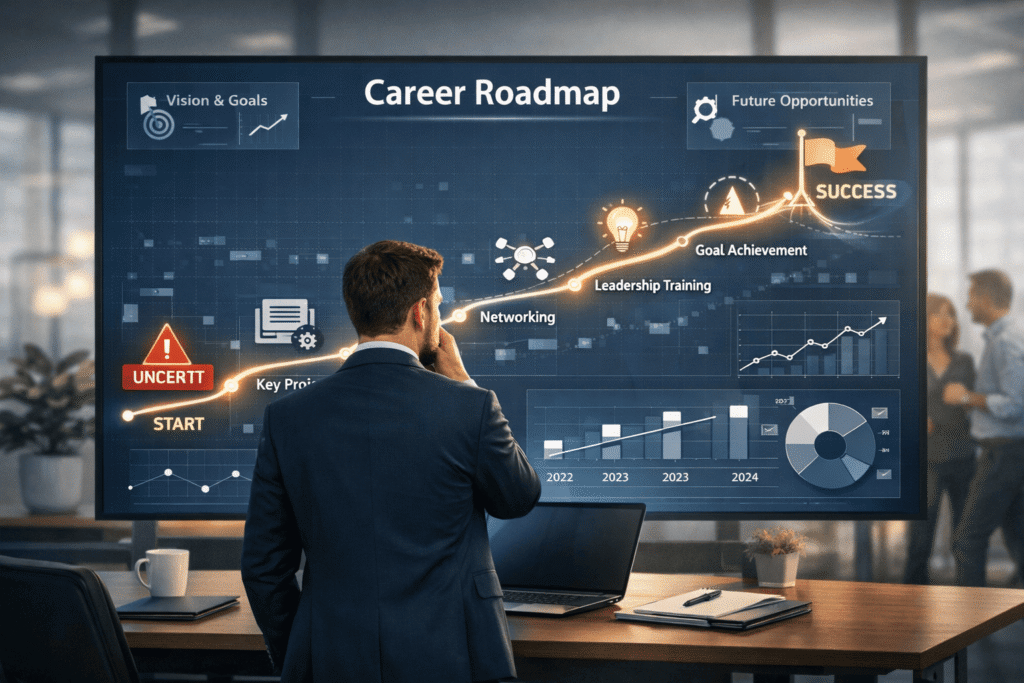
Strategic career growth requires a long-term perspective. Instead of focusing only on immediate tasks or short-term goals, professionals need to think about where they want to be in the future and how to get there.
This involves setting clear goals, identifying skill gaps, and continuously adapting to changes in the industry. It also requires flexibility, as career paths are no longer linear.
A long-term strategy helps professionals make better decisions about opportunities, roles, and learning investments. It ensures that each step contributes to overall growth rather than short-term gains.
Key Points:
- Long-term planning provides direction and clarity
- Continuous learning supports future readiness
- Career paths are dynamic, not linear
- Strategic decisions lead to sustainable growth
Closing Reflection
Hard work will always be a valuable part of professional success—but on its own, it is no longer enough. In today’s evolving workplace, growth is driven by the ability to think strategically, align with business needs, and adapt to change.
Professionals who combine effort with direction create meaningful impact, build visibility, and position themselves for long-term success. Those who rely only on hard work risk staying busy without truly progressing.
The real shift is not about working less—it is about working with purpose.
In the end, career growth is not defined by how much you do, but by how effectively your work moves you forward.
References and Further Reading
- Harvard Business Review – Articles on strategic thinking and career growth: https://hbr.org
- McKinsey & Company – Insights on skills, leadership, and future of work: https://www.mckinsey.com
- World Economic Forum – Future of Jobs and evolving skills reports: https://www.weforum.org/reports
- MIT Sloan Management Review – Research on leadership and strategic decision-making: https://sloanreview.mit.edu