Introduction
Modern applications increasingly require real-time communication, immediate responsiveness, and the ability to process large volumes of data across distributed systems. Traditional request-response architectures—such as synchronous REST APIs—often struggle to support highly dynamic environments where systems must react instantly to events generated by users, services, or devices.
To address these limitations, many organizations adopt Event-Driven Architecture (EDA). In this model, applications communicate through events that signal state changes, allowing services to respond asynchronously without tight coupling between components.
Event-driven architecture is widely used in modern cloud platforms, streaming systems, microservices environments, and large-scale applications that demand real-time responsiveness.
Key Context: Why Real-Time Communication Matters
Real-time communication has become essential across many modern digital systems. Applications must react immediately to actions such as:
- Online purchases
- User notifications
- Financial transactions
- IoT device updates
- Streaming data analytics
Traditional synchronous models often require systems to wait for responses from multiple services before continuing execution. This creates latency, bottlenecks, and reduced scalability.
Event-driven architectures solve this challenge by enabling systems to react to events instead of continuously requesting data. Many large technology platforms rely heavily on event streaming and asynchronous messaging to manage high-throughput operations.
For example, distributed messaging platforms like Apache Kafka are designed specifically to process massive event streams in real time across large systems.
Supporting Source
https://kafka.apache.org/documentation/
Section 1: Understanding Event-Driven Architecture
Explanation
At its core, event-driven architecture is built around events—messages that indicate something has happened within a system.
An event might represent:
- A user placing an order
- A payment confirmation
- A file upload
- A sensor reading from an IoT device
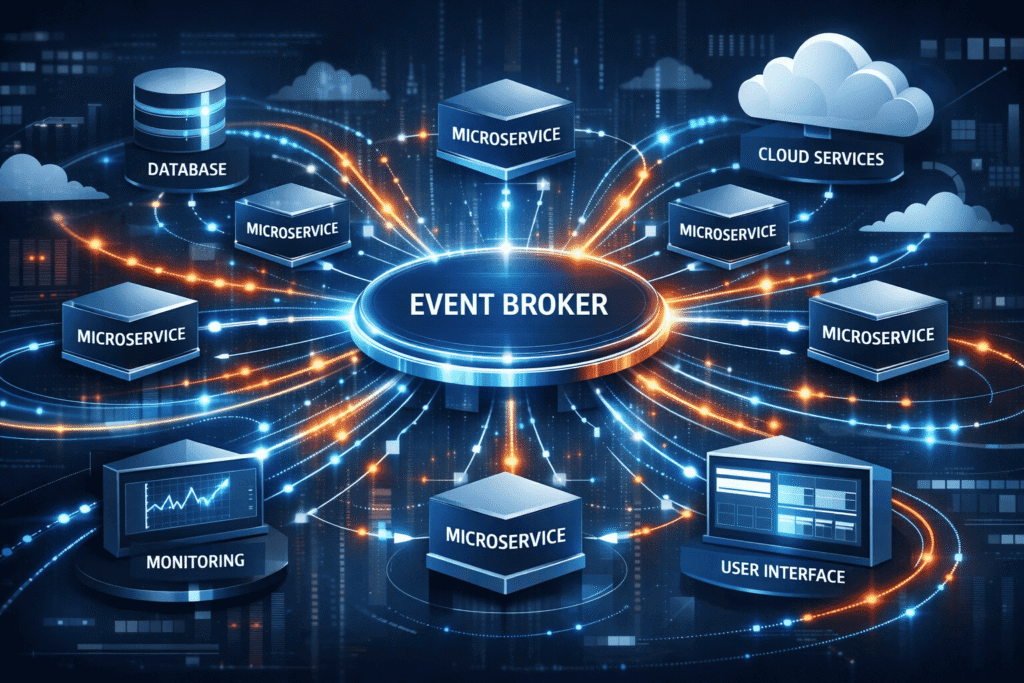
When an event occurs, it is sent to an event broker or message system, which distributes the event to services that are interested in reacting to it.
Key components of EDA include:
Event Producer
The service or system that generates the event.
Event Broker / Message Queue
The infrastructure responsible for distributing events.
Event Consumers
Services that listen for specific events and trigger actions when they occur.
Common event brokers include:
- Apache Kafka
- RabbitMQ
- Amazon EventBridge
These tools allow systems to process millions of events without direct service-to-service communication.
Supporting Sources
Apache Kafka Documentation
https://kafka.apache.org/documentation/
RabbitMQ Overview
https://www.rabbitmq.com/
Amazon EventBridge Documentation
https://docs.aws.amazon.com/eventbridge/
Section 2: How Event-Driven Systems Work
Explanation
In event-driven systems, applications operate through asynchronous communication rather than direct requests.
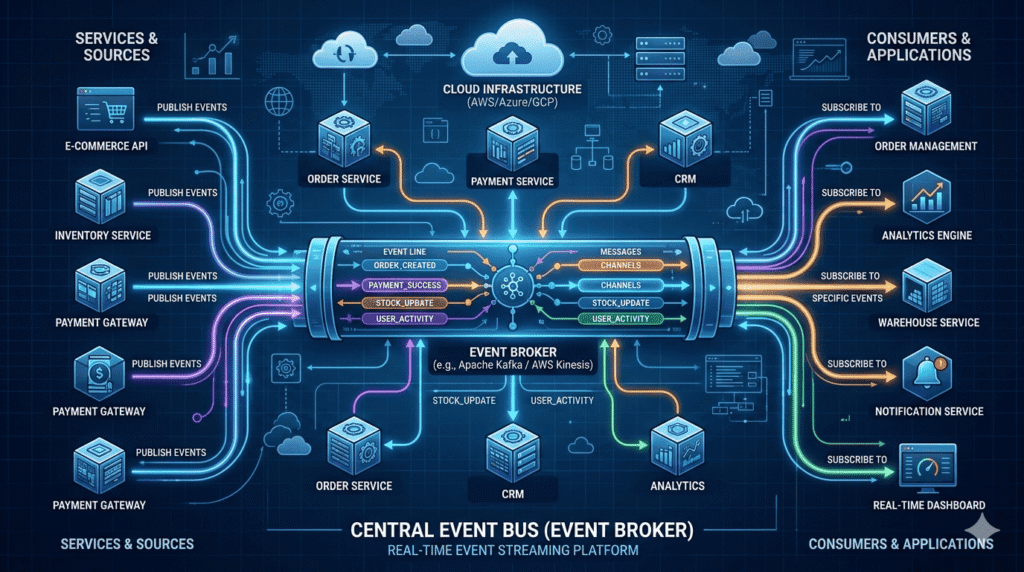
The workflow typically follows these steps:
- A system action occurs (for example, a user completes a purchase).
- The application generates an event (OrderCreated).
- The event is published to a broker.
- Multiple services subscribe to the event.
- Each service processes the event independently.
For instance:
An OrderCreated event may trigger:
- Payment processing
- Inventory updates
- Shipping service notifications
- Email confirmations
Each service reacts independently without needing direct integration with the others.
This decoupled model improves:
- scalability
- fault tolerance
- system flexibility
Many event-driven environments are also built on distributed application frameworks such as Kubernetes, which help manage scalable microservices infrastructures.
Supporting Source
Kubernetes Documentation
https://kubernetes.io/docs/
Section 3: Benefits of Event-Driven Architecture
Explanation
Event-driven architecture offers several advantages for modern software development.
1. Loose Coupling
Services do not need direct knowledge of each other. They simply react to events, which reduces system complexity and dependency chains.
2. Scalability
Event brokers allow systems to handle large volumes of events by distributing workloads across multiple consumers.
3. Real-Time Processing
Applications can react instantly to new data without polling or waiting for synchronous responses.
4. Fault Isolation
If one service fails, other services can continue processing events independently.
5. System Flexibility
New services can subscribe to existing events without modifying existing systems.
These properties make EDA especially valuable in cloud-native applications and microservices environments.
Supporting Source
Martin Fowler – Event-Driven Architecture Overview
https://martinfowler.com/articles/201701-event-driven.html
Section 4: Real-World Use Case Example
Example Case Study
Large streaming platforms rely heavily on event-driven architectures to process user interactions in real time.
For example, Netflix uses event-driven systems to manage user actions such as:
- viewing activity
- recommendation updates
- playback tracking
- system monitoring
When a user watches a show:
- A viewing event is generated.
- The event is sent to an event pipeline.
- Multiple services process the event:
- analytics systems
- recommendation engines
- monitoring dashboards
This architecture allows Netflix to process billions of events per day while maintaining system scalability.
Supporting Source
Netflix Technology Blog
https://netflixtechblog.com/
Section 5: Challenges of Event-Driven Systems
Explanation
Despite its advantages, event-driven architecture introduces new design challenges.
Event Ordering
In distributed systems, events may arrive out of sequence, which can affect data consistency.
Debugging Complexity
Because services operate asynchronously, tracing issues across multiple event streams can be difficult.
Event Schema Management
Changes to event formats must be carefully managed to avoid breaking consumer services.
Tools such as schema registries in platforms like Apache Kafka help manage event format evolution safely.
Supporting Source
Kafka Schema Management Documentation
https://docs.confluent.io/platform/current/schema-registry/
Conclusion
Event-driven architecture has become a fundamental design pattern for modern applications that require real-time responsiveness, scalability, and flexible system integration.
By allowing services to communicate through asynchronous events rather than direct requests, EDA reduces system coupling and enables applications to process large volumes of data efficiently.
As organizations increasingly adopt microservices, cloud-native platforms, and real-time analytics, event-driven architecture will continue to play a central role in how distributed systems communicate and scale.
Understanding how events flow through a system—and how services react to them—helps developers build more resilient and responsive modern applications.
References & Further Reading
Apache Kafka Documentation
https://kafka.apache.org/documentation/
RabbitMQ Documentation
https://www.rabbitmq.com/
Amazon EventBridge Documentation
https://docs.aws.amazon.com/eventbridge/
Martin Fowler – Event-Driven Architecture
https://martinfowler.com/articles/201701-event-driven.html
Kubernetes Documentation
https://kubernetes.io/docs/
Netflix Technology Blog
https://netflixtechblog.com/
Confluent Schema Registry Documentation
https://docs.confluent.io/platform/current/schema-registry/