Search is changing.
For years, website visibility meant optimizing for traditional search engines — primarily Google — using tools like robots.txt, sitemap.xml, structured data, and SEO plugins.
But today, AI systems are increasingly summarizing, referencing, and interpreting web content directly. Tools like ChatGPT (with browsing), Perplexity, Bing AI, and other large language model (LLM)–powered systems are shifting how users discover information.
This shift raises a new question for website owners:
What is LLMs.txt — and should WordPress sites create one?
Let’s break it down clearly and practically.
What Is LLMs.txt?
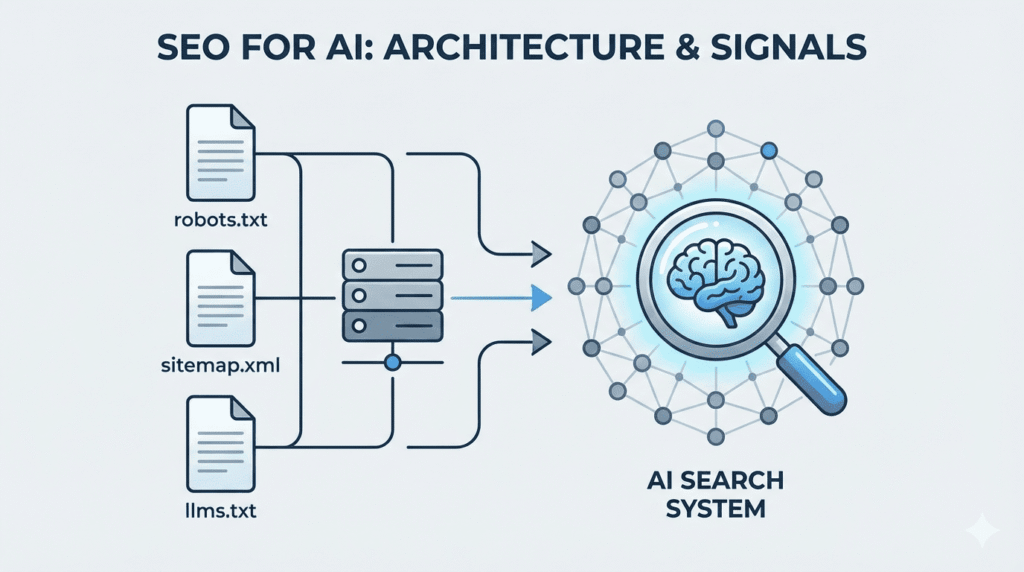
LLMs.txt is an emerging concept — similar in spirit to robots.txt — designed to communicate with large language models (LLMs) about how a website’s content may be accessed, summarized, or cited.
It is not currently an official web standard like robots.txt or sitemap.xml. There is no formal W3C specification governing it. However, the idea is gaining attention in AI and SEO communities as site owners seek clarity and control over AI-based content usage.
Conceptually, an llms.txt file may:
- Indicate whether AI systems can use your content
- Provide guidance on attribution
- Specify citation preferences
- Clarify restrictions on automated summarization
- Point to structured resources
It functions as a signal — not a ranking factor.
That distinction matters.
Why Is LLMs.txt Being Discussed Now?
AI-powered search experiences differ from traditional search engines.
Instead of returning a list of links, AI systems often:
- Summarize content
- Provide synthesized answers
- Cite multiple sources in a single response
- Extract contextual meaning
This changes how websites are surfaced.
Traditional SEO focuses on:
- Crawling
- Indexing
- Ranking
AI search focuses more on:
- Context
- Authority
- Structure
- Clarity
- Content depth
LLMs.txt emerges from this shift — as a possible mechanism for signaling preferences to AI systems.
Does LLMs.txt Affect Search Rankings?
Currently, there is no evidence that an LLMs.txt file directly improves rankings in Google Search or other traditional engines.
Even for AI systems:
- There is no confirmed requirement
- No official ranking documentation
- No guarantee of visibility
AI discoverability depends far more on:
- Content quality
- Structured data (Schema.org)
- Clear HTML structure
- Crawl accessibility
- Page authority
- Reputable citations
LLMs.txt is supplementary — not foundational.
Why WordPress Site Owners Are Interested
WordPress powers over 40% of the web. Naturally, WordPress users are looking for ways to prepare for AI-driven search changes.
The motivations typically include:
- Wanting AI systems to cite their content properly
- Attempting to control content usage
- Staying ahead of SEO trends
- Protecting intellectual property
- Signaling authority
However, creating an LLMs.txt file should be part of a broader AI-readiness strategy — not a standalone tactic.
How to Create an LLMs.txt File in WordPress
There are currently two practical approaches.
Option 1: Create It Manually
If you prefer manual control:
- Access your site’s root directory (via cPanel or FTP).
- Create a file named:
llms.txt - Add structured instructions.
Example (simple illustrative format):
# LLM Usage Policy

User-agent: *
Allow: /

Attribution: Required
Preferred-Citation: https://yourwebsite.com
Contact: admin@yourwebsite.com
This is not a standardized format — but mirrors robots.txt structure for clarity.
After uploading, the file should be accessible at:
https://yourwebsite.com/llms.txt
Keep in mind:
There is no universal parser or enforcement mechanism yet.
Option 2: Through WordPress SEO Plugins
Major SEO plugins like:
- Yoast SEO (https://yoast.com)
- Rank Math (https://rankmath.com)
- All in One SEO (https://aioseo.com)
Currently focus on:
- robots.txt management
- XML sitemaps
- Schema markup
- Metadata optimization
As of now, most do not officially generate LLMs.txt automatically. However, many allow:
- Custom robots.txt editing
- File creation via file manager
- Advanced SEO configuration
If plugins eventually add LLM-specific features, they will likely integrate into their technical SEO panels.
Until then, manual creation remains the most direct approach.
Short vs Long LLMs.txt — Does Length Matter?
This is where clarity is critical.
A longer LLMs.txt file does not automatically improve AI visibility.
AI systems primarily rely on:
- Publicly crawlable content
- Content structure
- Authority signals
- Semantic clarity
- High-quality linking
A long, complex LLMs.txt file does not compensate for weak content.
In fact:
- Overly detailed instructions may be ignored.
- Unclear policies may create ambiguity.
- Verbosity does not equal influence.
Clarity matters more than length.
If used, LLMs.txt should be concise, structured, and intentional.
What Matters More Than LLMs.txt in the AI Era
If your goal is better visibility in AI-powered search, prioritize:
1. Structured Data
Use Schema.org markup properly.
https://schema.org
2. Clear Author Signals
Author pages, expertise, and transparent profiles improve credibility.
3. Content Depth
AI systems favor comprehensive, well-structured content.
4. Internal Linking
Logical architecture improves content discoverability.
5. Technical Performance
Fast, mobile-friendly sites remain critical.
https://developers.google.com/search/docs
6. Crawl Accessibility
Ensure robots.txt and sitemaps are properly configured.
These factors carry significantly more weight than the presence of an experimental LLMs.txt file.
Preparing WordPress for AI Search — The Practical Strategy
Instead of focusing solely on LLMs.txt, WordPress site owners should:
- Maintain strong SEO fundamentals
- Optimize structured data
- Write content for clarity and context
- Improve internal knowledge architecture
- Monitor emerging AI guidelines from major platforms
If you create an LLMs.txt file, treat it as a signal of intent — not a shortcut to visibility.
Closing Insight: AI Search Rewards Structure, Not Shortcuts
LLMs.txt represents a broader shift in how website owners think about AI interaction.
But the future of discoverability won’t be defined by a single configuration file.
It will be defined by:
- High-quality content
- Transparent authorship
- Clear system architecture
- Structured semantic signals
WordPress sites that focus on fundamentals — while staying informed about emerging standards like LLMs.txt — will be better prepared for the evolving AI search landscape.
AI is changing how content is discovered.
But the principles of clarity, structure, and credibility still win.
References & Further Reading
- Google Search Central Documentation
https://developers.google.com/search/docs - Schema.org Structured Data
https://schema.org - OpenAI Platform Documentation
https://platform.openai.com/docs - Yoast SEO Official Website
https://yoast.com - Rank Math SEO Plugin
https://rankmath.com - All in One SEO Plugin
https://aioseo.com - Perplexity AI (AI-powered search example)
https://www.perplexity.ai