
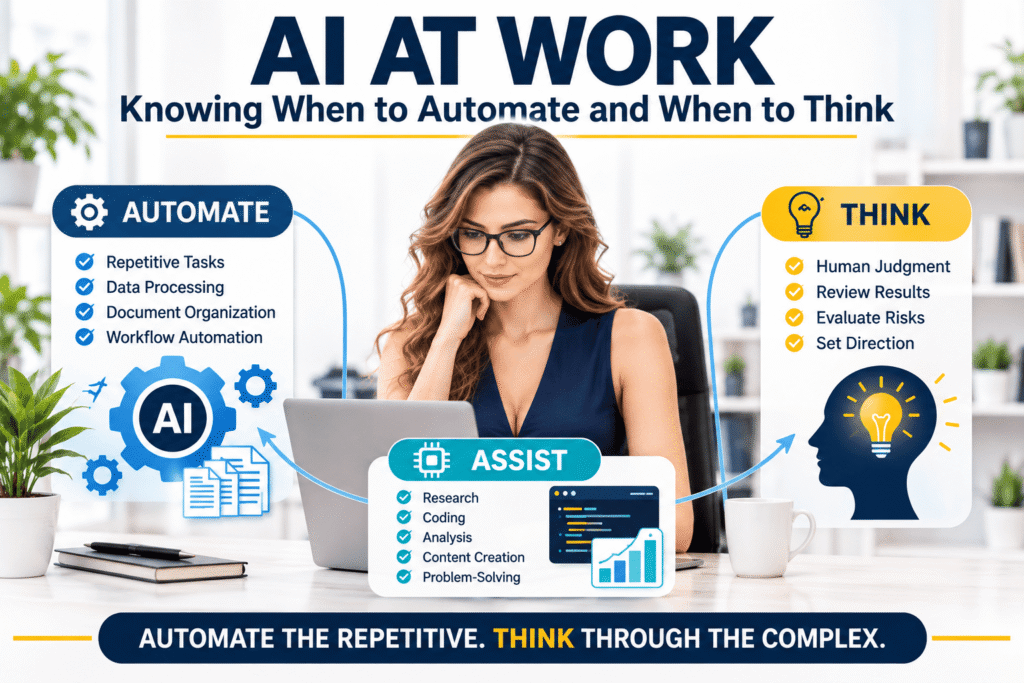
Artificial intelligence is changing how we work. It can draft content, summarize information, analyze data, generate code, support research, and automate repetitive tasks. But using AI effectively is not about automating everything. It is about recognizing which tasks benefit from automation and which still require human thinking, experience, and responsibility.
The real opportunity is to use AI to reduce unnecessary effort without removing the judgment that makes work valuable.
A useful principle is:
AUTOMATE REPETITIVE WORK. USE AI TO ASSIST COMPLEX WORK. KEEP HUMAN JUDGMENT IN IMPORTANT DECISIONS.
This distinction matters across software development, business operations, content creation, technical SEO, and Generative Engine Optimization (GEO).
1. Understand What Should Be Automated
Automation is most useful when a task follows a predictable process, has clear inputs and outputs, and can be checked against defined expectations.
For example, AI and automation can help with:
- Organizing information from documents.
- Creating initial drafts of emails and reports.
- Summarizing meeting notes.
- Categorizing support requests.
- Generating repetitive code patterns.
- Preparing content outlines.
- Identifying missing fields in structured data.
- Running scheduled checks and generating reports.
Consider a WordPress website with hundreds of published articles. Manually checking every page for missing metadata can take considerable time.
An automated process could inspect titles, descriptions, headings, image alt attributes, and other technical elements, then generate a report of potential problems.
However, identifying an issue and deciding how to fix it are different responsibilities.
A missing meta description may require a new description. An existing description may simply need improvement. Automatically replacing every description without considering page intent could make the website worse.
Automate the inspection. Review the recommendation. Approve the change.
2. Know When AI Should Assist Rather Than Decide
Not every task has a predictable answer.
Some work requires understanding business objectives, technical dependencies, user expectations, security implications, or information that may not be available to an AI system.
In these situations, AI should support the thinking process rather than independently make the final decision.
For example, during software development, AI can:
- Explain unfamiliar code.
- Suggest possible solutions.
- Compare implementation approaches.
- Identify potential edge cases.
- Generate test cases.
- Review code for common problems.
But developers must still determine whether the proposed solution fits the existing architecture, protects user data, handles errors correctly, and remains maintainable.
The same principle applies to business decisions.
AI can summarize market research, compare options, and identify patterns. It cannot automatically understand every organizational constraint, customer relationship, or long-term consequence.
Before delegating a task, ask:
- Does this task require contextual understanding?
- Could an incorrect result cause financial, technical, or reputational damage?
- Can the output be independently verified?
- Who is responsible if the recommendation is wrong?
If the consequences are significant, human approval should remain part of the workflow.
3. Apply the Same Thinking to AI SEO and GEO
Search optimization is another area where AI can save time, but excessive automation can damage the quality of a website.
AI can assist with keyword research, search-intent analysis, content outlines, metadata suggestions, topic clustering, internal-link recommendations, and content audits.
It can also help identify questions that users may ask when researching a product, service, or technical problem.
For GEO, these capabilities can support the process of making website information clearer and easier for search engines and AI-powered discovery systems to interpret.
However, AI SEO and GEO should not become exercises in producing more content or adding unnecessary optimization elements.
What to automate in SEO and GEO
Consider automating repeatable activities such as:
- Checking missing or duplicated title tags and meta descriptions.
- Identifying broken internal links.
- Detecting missing image alt attributes.
- Generating initial schema markup drafts.
- Auditing heading structures.
- Organizing keyword and topic research.
- Identifying outdated content for review.
- Monitoring technical SEO issues.
- Preparing reports from available search-performance data.
These tasks have identifiable patterns and can often be checked systematically.
Where human thinking matters
Human judgment becomes especially important when:
- Selecting the primary search intent for an article.
- Deciding whether a topic deserves a new page or an update.
- Evaluating whether content provides original value.
- Verifying facts, technical claims, and recommendations.
- Determining whether structured data accurately represents visible content.
- Assessing whether an internal link genuinely helps readers.
- Deciding whether an SEO recommendation supports business objectives.
For example, AI may suggest creating five articles around closely related keywords. But a human reviewer should consider whether these topics deserve separate articles or whether they would create unnecessary content duplication.
More published pages do not automatically mean better search visibility.
Practical GEO recommendations
For websites seeking visibility across traditional and AI-powered search experiences, focus on the foundations:
- Publish useful, original information: Include practical examples, firsthand observations, technical explanations, and insights that go beyond generic summaries.
- Structure information clearly: Use descriptive headings, meaningful paragraphs, direct explanations, and logical relationships between topics.
- Strengthen technical accessibility: Make important content crawlable, indexable, accessible, and available in a useful textual form.
- Maintain accurate structured data: Use relevant Schema.org types and ensure markup reflects the actual visible content. Validate generated JSON-LD before implementation.
- Build meaningful internal links: Connect related articles, products, services, and resources so users and search systems can understand their relationships.
- Keep important information current: Review outdated claims, product details, documentation, and technical instructions rather than automatically changing publication dates.
- Measure what can be observed: Use Search Console, analytics, server logs, and available AI-search reporting to understand performance. Do not assume that a crawler request or an
llms.txtfile guarantees AI visibility.
Google’s current guidance emphasizes that foundational SEO practices remain relevant to its generative AI search features. It also prioritizes unique, helpful content over GEO shortcuts and unnecessary optimization tactics.
The objective should be to make information genuinely useful and understandable, not simply to make it appear optimized for an AI system.
4. Build a Human-Controlled AI Workflow
Effective AI adoption needs more than choosing a tool. It requires defining responsibilities, review points, and limits.
A practical workflow can look like this:
IDENTIFY → CLASSIFY → AUTOMATE → REVIEW → VERIFY → IMPROVE
- Identify: Understand the task and the problem it should solve.
- Classify: Decide whether the task is suitable for automation, AI assistance, or human decision-making.
- Automate: Let AI handle repetitive and clearly defined work.
- Review: Examine outputs that require contextual or professional judgment.
- Verify: Test results against actual requirements and reliable evidence.
- Improve: Adjust prompts, workflows, permissions, and review procedures based on results.
For example, a content publishing workflow might use AI to prepare an article outline, suggest metadata, and identify possible internal links.
The writer still verifies the information, adds original insight, reviews the search intent, and approves the final article before publication.
Similarly, a development workflow can use AI to generate an initial implementation, while the developer reviews the architecture, checks security, runs tests, and approves deployment.
This approach also connects with the principles discussed in my article on AI-assisted development.
5. What We Should Not Automate Blindly
Automation becomes risky when it operates without sufficient context, verification, or clear responsibility.
Avoid these common mistakes:
- Publishing AI-generated content without review: Incorrect information, generic explanations, and unsupported claims can damage trust.
- Making production changes without testing: Generated code, plugin updates, and configuration changes can introduce unexpected problems.
- Automating sensitive decisions: Financial, legal, security, and other high-impact decisions need appropriate human oversight.
- Sharing confidential information carelessly: Review data-handling policies before submitting customer records, credentials, private documents, or business information to AI tools.
- Allowing unlimited permissions: AI agents and automation workflows should have only the access required for their assigned tasks.
- Confusing activity with productivity: Generating more reports, content, or code does not necessarily mean better results.
- Ignoring failures: Automation should have error handling, logging, monitoring, and a way to stop or escalate unexpected situations.
A workflow that saves ten minutes but creates an hour of correction work is not an improvement.
Responsible automation must consider reliability, security, maintenance, and the cost of mistakes—not just speed.
6. A Simple Test Before Automating Any Task
Before introducing AI into a workflow, evaluate the task using five questions:
1. Is it repetitive?
If the same process happens regularly, automation may be worthwhile.
2. Are the inputs and expected outputs clear?
Unclear requirements make automation difficult to verify.
3. Can the result be checked?
There should be a practical way to identify incorrect or incomplete outputs.
4. What happens if it fails?
Consider the financial, technical, operational, and reputational consequences.
5. Who remains responsible?
Every important workflow needs an accountable person who can review, approve, correct, or stop the process.
If the task is repetitive, predictable, low-risk, and verifiable, automation is a strong candidate.
If it requires interpretation, use AI as an assistant.
If it involves significant consequences, keep meaningful human oversight.
Final Thoughts
AI should not make us less thoughtful. It should give us more time to focus on the work that requires our attention, experience, and creativity.
The objective is not to automate every possible activity. It is to identify where automation creates genuine value and where human judgment protects the quality of the result.
For developers, that means understanding the system before accepting generated code. For content creators, it means adding original value rather than publishing generic AI output. For SEO professionals, it means improving the website and its information instead of chasing every new optimization trend.
The same principle applies to almost every profession.
AUTOMATE THE REPETITIVE.
THINK THROUGH THE COMPLEX.
VERIFY WHAT MATTERS.
AI can help us work more efficiently, but we remain responsible for the quality of the work we deliver.
About the Author
Mirza Hadi Baig is a Full-Stack Web Developer, Technical Problem Solver, AI SEO & GEO Strategist, and Product Builder with 17+ years of experience in the technology industry. His professional journey spans IT education, healthcare IT and administrative information systems, WordPress and WooCommerce development, technical troubleshooting, and independent digital product building.
His work explores practical applications of AI in software development, technical SEO, structured data, and emerging AI-search technologies. He builds digital tools and WordPress solutions while emphasizing accuracy, security, maintainability, and the importance of human judgment in technology-driven work.
Through DCX Herald, he shares practical insights on development, AI adoption, search optimization, and continuous technology learning.