
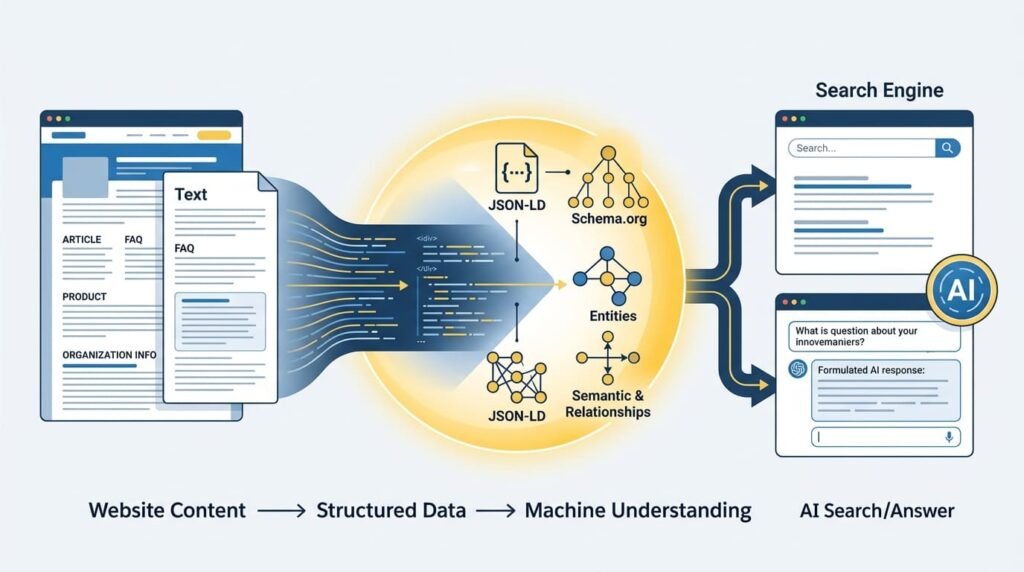
Structured data has been part of modern SEO for years. Website owners have used Schema.org markup to help search engines understand pages, products, articles, organizations, events, reviews, and other entities.
But search is changing.
Users are increasingly asking AI systems questions instead of simply entering keywords into a traditional search box. That raises an important question:
Does structured data still matter when AI systems are understanding and answering queries?
Yes—but probably not for the reason many website owners think.
Structured data is not a magic button for appearing in AI-generated answers. Its real value is helping machines understand what a page and its content represent.
What Is Structured Data?
Structured data is machine-readable information added to a webpage to describe its meaning.
For example, a page might contain information about:
- An article
- A person
- An organization
- A product
- A service
- An event
- A review
- A FAQ
- A webpage
The most common implementation for modern websites is JSON-LD.
Think of the difference this way:
Visible content:
“Mirza Hadi Baig is a Full-Stack WordPress Developer.”
Structured information:
This page describes a Person, whose name is Mirza Hadi Baig, with a particular professional identity.
The first is written primarily for humans.
The second gives machines additional semantic context.
Why Does Structured Data Matter for AI Search?
AI search systems need to interpret information, connect concepts, identify entities, and determine relationships between pieces of information.
Clear structure can help provide those signals.
Consider a website containing:
John Smith
Without additional context, a machine may need to determine whether John Smith is:
- An author
- A company founder
- A customer
- An employee
- A fictional character
Structured data can explicitly describe the entity and its relationship to the page.
This is where structured data fits into AI SEO and Generative Engine Optimization (GEO).
It doesn’t guarantee that an AI system will cite your website.
Instead, it can contribute to a clearer machine-readable representation of your content and entities.
Structured Data Is Not an AI Ranking Shortcut
This distinction is important.
You may see claims such as:
“Add Schema and AI will rank your website.”
That’s far too simplistic.
Structured data does not guarantee:
- AI citations
- AI Overview visibility
- Chatbot recommendations
- Higher traditional rankings
- Inclusion in every search feature
AI systems use multiple signals and sources to understand information.
Your underlying content still matters.
Good content + clear entities + useful information + technical accessibility + appropriate structured data
is a much more realistic model.
Structured Data and GEO Work Together
GEO focuses on making content easier for generative search systems to understand, retrieve, summarize, and potentially cite.
Structured data can support that objective by adding semantic context.
For example, an article might clearly communicate:
Topic: AI SEO
Author: Mirza Hadi
Publisher: Website/Organization
Date Published: Specific date
Date Modified: Specific date
Main Entity: Article
Related Entities: AI search, structured data, SEO
The visible article provides the information.
Structured data provides another machine-readable representation of important relationships.
This is why I see structured data as one component of an AI-search-ready website, rather than a replacement for content optimization.
Your Content Still Comes First
One of the biggest mistakes website owners can make is focusing heavily on Schema while neglecting the actual content.
AI-search-friendly content should answer real questions clearly.
Instead of writing:
“Structured data is important for SEO.”
A stronger passage might answer:
What does structured data do for AI search?
Structured data provides machine-readable information about the entities and relationships represented on a webpage. It can help search systems interpret content more clearly, although it does not guarantee AI citations or visibility.
Notice the difference.
The second version gives a direct answer to a specific question.
That matters for both users and AI retrieval.
Think Beyond Keywords: Think Entities and Relationships
Traditional SEO often emphasizes keywords.
AI search increasingly requires thinking about meaning and relationships.
For example:
Website
→ publishes → Article
→ written by → Person
→ discusses → AI SEO
→ references → Structured Data
→ belongs to → Organization
Structured data can help express some of these relationships explicitly.
This doesn’t mean every possible relationship should be marked up.
It means website owners should use structured data accurately and where it genuinely represents the content.
What Website Owners Should Actually Implement
You don’t need to add every Schema type available.
Start with the markup that accurately describes your website.
Common examples include:
Article
For articles, blog posts, and similar editorial content.
Person
Useful for establishing an author’s identity and professional context.
Organization
Helps describe the business, publisher, or organization behind a website.
WebPage
Describes the page itself and its relationship to the broader website.
BreadcrumbList
Helps describe the site’s navigational hierarchy.
Product
For genuine product pages.
LocalBusiness
For eligible local businesses.
Event
For genuine events.
The principle is simple:
Don’t add Schema because it exists. Add it because it describes something that actually exists on the page.
What About FAQ Schema?
FAQs are particularly interesting in the AI-search era.
Even when a search engine doesn’t display FAQ rich results in the way website owners once expected, clearly written questions and answers can still make content easier for humans to scan and potentially easier for automated systems to interpret.
The important distinction is:
FAQ content is useful because it answers real questions.
Schema is a structured representation of that content.
Don’t create artificial FAQs simply to add more markup.
Instead, identify genuine questions your audience asks and provide concise, accurate answers.
Google may no longer show FAQ rich results, but FAQ structured data can still describe question-and-answer content in a machine-readable format, making it useful beyond Google’s traditional search features—including potential AI and other structured-data applications.
Don’t Put Structured Data in a Separate SEO Bubble
Structured data works best as part of a larger technical and content strategy.
A practical AI-search workflow might look like:
Research
↓
Write for real questions
↓
Analyze content
↓
Improve clarity and completeness
↓
Add appropriate structured data
↓
Validate
↓
Publish
↓
Monitor
This is much more sustainable than treating Schema as a standalone SEO trick.
A Practical Example
Imagine you publish an article titled:
“How AI Search Changes Website Optimization.”
Your visible content should clearly explain:
- What AI search is
- How it differs from traditional search
- What website owners should change
- Common optimization problems
- Practical solutions
- Frequently asked questions
Then structured data can describe the page as an Article, identify its author and publisher, provide publication information, and connect appropriate entities.
The two layers complement each other:
Content explains the subject.
Structured data describes the content.
That distinction is easy to overlook.
Where My Own Tools Fit Into This Workflow
I’ve built tools around this same practical problem: making technical SEO and AI-search preparation easier without forcing website owners to manually manage everything.
Schema Genie Pro is my WordPress plugin for generating and managing structured data, allowing website owners to create Schema markup without manually editing theme files or repeatedly handling JSON-LD code.
I also developed Geoscope Content Analyzer, a web-based tool designed to analyze content across traditional SEO, AI SEO, GEO, readability, keyword usage, and related content signals before publication.
The two solve different parts of the workflow:
Analyze the content → Improve it → Structure the information → Validate → Publish
That separation matters.
You shouldn’t expect Schema to fix weak content, and you shouldn’t expect content optimization alone to replace sound technical implementation.
The Bigger Picture: AI Search Needs Understandable Websites
AI search doesn’t eliminate technical SEO.
It changes what technical SEO needs to accomplish.
A modern website needs to be understandable to:
People
Search engines
AI systems
Other machine-readable systems
That means website owners should think beyond:
“How do I rank for this keyword?”
and increasingly ask:
“Can machines clearly understand what this page is, who created it, what it is about, and how its information relates to other entities?”
Structured data can contribute to that understanding.
But it is only one piece of the puzzle.
Final Thought
Structured data isn’t a secret doorway into AI search.
It is better understood as semantic infrastructure for the web.
Your content tells the story.
Your page structure organizes it.
Structured data adds machine-readable meaning.
Technical accessibility allows systems to reach it.
And strong, useful content gives AI systems something worth understanding and potentially citing.
So don’t add Schema simply because someone says:
“AI needs Schema.”
Add it because your website contains information that can be described clearly and accurately.
The future of search isn’t only about being found. It’s about being understood.
Frequently Asked Questions
Does structured data help with AI search?
Structured data can provide machine-readable context about webpages, entities, and relationships. It may support machine understanding, but it does not guarantee AI-search visibility or citations.
Is Schema markup still useful for SEO?
Yes. Structured data remains useful for helping search engines understand page content and can support eligible search features. Its role should be viewed as part of broader technical SEO rather than a ranking shortcut.
Does structured data guarantee AI citations?
No. AI systems consider multiple signals and sources. Structured data alone cannot guarantee that a website will be cited in an AI-generated answer.
What Schema should a website owner use?
Use Schema types that accurately describe the content and entities on the page. Common types include Article, Person, Organization, WebPage, BreadcrumbList, Product, LocalBusiness, and Event where appropriate.
Should every webpage have Schema?
Not necessarily every page needs the same Schema. Structured data should accurately represent the page rather than being added simply to increase the amount of markup.
Is FAQ Schema still useful?
FAQ content can be valuable when it answers genuine user questions. FAQ Schema should accurately represent visible FAQ content, but website owners should not expect it to guarantee rich results or AI-search visibility.
What is the relationship between structured data and GEO?
GEO focuses on making content useful and understandable for generative search systems. Structured data can support GEO by providing additional machine-readable information about entities and relationships, but it is only one part of the strategy.
About the Author
Mirza Hadi Baig is a Full-Stack WordPress Developer | Technical Problem Solver | AI SEO & GEO Strategist focused on the intersection of web development, technical SEO, structured data, and AI search.
He explores how websites can become easier for both people and machines to understand while using AI to enhance development, content analysis, and digital workflows.
Mirza is also an AI enthusiast, continuous learner, and practical product builder who develops tools and WordPress solutions to solve real-world problems. His projects include Schema Genie Pro, built to simplify structured-data implementation and management, and HS3Dev AI Content Index for llms.txt, developed around emerging AI-oriented content discovery.
His approach is practical:
Build useful content. Structure information clearly. Use AI intelligently. Make the web easier to understand.