For years, website owners focused on one primary question:
Can search engines crawl and index my website?
That question still matters.
But the search environment is changing. AI-powered search and answer engines increasingly retrieve, interpret, summarize, and reference information from websites. This creates another practical question for website owners:
Is my website technically and semantically ready for AI-driven discovery?
Being ready for AI crawlers does not mean adding one special file or installing one AI plugin.
It means making sure your website can be discovered, accessed, understood, interpreted, and trusted by modern search and AI systems.
What Are AI Crawlers?
AI crawlers are automated systems used by AI companies and AI-powered services to access web content for purposes such as search, retrieval, training, or other AI-related applications.
However, it is important not to treat all AI crawlers as one standardized technology.
Different AI systems may use different crawlers, retrieval systems, search indexes, APIs, or combinations of these technologies.
That means there is no single checklist called:
“Make your website AI-crawler compatible.”
Instead, website owners should focus on the fundamentals that help machines access and understand content.
1. Can Crawlers Actually Access Your Content?
Before worrying about AI SEO or GEO, start with the technical basics.
A crawler cannot understand content it cannot access.
Check whether your website has:
- Accessible pages
- Proper HTTP responses
- No accidental crawler blocking
- Working internal links
- Correct canonical URLs
- A functional XML sitemap
- Reasonable server performance
- No unnecessary authentication barriers
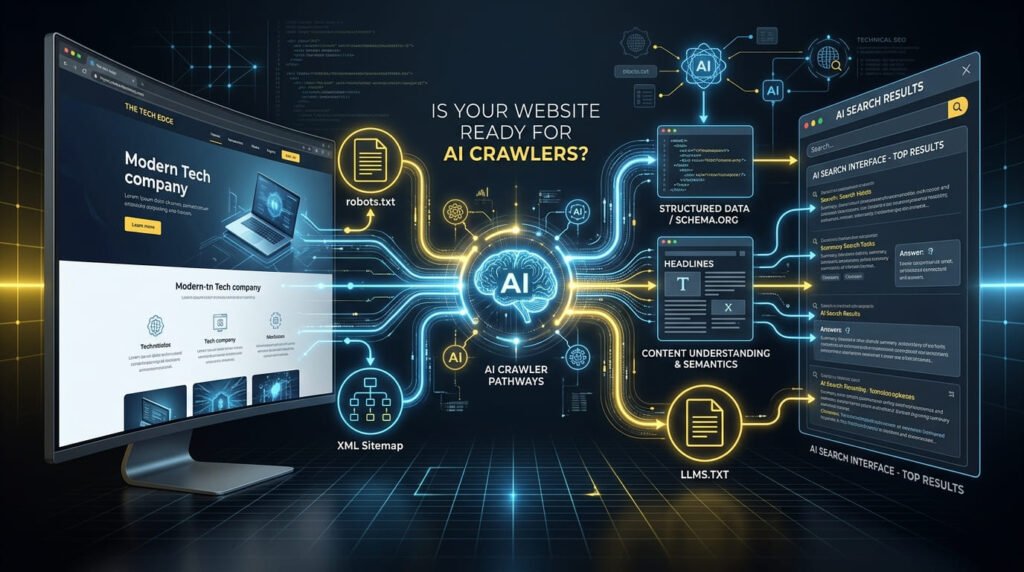
Your robots.txt file is particularly important because it can provide crawler access instructions.
But remember:
robots.txtcontrols crawler access guidance. It does not explain what your content means.
That is a different problem.
2. A Sitemap Helps With Discovery
An XML sitemap answers a relatively simple question:
“Which URLs are available on this website?”
It can help search systems discover important pages, especially on larger websites.
But a sitemap does not explain whether a page is useful, authoritative, accurate, or relevant to a particular question.
Think of the process this way:
Sitemap → URL discovery
Page content → Information
Structured data → Relationships and meaning
Internal links → Context and connections
Each plays a different role.
3. Your Content Needs to Be Understandable
A crawler may successfully retrieve your page and still struggle to understand what it is about.
This is where AI SEO and GEO become important.
AI-oriented systems need more than keywords.
They benefit from content that clearly communicates:
- What the page is about
- Who the information is for
- What problem it solves
- Important concepts and entities
- Relationships between topics
- Clear answers to relevant questions
- Supporting context
For example, instead of writing a vague paragraph about website performance, answer the actual question:
What makes a website slow?
Then explain the major causes, how they affect users, and what can be done about them.
This creates content that is easier to retrieve and interpret.
4. Write for Questions, Not Just Keywords
Traditional SEO often starts with:
Keyword → Page
AI search increasingly makes it useful to think in terms of:
Question → Answer → Context → Evidence
A strong AI-search-ready article should naturally answer questions such as:
- What is the problem?
- Why does it happen?
- Who is affected?
- What are the possible solutions?
- What are the limitations?
- When should someone use one approach instead of another?
This doesn’t mean stuffing dozens of questions into every article.
It means making the information explicit enough that both humans and machines can identify the answers.
5. Structured Data Helps Machines Understand Relationships
Structured data provides machine-readable information about a page and the entities it contains.
Depending on the page, this might include:
- Article
- Person
- Organization
- Product
- SoftwareApplication
- FAQ
- Breadcrumb
- WebPage
Structured data should accurately represent visible page content.
It should not be treated as a place to insert claims that visitors cannot actually see.
Think of structured data as an additional layer of meaning:
This is also why I built Schema Genie Pro, a WordPress schema-generation solution designed to simplify creating, implementing, managing, and testing structured data. Instead of treating schema as code that developers have to manually build and maintain, the goal is to make structured data more accessible to WordPress site owners while keeping it aligned with the content and purpose of the page.
HTML → Human-readable content
Structured data → Machine-readable relationships
Both should agree.
6. What About llms.txt?
This is where discussions about AI crawlers often become confusing.
llms.txt is an emerging proposal for providing an AI-oriented representation of important website resources.
It should not be treated as a replacement for:
- XML sitemaps
robots.txt- Good HTML
- Internal linking
- Structured data
- High-quality content
A useful way to remember the distinction is:
robots.txt → crawler access guidance
XML sitemap → URL discovery
Website content → information
Structured data → machine-readable meaning
llms.txt → an AI-oriented content/resource representation
The important point is that adding llms.txt cannot compensate for a website that is technically inaccessible or filled with poor content.
For WordPress site owners who want a practical way to manage this emerging layer, I developed HS3Dev AI Content Index for llms.txt, a WordPress solution designed to generate and manage an AI-oriented content index. The goal is not to replace XML sitemaps or traditional SEO practices, but to make it easier for site owners to organize important content for AI-oriented discovery.
7. AI-Ready Content Needs More Than Keywords
A page may rank for a keyword and still provide a weak answer for AI-powered search.
Why?
Because AI systems increasingly need to understand topics and relationships, not just keyword occurrences.
Consider an article about WordPress security.
A strong resource might naturally cover:
WordPress security → vulnerabilities → plugins → authentication → updates → permissions → backups → monitoring
This creates a connected topical structure.
For GEO, the goal should not be:
“How many times can I mention my keyword?”
It should be:
“How clearly can I explain the topic and answer the user’s underlying questions?”
8. Make Important Information Easy to Extract
AI systems work with content in ways that differ from traditional page visitors.
Make important information easy to identify through:
- Descriptive headings
- Short explanatory paragraphs
- Lists where appropriate
- Direct answers
- Definitions
- Examples
- Clear comparisons
- FAQs
- Consistent terminology
For example:
What is an AI crawler?
Then provide a concise definition before expanding into technical details.
This creates an answer-first structure that benefits both readers and AI-oriented retrieval.
9. Don’t Forget Trust and Human Quality
Technical accessibility doesn’t make content trustworthy.
AI systems—and the people using them—still benefit from content that demonstrates:
- First-hand experience
- Clear authorship
- Accurate information
- Relevant evidence
- Original insights
- Transparent limitations
- Regular updates
Avoid publishing large volumes of AI-generated content simply because AI makes production cheap.
More content does not automatically create more visibility.
Useful content creates value.
A Simple AI-Readiness Test
Before publishing, ask:
Discoverable?
Can search and crawler systems find the page?
Accessible?
Can they retrieve the content without unnecessary barriers?
Understandable?
Is the topic immediately clear?
Answerable?
Does the page directly answer important questions?
Structured?
Are important entities and relationships clearly represented?
Trustworthy?
Does the content demonstrate expertise, accuracy, and useful context?
Maintainable?
Will the information remain accurate as the topic changes?
If the answer is yes across these areas, your website is moving toward stronger AI-search readiness.
Final Thought
Being ready for AI crawlers isn’t about finding a secret technical switch.
It is about building a website that machines can discover and understand—and humans can trust and use.
Start with the fundamentals:
Crawlability → Discoverability → Content clarity → Structured data → Answer-focused content → Trust
Then consider emerging approaches such as llms.txt where they make sense for your website.
The future of search may involve more AI systems interpreting web content, but the fundamental principle remains remarkably familiar:
Build a technically accessible website with clear, useful, trustworthy information.
If your website does that well, you’re not just preparing for AI crawlers.
You’re building a better website for the web itself.
Frequently Asked Questions
How do I make my website ready for AI crawlers?
Start with crawlability, accessible content, XML sitemaps, internal linking, clear page structure, structured data, useful answers, and trustworthy content. Then evaluate emerging AI-oriented approaches such as llms.txt.
Does robots.txt control AI crawlers?
robots.txt can provide crawler access instructions, but different AI services may interpret or operate under their own systems and policies. It should not be considered a complete AI-search optimization strategy.
Is llms.txt required for AI SEO?
No. llms.txt is an emerging approach and should not be treated as a mandatory replacement for established technical SEO practices such as crawlable HTML, XML sitemaps, internal links, and structured data.
What is the difference between AI SEO and GEO?
AI SEO generally focuses on optimizing a website for discovery and visibility in AI-influenced search environments, while GEO—Generative Engine Optimization—focuses more specifically on making information useful and understandable for generative answer systems.
Does structured data help AI search?
Structured data provides machine-readable information about entities and relationships on a page. It can support machine understanding, although structured data alone does not guarantee visibility in AI search results.
Can AI crawlers understand poorly structured content?
They may be able to retrieve it, but unclear structure can make information harder to interpret and extract reliably. Clear headings, direct answers, context, and logical organization improve machine readability as well as human readability.
About the Author
Mirza Hadi Baig is a Full-Stack WordPress Developer | Technical Problem Solver | AI SEO & GEO Strategist focused on the intersection of web development, technical SEO, structured data, and AI-driven search.
He writes about WordPress, technical problem-solving, AI SEO, Generative Engine Optimization (GEO), structured data, and practical strategies for making websites more understandable to both search engines and emerging AI systems.
Beyond writing and consulting, Mirza is also a product builder who develops practical tools to solve real-world problems faced by website owners and developers. His projects include HS3Dev AI Content Index for llms.txt, developed to help WordPress websites manage AI-oriented content indexing, and Schema Genie Pro, developed to simplify the generation, implementation, management, and testing of structured data.
His approach is simple: don’t just identify a technical problem—build a practical solution for it.