PHP isn’t the newest programming language.
It isn’t the language dominating every developer conversation.
And it certainly isn’t the only way to build a modern web application.
Yet PHP remains deeply embedded in the web.
That raises an interesting question:
Why is PHP still so widely used when newer technologies have appeared?
The answer isn’t simply that developers are afraid to move on. PHP has survived because it evolved, built an enormous ecosystem, and continues to solve practical web-development problems.
PHP Was Built for the Web
One reason PHP has remained relevant is simple: it was designed around web development.
PHP made it relatively straightforward to generate dynamic HTML, interact with databases, process forms, manage sessions, and build server-side applications.
That simplicity helped create a huge ecosystem of:
- Websites
- Content management systems
- E-commerce platforms
- APIs
- Plugins
- Themes
- Frameworks
- Hosting environments
Once an ecosystem reaches this scale, replacing the underlying technology isn’t simply a matter of choosing a newer language.
There are applications to maintain, developers to support, businesses to migrate, and infrastructure to consider.
Technology adoption is about ecosystems—not just programming-language popularity.
WordPress Keeps PHP Highly Relevant
One of the biggest reasons PHP remains important is WordPress.
WordPress powers a significant portion of the web, and its core, themes, and plugins rely heavily on PHP.
That creates an enormous continuing demand for PHP knowledge.
A WordPress developer may work with:
- PHP functions
- Hooks and filters
- Custom post types
- REST APIs
- Database queries
- Plugin development
- Theme development
- Authentication and permissions
This means learning PHP isn’t simply learning an old language.
For WordPress developers, it means understanding part of the platform they are actually building on.
Modern PHP Isn’t the PHP of 20 Years Ago
Another common misconception is that PHP hasn’t changed.
It has.
Modern PHP has introduced significant improvements in areas such as:
- Type declarations
- Error handling
- Object-oriented programming
- Performance
- Syntax
- Anonymous functions and closures
- Attributes
- Enums
- Better developer tooling
Modern PHP development can look very different from the PHP code many developers encountered years ago.
This is an important lesson about technology:
A technology can be old without being outdated.
The age of a language tells you when it began—not whether it has continued evolving.
PHP has continued evolving to compete with modern development ecosystems—not only on the web, but increasingly across application platforms.
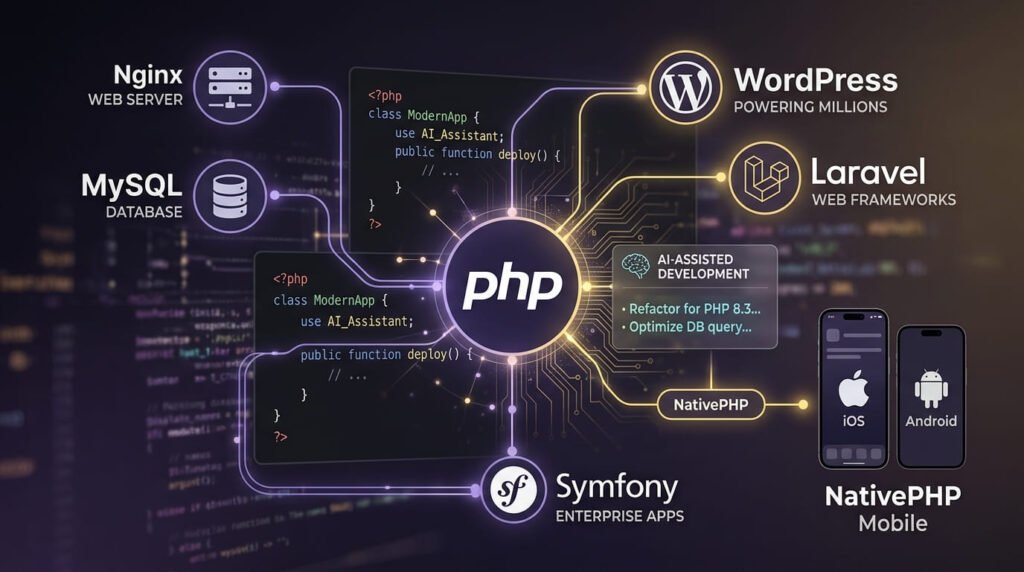
Frameworks such as Laravel and Symfony have helped modernize PHP development with structured approaches to application architecture, routing, APIs, databases, authentication, testing, and more. And the ecosystem is expanding beyond traditional server-side applications. NativePHP for Mobile now allows PHP and Laravel developers to build native iOS and Android applications, using an embedded PHP runtime and bridges to the native mobile platforms.
This is a good example of why it is too early to describe PHP as an outdated technology.
Its ecosystem continues to adapt to new development requirements, platforms, and workflows. Laravel, Symfony, NativePHP, and the wider PHP library ecosystem show that PHP is not simply maintaining its old position—it is finding new ways to remain useful. In an upcoming article, we’ll look more closely at PHP frameworks and libraries that continue to shape modern PHP development. Stay with us.
Why Businesses Don’t Simply Replace PHP
Replacing a technology isn’t free.
A company may have years of business logic, integrations, customer data, internal tools, APIs, plugins, and applications built around PHP.
The question isn’t:
“Is there a newer language?”
There almost certainly is.
The better question is:
“Does replacing the existing technology provide enough value to justify the cost and risk?”
Sometimes the answer is yes.
Often, modernization can happen incrementally instead.
Applications can be upgraded, refactored, containerized, integrated with new services, or connected to systems written in other languages.
Modern software doesn’t have to be built with one technology.
PHP in the AI-Assisted Development Era
AI has changed how developers write software.
A developer can now ask an AI assistant to:
- Generate a PHP function
- Explain unfamiliar PHP code
- Convert procedural code into an object-oriented approach
- Find potential bugs
- Write tests
- Refactor repetitive code
- Help troubleshoot an error
This makes PHP development faster.
But it doesn’t make PHP knowledge unnecessary.
If AI generates a function that interacts with a database, a developer still needs to understand:
What does the query do?
Is the input validated?
Could it create a security vulnerability?
Is the query efficient?
Will it work correctly at scale?
AI can generate the implementation.
The developer remains responsible for the implementation.
AI SEO and GEO Also Depend on the Underlying Web
There is another reason developers shouldn’t look at PHP as irrelevant in the AI era.
AI search, traditional SEO, and GEO ultimately depend on websites being technically accessible and understandable.
A content strategy can be excellent, but the website still needs to deliver that content effectively.
Developers may need to consider:
- Server-side rendering
- Page performance
- Crawlability
- HTML structure
- Structured data
- Internal linking
- Accessibility
- Content delivery
- Technical errors
AI can help generate code for these tasks.
But generating code isn’t the same as implementing a technically sound solution.
AI SEO still depends on good web engineering.
Is PHP Still Worth Learning?
For someone interested in WordPress, server-side web development, or maintaining existing PHP applications, the answer can still be yes.
You don’t necessarily need to become a PHP language expert before using AI.
But you should understand the fundamentals:
- Variables and data types
- Conditions and loops
- Functions
- Arrays
- Objects and classes
- Error handling
- Database interaction
- Security principles
- WordPress hooks and APIs
That knowledge gives you something AI cannot replace:
the ability to evaluate what it produces.
The Real Reason PHP Survived
PHP didn’t survive simply because it was first.
It survived because it became part of a massive web ecosystem—and because the language and ecosystem continued evolving.
Its longevity demonstrates something that is easy to forget in an industry obsessed with what’s “new”:
The newest technology isn’t automatically the best technology for every problem.
A mature technology with a huge ecosystem, established tooling, experienced developers, and proven infrastructure can remain extremely valuable.
Final Thought
PHP doesn’t need to win every technology debate.
It simply needs to continue solving real problems.
And it does.
Modern developers also have something previous generations didn’t have at the same scale: AI assistance.
That means the question isn’t whether developers should choose PHP or AI.
They can use both.
AI can help developers write PHP faster.
PHP can continue powering applications.
And developers who understand both the technology and the tools assisting them can make better decisions than developers who simply generate code and hope it works.
PHP’s longevity isn’t proof that web development stopped evolving.
It’s proof that useful technology can evolve with the web.
Frequently Asked Questions
Is PHP still relevant for web development?
Yes. PHP remains widely used across web development, particularly through large ecosystems such as WordPress and established PHP-based applications and frameworks.
Is PHP outdated?
PHP is an older programming language, but that doesn’t mean modern PHP is obsolete. The language and its ecosystem have continued to evolve significantly.
Why is PHP still popular?
PHP combines a large developer ecosystem, extensive hosting support, mature tools, established applications, and a long history of web development.
Should developers still learn PHP?
PHP remains worth learning for people working with WordPress, PHP-based applications, or server-side web development. Understanding its fundamentals is also useful when reviewing AI-generated PHP code.
Will AI replace PHP developers?
AI can automate parts of development, but developers still need to understand software architecture, security, debugging, testing, performance, and business requirements. AI changes development workflows more than it eliminates the need for developers.
Does PHP matter for AI SEO and GEO?
Yes. AI SEO and GEO depend partly on technically sound websites. Server-side code can affect performance, content delivery, structured data, crawlability, and other technical aspects that support search visibility.
About the Author
Mirza Hadi Baig is a Full-Stack WordPress Developer | Technical Problem Solver | AI SEO & GEO Strategist who works at the intersection of web development, technical SEO, structured data, and AI-driven search.
He writes about WordPress development, practical technology decisions, AI-assisted development, technical SEO, AI SEO, and Generative Engine Optimization (GEO), with a focus on helping businesses and developers understand how established web technologies continue to evolve alongside AI.