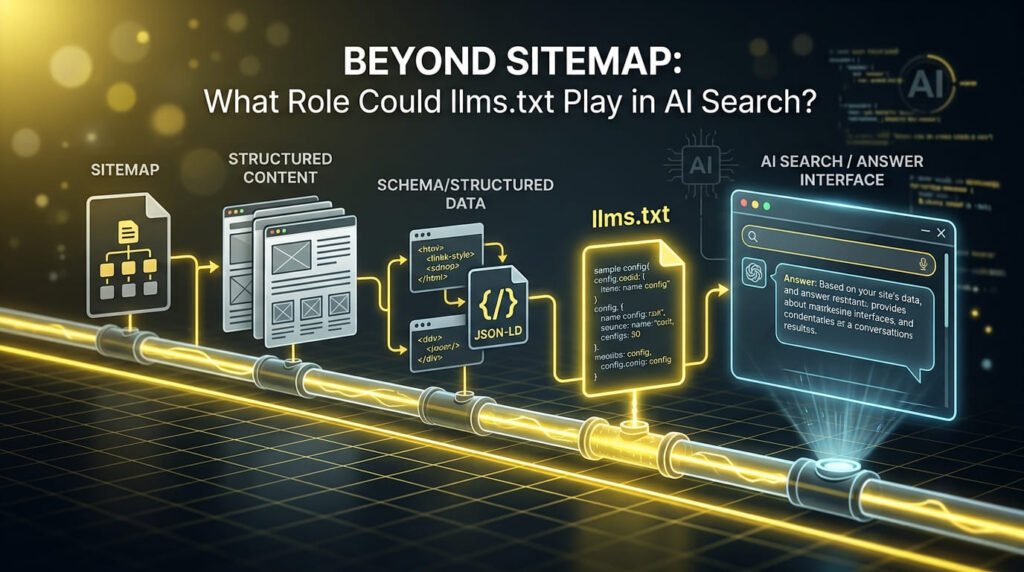
The web has spent decades becoming easier for search engines to crawl, index, and rank. XML sitemaps help search engines discover URLs. robots.txt communicates crawler access preferences. Structured data adds machine-readable context. Internal links connect related information.
But AI search introduces another question:
Is helping a machine discover a URL enough—or does an AI system also need clearer guidance about what that content means, which resources matter, and how different pieces of information fit together?
This question sits at the intersection of AI SEO, Generative Engine Optimization (GEO), content architecture, and AI-ready websites.
One proposed answer is a small text file called llms.txt.
The idea is simple: instead of leaving an AI system to navigate an entire website and determine what matters from the surrounding HTML, a site can provide a concise, structured, human- and machine-readable overview of its important resources.
That does not mean llms.txt replaces a sitemap.
It does not mean publishing one guarantees visibility in ChatGPT, Google AI Overviews, Claude, Perplexity, or another AI search system.
And it certainly should not be treated as a magic ranking file.
Instead, llms.txt is better understood as part of a broader conversation about how websites can make their content easier for AI systems and other machine-driven workflows to discover, interpret, and use.
That distinction matters.
Because the future of search may not be only about whether a page can be crawled.
It may increasingly be about whether the information on that page can be understood, connected, retrieved, evaluated, and represented accurately.
Search Has Always Had a Discovery Problem
Traditional SEO begins with a relatively straightforward question:
How does a search engine find my website and its pages?
A website may contain hundreds or thousands of URLs.
There may be:
- Blog posts
- Service pages
- Product pages
- Documentation
- Category pages
- Author pages
- Landing pages
- PDFs
- FAQs
- Support resources
- Other important content
An XML sitemap provides search engines with a structured list of URLs that a site considers important for discovery and indexing.
For a conventional search workflow, that is extremely useful.
A simplified model looks like this:
Website → Crawl → Discover URLs → Process content → Index → Rank
But AI-assisted search introduces another layer.
Consider what happens when someone asks an AI-powered search system:
“Which WordPress SEO tools are useful for managing structured data?”
The system does not merely need to know that a website contains /schema-tool/.
It needs to understand what the page is about.
It needs context.
It needs to determine whether the page is relevant to the question.
It may need to connect information from several pages.
It may need to distinguish a product page from a tutorial, documentation page, opinion article, or unrelated resource.
And if it eventually uses the information in an answer, the quality and clarity of the underlying content matter.
This creates a broader concept:
URL discovery is not the same thing as content understanding.
That is where the discussion around llms.txt becomes interesting.
What Does an XML Sitemap Actually Do?
An XML sitemap is primarily a discovery and URL-listing mechanism.
A simplified sitemap might look like this:
<urlset>
    <url>
        <loc>https://example.com/about/</loc>
    </url>

    <url>
        <loc>https://example.com/services/</loc>
    </url>

    <url>
        <loc>https://example.com/blog/seo-guide/</loc>
    </url>
</urlset>
The sitemap tells a search engine:
“These URLs exist and are part of the website’s discoverable content.”
Depending on the implementation, a sitemap can also provide additional information such as modification dates.
But the sitemap does not normally explain the entire meaning of the website.
It does not tell an AI system:
“This is our most authoritative guide about technical SEO.”
It does not necessarily explain:
“These five pages together represent our core knowledge about AI search.”
It does not automatically establish:
“This page is a beginner introduction, while this other page is our detailed technical reference.”
And it does not transform a large collection of URLs into a concise knowledge representation.
This is one reason it is useful to distinguish discovery from context.
Sitemap
Primary idea:
“Here are the URLs.”
llms.txt
Proposed idea:
“Here is a concise, structured representation of the resources that may help an LLM understand this website and its important information.”
The original llms.txt proposal explicitly describes the file as a way to provide LLM-friendly information and links to useful resources, partly because processing large, complex websites can be difficult and context windows are limited.
That makes the two concepts complementary rather than interchangeable.
Sitemap vs. llms.txt vs. robots.txt
These three files are often discussed together, but they serve different purposes.
| File | Primary role | Simple question |
|---|---|---|
robots.txt | Crawler access instructions | “What automated crawlers may access?” |
sitemap.xml | URL discovery | “What URLs exist?” |
llms.txt | Proposed LLM-oriented context/resource index | “What information and resources are important?” |
The distinction between robots.txt and llms.txt is particularly important.
robots.txt is fundamentally about crawler behavior and access preferences.
llms.txt does not function as a permission system simply because a page is listed or omitted. The current proposal describes it as a way to provide useful information and links for LLM-oriented processing.
So a website should not think:
“I left this URL out of
llms.txt, therefore AI crawlers cannot access it.”
That is not what the file is designed to guarantee.
Likewise:
“I added this page to
llms.txt, therefore every AI search engine will index and cite it.”
That is also an assumption the technology cannot guarantee.
This is why responsible AI SEO needs to separate technical capability from marketing claims.
So, What Exactly Is llms.txt?
The llms.txt proposal was introduced by Jeremy Howard in 2024 as a suggested convention for giving LLMs a concise, structured overview of a website. The proposed format uses Markdown and is intended to provide background information plus links to important resources.
A basic conceptual example might look like this:
# Example Technology

> Resources about WordPress development, technical SEO,
> structured data, and AI search.

## Core Resources

- [About](https://example.com/about/)
- [Services](https://example.com/services/)

## SEO Resources

- [Technical SEO Guide](https://example.com/technical-seo/)
- [Structured Data Guide](https://example.com/structured-data/)

## AI Search

- [AI SEO Guide](https://example.com/ai-seo/)
- [GEO Guide](https://example.com/geo/)
The important idea is not the visual appearance.
The important idea is the relationship between summary, organization, and linked resources.
Instead of asking a machine to infer everything from a site’s navigation, HTML, scripts, page-builder output, advertisements, menus, and other interface elements, the website can publish a concise representation of its important knowledge resources.
That is the theory.
The practical question is more complicated:
Who actually consumes the file?
The Most Important Question: Do AI Search Engines Actually Use llms.txt?
This is where many articles about llms.txt become misleading.
There is a difference between:
- A website publishing an
llms.txtfile. - A crawler requesting the file.
- A platform supporting the convention.
- An AI system using the information during retrieval.
- The information influencing an answer.
- The page ultimately receiving a citation or mention.
These are six different things.
Publishing the file proves only the first.
As of 2026, public evidence does not justify saying that all major AI search providers systematically treat llms.txt as a standard equivalent to an XML sitemap. Independent research has found very low request rates across large samples, while other implementations and workflows demonstrate that the format can be consumed in certain AI, documentation, agent, or retrieval contexts.
That means the responsible position is:
llms.txtis an emerging convention and potential AI-content discovery/context layer—not a guaranteed AI ranking signal.
This distinction should remain central throughout any serious GEO strategy.
Then Why Should Website Owners Care?
If adoption is inconsistent, why bother?
Because AI search is not the only possible consumer of machine-readable content.
The broader ecosystem includes:
- AI assistants
- Retrieval-Augmented Generation (RAG) systems
- AI agents
- Developer tools
- Documentation systems
- Research workflows
- Internal knowledge systems
- Automated content-processing tools
- Future AI retrieval mechanisms
The official proposal itself describes potential uses beyond traditional web crawling and emphasizes the value of concise information and links when an LLM needs relevant context.
There is also another reason.
Creating an AI-oriented content index forces a website owner to ask a valuable strategic question:
What information on my website is actually important enough to represent to a machine?
That question is useful even if a particular AI platform never reads llms.txt.
It exposes weaknesses in content architecture.
For example, imagine a website with 500 articles.
The sitemap contains all 500 URLs.
But only 40 articles represent the site’s strongest expertise.
Which ones should an AI system understand first?
That is a content strategy question—not merely a technical SEO question.
llms.txt Is Not a Replacement for Good SEO
This point deserves emphasis.
An llms.txt file cannot rescue a website with:
- Poor content
- Broken internal links
- Weak topical coverage
- Confusing page structure
- Inaccessible content
- Duplicate pages
- Missing context
- Poor technical implementation
- Unsupported claims
- Outdated information
If the underlying content is weak, creating another file pointing toward it does not suddenly make the content authoritative.
Think of the relationship this way:
Technical SEO makes content accessible.
Content architecture makes relationships clearer.
Structured data adds machine-readable meaning.
High-quality content provides useful information.
GEO focuses on making that information useful and understandable within AI-mediated search experiences.
llms.txt can potentially provide an additional structured pathway for describing and organizing important resources.
It is one layer—not the entire system.
From “Can AI Find My Page?” to “Can AI Understand My Page?”
This is the bigger shift.
Traditional SEO often starts with:
Can Google crawl this page?
AI-oriented optimization increasingly asks additional questions:
What is this page about?
What question does it answer?
Who is the intended audience?
What entity or topic does it represent?
How does it relate to other pages?
Does it provide a clear answer?
Is the information supported by evidence?
Is the content sufficiently specific to be useful?
Can an AI system distinguish the main answer from navigation, advertisements, repetitive interface elements, and other page noise?
These questions move us from crawlability toward content interpretability.
And that is where AI SEO and GEO become much more than inserting keywords into an article.
What Does AI-Friendly Content Actually Look Like?
Consider two pages.
Page A
SEO is important for websites. SEO helps websites rank. There are many SEO techniques that businesses can use to improve visibility.
Technically, this is content.
But it is vague.
It does not establish much expertise.
It does not answer a specific question.
It does not define its scope.
It does not provide useful supporting detail.
Now consider:
Page B
Technical SEO is the part of SEO concerned with how effectively search engines can crawl, render, understand, and index a website. Common technical SEO areas include crawl directives, XML sitemaps, canonical URLs, structured data, internal linking, page performance, and indexation management.
The second example gives a machine—and a human—much more context.
It defines the topic.
It identifies related concepts.
It creates semantic relationships.
It can answer a question directly.
And it provides a clearer foundation for further retrieval.
This leads to an important GEO principle:
AI visibility is not simply about making content visible to AI systems. It is also about making the content understandable once it is encountered.
The GEO Connection
Generative Engine Optimization is often described as optimizing content for AI-generated answers and search experiences.
But GEO should not be reduced to:
“Write an article containing lots of keywords so ChatGPT mentions it.”
A more useful model is:
Understand the question → provide a direct answer → establish context → support the answer → connect related concepts → make important information easy to retrieve.
That means AI-oriented content should often contain recognizable information structures.
For example:
Problem
What problem does the reader have?
Cause
Why is the problem occurring?
Solution
What can the reader do about it?
Evidence
Why should the reader trust the solution?
Example
What does it look like in practice?
Related questions
What will the reader probably ask next?
Limitations
When does the solution not apply?
This structure is valuable for humans.
It is also much more compatible with the way modern AI-assisted retrieval and answer generation works.
And this is where the relationship between content optimization and llms.txt becomes much more interesting.
An AI-oriented content index can point toward important resources.
But the resources themselves still need to contain useful, clear, answerable information.
The AI Search Visibility Stack
Rather than thinking of AI visibility as one plugin, one file, or one SEO trick, consider it as a stack:
                AI SEARCH VISIBILITY

                    AI Answers
                        ↑
                 Retrieval / RAG
                        ↑
              Content Understanding
                        ↑
          Clear Topics + Questions + Entities
                        ↑
       Internal Links + Structured Data + Context
                        ↑
             High-Quality Website Content
                        ↑
            Crawlability + Accessibility
                        ↑
       robots.txt + Sitemap + Technical SEO
                        ↑
                    Website
llms.txt can be considered an additional layer around content discovery and context, rather than a replacement for everything underneath it.
This distinction prevents a common GEO mistake:
trying to optimize the AI-facing layer while ignoring the content itself.
What Should a Website Put Into llms.txt?
The exact implementation can vary, but the underlying idea is to make important information easier to identify.
Potential resources can include:
- Core website information
- Important documentation
- Major service pages
- Product information
- Knowledge-base resources
- Authoritative guides
- Technical documentation
- Important FAQs
- High-value educational resources
- Other pages that help explain the site’s subject matter
The official proposal centers on a concise site/project description followed by organized links to useful resources, with an optional ## Optional section for material that can be skipped when a consumer wants a shorter context.
That introduces an important content-strategy concept:
Not Everything Needs to Be Equally Important
A sitemap can contain a large number of URLs.
An AI-oriented content index can instead be curated around meaning and usefulness.
Imagine a 1,000-page website.
A machine does not necessarily benefit from being handed 1,000 equally weighted links.
A more useful representation might identify:
10 core pages
30 authoritative guides
20 important product/service resources
15 FAQ or support resources
Additional optional content
The exact numbers are not a standard requirement.
The strategic principle is what matters:
Prioritize information instead of merely listing information.
The Hidden Problem: Content Selection
This sounds simple until a website becomes large.
Who decides what goes into the file?
A website may contain:
- 800 blog posts
- 50 pages
- 100 products
- 30 categories
- 20 landing pages
- 15 documentation articles
- Custom post types
- Old content
- Seasonal content
- Private or low-value pages
Should everything be included?
Probably not.
Should nothing be included?
That defeats the purpose of a curated representation.
Should the website owner manually select every URL?
That may work for a small site.
But it becomes increasingly difficult as content changes.
This creates another important problem:
An AI-oriented content index is only useful if it remains aligned with the website it represents.
A stale index can become a liability.
What Happens When the Website Changes?
Imagine that a website publishes a new definitive guide:
/ai-search-guide/
Three months later, the website updates its URL:
/ai-search-visibility-guide/
The old page redirects.
Then a new service page is launched.
Then five outdated articles are removed.
Then a product description changes.
Then the site’s content architecture is reorganized.
If an AI-oriented content file is manually maintained, it can gradually become inaccurate.
That leads to a practical principle:
AI-readiness is not a one-time configuration. It is a content-maintenance problem.
And this is where automation starts to make sense.
But before discussing automation, there is an even more fundamental question:
What happens when the content itself is not AI-ready?
That is where we need to move next—from the file to the content it represents.
From the File to the Content
So far, we have established three important ideas.
First: an XML sitemap and llms.txt are not substitutes. They address different problems.
Second: llms.txt should not be presented as a guaranteed AI ranking or citation mechanism. Its adoption remains emerging and inconsistent.
Third: the real AI-search challenge goes beyond creating a machine-readable file. The content being referenced still needs to be clear, useful, well-structured, and relevant to the questions people ask.
That brings us to the more important GEO question:
If an AI system encounters your content, is the content actually structured in a way that helps the system understand the answer?
A website can have excellent crawlability and still have poor AI visibility.
It can have a sitemap.
It can have structured data.
It can even have an llms.txt.
Yet its pages may still be difficult to interpret because the answers are buried, the topics are unclear, related concepts are disconnected, or the content does not address the questions users actually ask.
From AI-Readable Files to AI-Understandable Content
A website can have excellent crawlability and still have poor AI visibility.
It can have an XML sitemap. It can have structured data. It can even publish an llms.txt file.
But if the underlying content is unclear, poorly organized, difficult to interpret, or fails to answer the questions people actually ask, another file cannot solve the fundamental problem.
This brings us to the next stage of the discussion:
AI search optimization is not only about helping machines find your content. It is about making the content itself easier to understand, connect, retrieve, and use.
That is where AI SEO and Generative Engine Optimization become important.
What Is AI SEO?
AI SEO can be understood as the broader practice of preparing websites and content for search environments where artificial intelligence plays a role in discovery, interpretation, retrieval, summarization, and answer generation.
Traditional SEO often focuses heavily on:
- Search visibility
- Rankings
- Crawling
- Indexation
- Keywords
- Technical performance
- Links
AI-oriented search adds additional questions:
- Can an AI system identify the topic?
- Can it understand the entity being discussed?
- Can it identify the direct answer?
- Can it connect the page with related concepts?
- Can it determine whether the information is useful for a particular question?
- Can it distinguish factual information from navigation or unrelated page elements?
- Can it understand who created the content?
- Can it determine whether the information appears trustworthy and current?
This does not mean traditional SEO has become irrelevant.
Quite the opposite.
Technical SEO remains part of the foundation.
The difference is that AI search introduces additional layers of interpretation.
GEO Is More Than “Ranking in ChatGPT Google AI ”
Generative Engine Optimization, or GEO, is another term that has emerged around optimization for AI-generated search and answer experiences.
But GEO is sometimes reduced to a simplistic idea:
“Write content so AI mentions your website.”
That is too narrow.
A stronger approach asks:
What information would an AI system need in order to confidently understand and represent this topic?
For example, suppose someone asks:
“What is structured data and why does it matter for SEO?”
A page that simply repeats the phrase “structured data” twenty times is not necessarily useful.
A stronger page might:
- Define structured data.
- Explain how it works.
- Explain what Schema.org is.
- Give examples.
- Explain relevant schema types.
- Discuss implementation.
- Explain validation.
- Clarify what structured data does not guarantee.
- Answer common implementation questions.
- Link to related resources.
The second page creates a knowledge structure.
That structure is useful to people first.
And it can also give AI systems more meaningful material to retrieve and synthesize.
The Difference Between Keyword Coverage and Question Coverage
Traditional keyword research often starts with:
“What keywords should this page target?”
That remains useful.
But AI search introduces another valuable question:
What questions does this topic need to answer?
Consider the topic:
llms.txt
A keyword-focused content strategy might target:
- llms.txt
- llms txt
- llms.txt file
- LLM SEO
- AI SEO
- AI search
A question-focused strategy goes much further:
- What is
llms.txt? - What does
llms.txtdo? - Is
llms.txta replacement for sitemap.xml? - Does Google use
llms.txt? - Do AI search engines use
llms.txt? - What should go inside
llms.txt? - Should every website have one?
- How do you create one?
- How often should it be updated?
- Can WordPress generate it automatically?
- Does it improve GEO?
- Does it guarantee AI citations?
The second approach creates content that is closer to the information needs behind search queries.
That is particularly important when the search interface is conversational.
AI Search Is Often Question-Driven
A conventional search query might look like:
llms.txt SEO
A conversational search might look like:
“Does adding an llms.txt file actually help my website appear in AI search results?”
Those queries are related.
But the second contains an explicit information need.
A strong AI-oriented article should therefore anticipate the natural follow-up questions surrounding its primary topic.
This is why question-based content can be valuable for GEO.
Not because adding a question heading automatically creates an AI ranking signal.
Instead, because clear questions create clear information units.
The Question → Answer → Context Model
One useful content structure is:
Question
What does the reader want to know?
Direct answer
Give the answer early.
Explanation
Explain why.
Evidence or qualification
Clarify limitations and exceptions.
Example
Show how it works.
Related question
Address the next likely concern.
For example:
Does llms.txt guarantee AI citations?
No.
Publishing an llms.txt file does not guarantee that an AI search system will crawl it, use it, cite the website, or include its pages in generated answers.
Its potential value is better understood as an additional way of organizing and communicating information for LLM-oriented workflows.
This structure is useful because the reader does not need to extract the answer from five paragraphs.
The answer is immediately visible.
Problem-Solution Content Is Also Important
Another useful structure for AI-oriented content is the problem → cause → solution → limitation model.
Consider a website owner who says:
“My website has 500 pages, but I don’t know which content is most important for AI systems.”
The article can answer:
Problem
Large websites contain too much content to treat every URL as equally important.
Cause
A sitemap primarily provides URL discovery, while content importance and relationships require additional context.
Solution
Create a curated AI-oriented content index that identifies important resources.
Limitation
The index does not guarantee that an AI system will consume or cite those resources.
This is much stronger than saying:
“Install
llms.txtand improve AI visibility.”
The first explanation teaches.
The second sells a promise.
For long-term authority, teaching is the better strategy.
Entity Clarity Matters
AI systems do not only process isolated keywords.
Modern search increasingly operates around entities, topics, relationships, and context.
Consider the phrase:
“Apple”
Depending on the surrounding content, it could mean:
- Apple Inc.
- An apple fruit
- Apple Records
- Apple TV
- Apple Music
- An Apple product
Context resolves ambiguity.
Now consider a professional website.
If a page says:
“We provide SEO services.”
That statement is vague.
A clearer page might say:
“We provide technical SEO services for WordPress websites, including structured data implementation, crawlability analysis, XML sitemap configuration, and AI-search-oriented content optimization.”
The second version establishes relationships between:
Business → Service → Platform → Technical areas
This helps both humans and machines understand what the page represents.
Content Should Establish Relationships, Not Just Topics
Imagine a website about WordPress SEO.
It publishes these pages:
/seo/
/technical-seo/
/structured-data/
/schema-markup/
/wordpress-seo/
/ai-seo/
/geo/
These URLs alone don’t explain how the topics relate.
A strong website should establish relationships through:
- Internal links
- Contextual references
- Clear headings
- Definitions
- Structured data where appropriate
- Breadcrumbs
- Category architecture
- Author information
- Related content
- Consistent terminology
For example:
AI SEO
can link to:
GEO
which can link to:
AI-readable content
which can link to:
structured data
which can link to:
technical SEO
Now the website becomes more than a collection of isolated pages.
It becomes a connected information system.
That is highly relevant to AI-oriented content strategy.
Internal Linking Becomes More Than Navigation
Internal links are traditionally discussed as a way to help users and search engines navigate a site.
They can also communicate relationships.
Suppose an article explains llms.txt.
It links naturally to articles about:
- XML sitemaps
- robots.txt
- structured data
- GEO
- AI SEO
- content entities
- WordPress content architecture
Those links provide context.
The site is effectively saying:
“These topics belong to the same knowledge area.”
That does not mean an AI system will necessarily interpret every link exactly as the publisher intended.
But good internal linking creates a stronger information architecture.
And that architecture benefits users regardless of whether AI systems consume it.
Structured Data Still Matters
The rise of AI search does not make Schema.org structured data obsolete.
In fact, it reinforces the importance of clearly describing entities and relationships where appropriate.
Structured data can communicate information such as:
- Organization
- Person
- Article
- Product
- SoftwareApplication
- LocalBusiness
- FAQPage
- BreadcrumbList
- WebSite
- Event
But structured data and llms.txt solve different problems.
Think of structured data as:
Machine-readable information about a page, entity, or relationship.
Whereas llms.txt can be thought of as:
A proposed human/LLM-friendly overview and collection of important resources.
They can therefore coexist.
A technically mature AI-search strategy does not need to choose one.
It can use multiple layers.
Making Structured Data Easier to Implement
Schema Genie Pro
Once the content is ready, the next challenge is communicating structured information correctly. Schema Genie Pro is a WordPress plugin developed to simplify schema markup implementation without requiring users to manually inject JSON-LD into theme files or rely on code-insertion workflows. It provides a visual, code-free interface with 25+ schema types, supports multiple schemas on a single page, offers a central schema management dashboard, and provides one-click access to Google Rich Results Test and the Schema.org Validator. This makes it a practical implementation layer for websites that want to add appropriate structured data while reducing the risks associated with manually editing theme or plugin code.
Content Hierarchy Is an AI SEO Issue Too
Consider this page structure:
H1: SEO Services

H2: Services

H2: About

H2: Why Choose Us

H2: Contact
Now compare it with:
H1: Technical SEO Services for WordPress Websites

Introduction

H2: What Technical SEO Includes

H3: Crawlability

H3: Indexation

H3: XML Sitemaps

H3: Structured Data

H3: Internal Linking

H2: Technical SEO Problems We Solve

H3: Duplicate URLs

H3: Indexation Problems

H3: Missing Structured Data

H2: Frequently Asked Questions

H3: Does technical SEO improve rankings?
H3: How often should a technical SEO audit be performed?
The second structure communicates much more clearly what the page is about.
It creates identifiable information sections.
It answers questions.
It establishes topical relationships.
And it gives both users and machine-processing systems clearer structural signals.
Again, this is not a claim that heading structure by itself makes a page rank in AI search.
It is a content-quality and information-architecture principle.
The Importance of Direct Answers
One common weakness in web content is making the reader wait too long for the answer.
Consider:
“In today’s rapidly changing digital landscape, businesses are increasingly looking for new ways to improve their online presence…”
Several sentences later, the page finally answers the question.
That structure may work as editorial storytelling.
But informational content often benefits from putting the answer first.
For example:
llms.txtdoes not replace an XML sitemap. A sitemap primarily helps communicate URLs for discovery, whilellms.txtis proposed as a concise way to describe and link to important resources for LLM-oriented processing.
Then expand.
This creates a strong information pattern:
Answer → Explanation → Evidence → Example → Limitation
For AI-oriented content, that structure is particularly useful because individual passages can make sense even when retrieved outside the full article.
Think in “Retrievable Answers”
This leads to one of the most useful concepts for GEO:
A good article should contain useful standalone answers.
Imagine an AI system retrieving only this paragraph:
“Does
llms.txtreplace sitemap.xml? No. An XML sitemap andllms.txthave different purposes. A sitemap primarily communicates URLs for discovery, whilellms.txtis proposed as an LLM-oriented summary and resource index.”
The paragraph still makes sense.
It does not depend on the AI system retrieving the previous five paragraphs.
This is retrieval-friendly writing.
It does not require keyword stuffing.
It requires clarity.
Content Quality Comes Before Content Indexing
This gives us a useful sequence:
Identify the audience
        ↓
Identify the topic
        ↓
Identify real questions
        ↓
Create useful answers
        ↓
Add supporting context
        ↓
Connect related resources
        ↓
Add appropriate structured data
        ↓
Maintain technical accessibility
        ↓
Create/maintain AI-oriented content indexes
Notice where llms.txt appears.
It is not at the beginning.
It comes after the website has something worth organizing.
That is intentional.
What About FAQs?
Frequently asked questions can be particularly useful when they reflect genuine information needs.
For this article, useful questions include:
Is llms.txt required for AI SEO?
No. There is currently no universal requirement that websites publish an llms.txt file to participate in AI search.
Does llms.txt improve Google rankings?
There is no established basis for treating publication of llms.txt as a guaranteed Google ranking factor.
Can llms.txt guarantee ChatGPT citations?
No. Publishing the file cannot guarantee that ChatGPT or another AI system will access it or cite the website.
Should every URL be included?
Not necessarily. A curated representation of important resources can be more meaningful than indiscriminately listing every URL.
Is an XML sitemap still necessary?
Yes, there is no reason to treat llms.txt as a replacement for conventional sitemap infrastructure.
These answers are intentionally cautious.
That is important because AI SEO should not become a collection of unsupported promises.
Content Analysis Before AI Indexing
At this point, we can see why simply generating an llms.txt file is only one part of the workflow.
Before deciding which pages deserve representation, a website owner should ask:
Content relevance
Does the page genuinely contribute to the site’s expertise?
Search intent
What problem or question does the page solve?
Topic coverage
Does it provide enough useful context?
Answer clarity
Can the main question be answered quickly?
Entity clarity
Is it clear who, what, where, or which organization the page discusses?
Content structure
Are headings and sections logically organized?
Internal relationships
Does the page connect to relevant resources?
Freshness
Is the information still accurate?
Technical accessibility
Can users and crawlers actually access the content?
Metadata
Does the page title and description accurately communicate its subject?
This is where AI content analysis becomes part of the larger GEO workflow.
Check the Content Before You Publish It
Geoscope Content Analyzer
Before asking how AI systems might discover or retrieve a page, it is worth asking whether the content itself is prepared for modern search. GEOscope Content Analyzer is a free browser-based content optimization tool designed for writers, bloggers, marketers, and SEO professionals to analyze content across traditional SEO, AI SEO/GEO, readability, keyword usage, and word count. It can also help review titles, meta descriptions, headings, and overall content quality before publication. Because the analysis runs entirely in the browser without sending the content to external servers, it can be used as a privacy-friendly pre-publishing check. The purpose is not to promise an “AI ranking score,” but to help identify content areas that may need improvement before a page becomes part of a website’s search and AI-content ecosystem.
A Simple AI Content Readiness Model
A practical way to think about a page is to score it across several dimensions:
| Area | Question |
|---|---|
| Topic clarity | Is the main subject immediately obvious? |
| Search intent | Does the page satisfy a recognizable user need? |
| Answerability | Does it provide direct answers? |
| Depth | Does it provide enough useful context? |
| Structure | Is information logically organized? |
| Entities | Are important entities clearly identified? |
| Relationships | Are related concepts connected? |
| Evidence | Are important claims supported? |
| Freshness | Is the information current? |
| Technical SEO | Can the page be crawled and processed? |
This does not need to become a rigid universal scoring system.
It is a framework for thinking.
The important insight is:
A website should optimize the content before attempting to optimize the representation of that content.
The Role of AI Content Analysis Tools
This is where automated content analysis can become useful.
A content analyzer can help identify patterns that are difficult to evaluate manually across hundreds of pages.
For example, a site owner may want to identify:
- Pages with weak topic coverage
- Missing or unclear headings
- Overused keywords
- Very short content
- Poor readability
- Missing question coverage
- Weak contextual relationships
- Inconsistent terminology
- Pages that should be consolidated
- Important content that deserves inclusion in an AI-oriented index
The goal is not to produce a mysterious “AI score.”
The goal is to turn a large website into something that can be understood and improved systematically.
From Content Analysis to Content Selection
Now the connection to llms.txt becomes clearer.
Suppose a website has 1,000 URLs.
A content analysis process identifies:
100 pages with strong topical value.
A human review then identifies:
40 pages that represent the site’s most useful knowledge.
Those 40 pages can potentially form the core of an AI-oriented content index.
The process becomes:
1,000 website URLs
        ↓
Content analysis
        ↓
100 potentially valuable resources
        ↓
Human/editorial evaluation
        ↓
40 priority resources
        ↓
AI-oriented content index
This is much more strategic than:
“Put every URL into
llms.txt.”
But Large WordPress Sites Create Another Problem
For a small website with 20 pages, manually maintaining a Markdown file may be perfectly reasonable.
For a WordPress website with:
- Hundreds of posts
- Pages
- Products
- Categories
- Custom content
- Frequent publishing
- Page builders
- SEO plugins
- Dynamic metadata
the situation changes.
Every time content changes, someone potentially has to update the AI-oriented index.
That creates a maintenance burden.
And this is where the original question becomes practical:
If AI-oriented content indexing is useful enough to maintain, can the process be automated without losing editorial control?
The answer is increasingly important for WordPress publishers.
Automation Should Not Mean “Include Everything”
There is a temptation to make automation completely automatic:
“Find every page and put every URL into
llms.txt.”
That solves the manual work problem.
But it creates another problem:
Noise.
A large website can contain:
- Thin pages
- Duplicate pages
- Utility pages
- Temporary pages
- Low-value archives
- Outdated content
- Internal pages
- Content that should not be prioritized
Automation should therefore ideally provide control, not simply volume.
The website owner should be able to decide what types of content belong in its AI-oriented representation.
That distinction will become especially important when we look at WordPress implementation.
llms.txt and llms-full.txt
The ecosystem around llms.txt has also introduced the concept of a fuller version of the content.
The basic idea is that a concise llms.txt can point toward important resources, while a full representation can provide substantially more of the site’s relevant content in an LLM-friendly format.
These approaches serve different practical purposes.
A concise index can function as a map.
A full version can function more like a larger content resource.
The exact usefulness depends on the consumer and implementation.
This is another reason not to think of these files as replacements for the normal website.
The canonical webpages remain important.
The AI-oriented files are additional representations.
AI Search Optimization Is a System, Not a File
At this stage, we can extend our earlier visibility stack:
                 AI SEARCH EXPERIENCE
                         ↑
                Retrieval / Answers
                         ↑
                 Content Relevance
                         ↑
             Clear Questions + Answers
                         ↑
           Entities + Topic Relationships
                         ↑
        Internal Links + Structured Data
                         ↑
             High-Quality Content
                         ↑
          Technical SEO + Accessibility
                         ↑
       Sitemap / Crawl Infrastructure
                         ↑
          AI-oriented Content Index
                         ↑
                    Website
The exact technical path used by an individual AI system will differ.
This is a strategic model, not a claim about an identical processing pipeline used by every AI provider.
But it demonstrates the larger point:
No single file creates AI visibility.
AI search readiness is the result of multiple layers working together.
The Practical GEO Checklist
Before publishing a page, ask:
Topic
- Is the main topic obvious?
- Does the page have a clear purpose?
Questions
- What questions does the reader have?
- Are the important questions answered directly?
Content
- Is the information useful?
- Is it sufficiently specific?
- Does it avoid unnecessary filler?
Structure
- Are headings descriptive?
- Are related ideas grouped together?
Entities
- Are important people, organizations, products, concepts, and relationships clear?
Evidence
- Are important claims supported?
- Are limitations acknowledged?
Links
- Does the page connect to relevant resources?
Technical SEO
- Is the page accessible?
- Is it indexable when appropriate?
- Is the canonical URL correct?
- Is structured data implemented appropriately?
AI representation
- Is this page important enough to be represented in an AI-oriented content index?
- If yes, does its summary accurately describe the resource?
This final question takes us directly back to llms.txt.
The Real Value May Be the Discipline It Creates
There is an interesting possibility here.
Even if llms.txt adoption remains uneven, preparing a website for it can encourage better information architecture.
It makes website owners think about:
- Which pages are authoritative?
- Which resources are redundant?
- Which content represents the business?
- Which topics are core?
- Which pages answer important questions?
- Which resources should an AI system encounter first?
- Which information is outdated?
In that sense, llms.txt can be useful as a content governance exercise, even beyond the file itself.
The technology may evolve.
The underlying discipline remains valuable.
Where This Leaves Website Owners
At this point, the strategy becomes clearer.
You do not need to choose between:
SEO
and
AI SEO
or between:
sitemap
and
llms.txt.
A better approach is to build layers.
Your website needs a technically sound foundation.
Your content needs to answer real questions.
Your information architecture needs to establish relationships.
Your structured data should accurately describe applicable entities.
Your content should be regularly reviewed.
And if an AI-oriented content index is useful for your site, it should be maintained as part of that broader system.
But there is still one practical challenge.
How do you actually implement this on a real WordPress website?
For a small site, manually creating a Markdown file may be straightforward.
For a large site, manual maintenance quickly becomes inconvenient.
A WordPress publisher may have to think about:
- New posts
- Updated pages
- Deleted content
- Custom post types
- Categories
- Products
- Page-builder content
- Metadata
- Content summaries
- Exclusions
- Custom URLs
- Diagnostics
- Keeping the generated files current
At that point, the question changes from:
“Should I have an
llms.txtfile?”
to:
“How can I manage an AI-oriented content index without creating another maintenance task for my SEO team?”
That is where implementation, automation, and editorial control come together.
And that is the next step in this article.
Putting llms.txt to Work on WordPress
The previous section ended with a practical question:
How can a website manage an AI-oriented content index without creating another maintenance task for its SEO team?
For a small website, the answer may be simple.
Create a text file.
Add the important resources.
Publish it at the appropriate location.
Update it when the website changes.
But WordPress websites are rarely static.
A site may publish several articles every week. Products may be added or removed. Existing pages may be rewritten. URLs can change. Categories evolve. Page builders generate dynamic content. SEO plugins add metadata. Custom post types introduce entirely new content structures.
Suddenly, maintaining an AI-oriented content index manually becomes another technical SEO task.
And that raises a practical question:
Can the process be automated while still giving the website owner control over what the AI-facing representation contains?
Why WordPress Makes AI Content Indexing More Complicated
WordPress is flexible precisely because it can represent many kinds of content.
A typical site might contain:
Posts
Pages
Products
Product Categories
Categories
Tags
Custom Post Types
Landing Pages
Documentation
Author Pages
Not every item deserves equal representation.
A website owner may want:
- All important pages
- Selected blog posts
- Selected products
- Certain documentation
- Specific custom URLs
while excluding:
- Outdated content
- Thin pages
- Utility pages
- Individual products
- Internal content
- Duplicate resources
This is why a useful AI content index should not simply be an automated dump of the entire WordPress database.
Automation should handle the repetitive work.
Editorial control should determine what represents the website.
That distinction is important.
The “Everything” Approach Can Create Noise
Imagine a WooCommerce website with 2,000 products.
A simplistic generator could produce:
Product 1
Product 2
Product 3
...
Product 2000
Technically, that may be a large list of URLs.
But is it a useful representation of the company’s knowledge?
Not necessarily.
Perhaps the business’s most important resources are actually:
- Product categories
- Buying guides
- Product documentation
- Comparison pages
- Shipping information
- Warranty information
- Five flagship products
A meaningful AI content index should therefore support selection and prioritization.
The goal isn’t:
“Put as many URLs as possible into the file.”
The goal is:
“Represent the website’s useful information as accurately and efficiently as possible.”
Manual Control vs. Full Automation
There are two extremes.
Manual approach
The website owner creates and maintains everything manually.
Advantages:
- Maximum editorial control
- Easy to curate a small website
Problems:
- Time-consuming
- Easy to forget updates
- Difficult for large websites
- URLs can become stale
Full automatic approach
Every eligible URL is automatically added.
Advantages:
- Minimal maintenance
- New content can be discovered automatically
Problems:
- Can create noise
- May include pages the owner doesn’t want represented
- Less editorial control
The more useful approach sits between these extremes:
Automate discovery and generation while preserving granular editorial control.
That is the approach a WordPress implementation can take.
What an Automated Workflow Can Look Like
A practical workflow could look like this:
WordPress Website
       ↓
Detect Available Content
       ↓
Select Content Types
       ↓
Apply Individual Exclusions
       ↓
Add Custom URLs if Needed
       ↓
Generate Descriptions / Summaries
       ↓
Build llms.txt
       ↓
Build llms-full.txt
       ↓
Serve the Generated Content
       ↓
Monitor Requests
       ↓
Diagnose Delivery Problems
Notice that this is more than simply writing Markdown.
The real challenge is content management.
What Should Be Automated?
Several repetitive tasks are natural candidates for automation.
1. Content discovery
The system can identify available WordPress content instead of requiring the site owner to copy URLs manually.
2. Content selection
The administrator can decide which post types should be represented.
3. Individual exclusions
A site may want an entire content type included while excluding a few specific pages.
4. Custom URLs
Some useful resources may exist outside the normal WordPress post/page structure.
5. Descriptions
The system can use existing metadata or excerpts rather than requiring the administrator to write a description for every URL.
6. File generation
The llms.txt and fuller representation can be generated consistently.
7. Monitoring
If the files receive requests, administrators can gain insight into whether automated clients are requesting them.
8. Diagnostics
If another physical file, caching layer, or server configuration interferes with the generated representation, troubleshooting tools can reduce guesswork.
This is where an AI content index moves from being a simple text file to becoming a WordPress content-management workflow.
A Practical WordPress Example
Consider a fictional website:
ExampleTech.com
It has:
- 250 blog posts
- 30 pages
- 80 products
- 15 product categories
- 10 documentation pages
The owner decides that not everything should be included.
The configuration could conceptually become:
Pages
✓ Include

Blog Posts
✓ Include

Products
✓ Include

Product Categories
✓ Include

Individual exclusions
- Old Product A
- Thin Article B
- Temporary Landing Page C

Custom URLs
+ External Documentation
+ Important Resource
The resulting AI-oriented content index is now much more intentional.
It represents the website on the website owner’s terms.
Why Page Builders Matter
There is another WordPress-specific problem that is easy to overlook.
Many WordPress websites do not store the final human-readable page content as simple text.
Page builders can use:
- Shortcodes
- Builder-specific structures
- Nested elements
- Dynamic content
- Visual components
A naive content extractor may retrieve something that looks like:
[column]
[widget]
...
instead of the content the visitor actually sees.
That is a poor representation.
If an AI-facing file is supposed to communicate useful website content, it should ideally represent meaningful rendered content rather than raw page-builder implementation details.
This is particularly relevant for WordPress sites using builders such as Elementor, WPBakery, or UX Builder.
Rendering Before Representing Content
One practical solution is to render the page content appropriately before extracting the material that will be represented.
This creates a conceptual workflow:
WordPress Content
       ↓
Page Builder Rendering
       ↓
Readable Content
       ↓
Content Extraction
       ↓
AI-Oriented Representation
That is preferable to simply extracting the raw database content.
The current HS3Dev AI Content Index for LLMs.txt plugin specifically addresses this problem by rendering pages properly for page-builder environments and providing a compatibility mode for builders that need additional handling.
This matters because AI-ready should mean readable content—not raw implementation code.
Using Existing SEO Metadata
Another practical question is:
Where should descriptions in the AI content index come from?
Writing a unique summary for every page would defeat much of the automation benefit.
But many WordPress websites already have useful metadata.
For example, an SEO plugin may already provide a meta description.
A post may have a manual excerpt.
A page may have another concise description.
An intelligent generator can use existing information before falling back to automatic summarization.
The HS3Dev implementation supports this type of hierarchy: it can use an SEO plugin’s meta description from Yoast, Rank Math, All in One SEO, or SEOPress, or use a manual excerpt or generated summary depending on what is available. Descriptions can also be disabled when a simpler title-and-link representation is preferred.
This creates an important SEO/GEO connection:
Good metadata can become useful source material for additional machine-readable representations of your content.
That gives SEO teams another reason to avoid treating title and description fields as afterthoughts.
Why llms-full.txt Can Be Useful
A concise llms.txt file is useful as a map of important resources.
But sometimes a consumer may benefit from a much fuller representation.
That is where llms-full.txt comes into the workflow.
Conceptually:
llms.txt
Shorter representation
“Here are the important resources and what they are about.”
llms-full.txt
Expanded representation
“Here is a much more complete machine-readable version of the relevant content.”
The two should not be confused.
A concise index is easier to scan.
A full representation can contain substantially more material.
The appropriate choice depends on the use case and the consumer.
The HS3Dev plugin generates both representations from the WordPress dashboard rather than requiring the administrator to maintain separate files manually.
The “No Physical File” Approach
Another implementation detail is worth understanding.
A WordPress plugin does not necessarily need to create a permanently stored physical file in the website’s document root every time content changes.
Instead, the application can generate and serve the required representation dynamically.
This can have practical advantages:
- Less manual file management
- Fewer stale copies
- Easier regeneration
- Centralized configuration
- Reduced theme-file modification
- Better separation from theme functionality
The HS3Dev plugin’s current implementation describes itself as generating the content from the WordPress dashboard without creating physical files that clutter the server and without requiring theme or page-builder modifications.
That is particularly attractive for WordPress administrators who do not want another developer-dependent change every time the content index needs to be updated.
Why This Is a Technical SEO Problem Too
At first glance, llms.txt may look like an AI-only feature.
But many of the implementation challenges are familiar technical SEO problems:
- URL management
- Content selection
- Metadata
- Rendering
- Canonical content
- Caching
- Server responses
- Content freshness
- Duplicate files
- Crawl/request analysis
This is why AI SEO should not be treated as something completely separate from technical SEO.
Instead, AI search introduces new requirements and new representations on top of an existing web infrastructure.
What If Something Goes Wrong?
Imagine an administrator generates the file successfully.
But visitors or automated clients receive an old cached version.
Or a manually created llms.txt already exists on the server.
Or a server configuration prevents the generated response from appearing.
Or a caching layer interferes with the expected output.
The administrator sees:
“My plugin says the file exists.”
But an external requester receives something different.
Without diagnostics, the administrator may have no idea where the problem is.
This is why monitoring and diagnostics are useful parts of a serious implementation.
The HS3Dev plugin includes built-in diagnostics for conflicting files and caching-related issues that can interfere with the generated content.
Are AI Crawlers Actually Requesting the File?
This is one of the most interesting questions.
Instead of assuming:
“I created
llms.txt, therefore AI systems are using it,”
a website can look for actual requests.
The current HS3Dev implementation includes request tracking for llms.txt and llms-full.txt, including crawler identification and request trends. Its documentation specifically mentions identifiers such as GPTBot, ClaudeBot, and PerplexityBot.
This creates a much healthier mindset:
Measure where possible.
Do not confuse:
“I published an AI-oriented file.”
with:
“An AI system definitely used that file to generate an answer.”
Server requests can tell you that a crawler requested a resource.
They do not automatically prove that the information influenced a particular AI answer or citation.
That distinction should remain clear.
Analytics Can Change the Conversation
Traditional SEO often gives us analytics such as:
- Search impressions
- Clicks
- Rankings
- Crawl statistics
- Traffic
AI search introduces another emerging question:
Are automated AI-related clients requesting the resources we intentionally publish for them?
Request analytics cannot answer every AI visibility question.
But they can provide another useful technical signal.
For example, an administrator might observe:
Date        Resource       Crawler
---------------------------------------
Aug 12      llms.txt       GPTBot
Aug 13      llms.txt       PerplexityBot
Aug 13      llms-full.txt ClaudeBot
Aug 15      llms.txt       GPTBot
That does not prove citation.
It does provide evidence that those resources were requested.
For emerging technologies, distinguishing observed behavior from assumed behavior is extremely important.
HS3Dev AI Content Index for LLMs.txt
This practical problem is what led to the development of HS3Dev AI Content Index for LLMs.txt.
The purpose is not to claim:
“Install this plugin and AI search will rank your website.”
That would be an irresponsible promise.
The more useful proposition is:
If you want to experiment with an AI-oriented content index on WordPress, the plugin can automate the repetitive parts while giving you control over what your website represents.
The plugin is currently presented as a free and open-source WordPress plugin under GPLv2.
Its feature set addresses several of the practical problems discussed throughout this article.
What Does the Plugin Actually Help With?
1. Generate llms.txt and llms-full.txt
Instead of manually constructing and maintaining the files, the plugin generates both representations from the WordPress environment.
2. Granular content control
Administrators can select post types and then exclude individual posts, pages, or products.
This is important because AI-oriented content representation should not necessarily mean:
“Include everything.”
3. Custom URLs
Useful resources that are not covered by the selected WordPress content types can be added manually.
That provides another layer of editorial control.
4. Page-builder compatibility
The plugin is designed to work with page-builder environments and includes compatibility handling for builders such as Elementor, WPBakery, and UX Builder.
5. Smart descriptions
Descriptions can be drawn from existing SEO metadata, manual excerpts, or generated summaries depending on availability.
This means a site does not necessarily need to manually write another description for every resource.
6. Optional descriptions
If a site owner prefers a cleaner representation, descriptions can be disabled so the output focuses on titles and links.
7. Request analytics
The plugin tracks requests to the generated files and provides crawler information and request trends.
8. Diagnostics
The built-in checker can help identify conflicts and caching-related problems that could prevent the generated representation from being delivered correctly.
Why Granular Control Matters More Than Automation Alone
One of the most important lessons from this entire discussion is that automation should not remove editorial judgment.
Suppose a website has:
1,000 posts
An automated system can discover them.
But the site owner may decide:
600 → useful but secondary
250 → outdated or low priority
100 → important resources
50  → core authority content
There is no universal formula that tells every website which 50 pages deserve priority.
That decision belongs to the website owner and content team.
A useful tool should therefore help automate the mechanics while leaving strategic decisions with humans.
A Practical AI-Search Workflow for WordPress
Putting everything together, a WordPress publisher could use this workflow:
Step 1 — Audit the website
Identify:
- Important pages
- Core topics
- Key entities
- Existing content
- Weak content
- Duplicate content
- Outdated resources
Step 2 — Improve the content
Make sure important pages:
- Answer real questions
- Provide direct answers
- Explain concepts clearly
- Use logical headings
- Establish entities
- Connect related resources
- Include appropriate evidence
- Stay current
Step 3 — Improve technical foundations
Review:
- Crawlability
- Indexation
- Internal links
- XML sitemap
- Canonicals
- Structured data
- Performance
- Accessibility
Step 4 — Decide what represents the site
Identify the content that should form the site’s AI-oriented resource layer.
Step 5 — Generate the AI-oriented files
Create and maintain:
/llms.txt
/llms-full.txt
Step 6 — Monitor
Look for:
- Requests
- Crawler activity
- Unexpected behavior
- Delivery issues
- Conflicts
- Cache problems
Step 7 — Reassess
As the website changes, review whether the content represented in the AI-oriented index still reflects the site’s most valuable information.
That final step is critical.
AI readiness is not a checkbox.
It is an ongoing content-management process.
What llms.txt Still Cannot Do
A responsible article about AI SEO should also explain the limitations.
It cannot guarantee AI citations
No file can guarantee that an AI system will cite your website.
It cannot guarantee AI visibility
Publishing llms.txt does not guarantee inclusion in an AI-generated answer.
It does not replace an XML sitemap
The two have different purposes.
It does not replace robots.txt
It is not a crawler access-control mechanism.
It cannot fix poor content
A poorly written article remains poorly written.
It cannot replace structured data
Schema markup and llms.txt provide different forms of machine-readable information.
It cannot replace technical SEO
If a website has fundamental accessibility, indexation, or rendering problems, another text file is not the solution.
It cannot force an AI provider to use it
Different AI systems may have different crawling, indexing, retrieval, and content-processing systems.
This is why the correct mindset is:
Prepare, structure, measure, and improve—not promise.
Should Every Website Create an llms.txt File?
There is no universal “yes.”
For a very small website with little content, the practical benefit may be limited.
For a documentation-heavy website, software project, knowledge base, publisher, professional service site, or large WordPress installation, the concept can be more interesting because there is more information to organize.
A useful decision framework is:
Consider experimenting with it if:
- Your site has substantial useful content.
- Your content is frequently used as a reference.
- You publish documentation.
- You have a large knowledge base.
- You operate a content-heavy WordPress website.
- You want to experiment with emerging AI retrieval conventions.
- You want to create a deliberate machine-readable representation of important resources.
Don’t expect it to:
- Replace SEO.
- Replace your sitemap.
- Guarantee AI citations.
- Automatically make poor content authoritative.
- Guarantee inclusion in every AI system.
The Bigger GEO Lesson
After looking at the technology, the most important conclusion may not actually be about llms.txt.
It is about content architecture.
AI search changes the question from:
“How do I make this page rank?”
toward a broader set of questions:
“What does this page mean?”
“What question does it answer?”
“What entity does it represent?”
“What evidence supports it?”
“What related information surrounds it?”
“Can the answer be retrieved independently?”
“Is the information current?”
“Which resources represent the site’s strongest expertise?”
These are fundamentally content and information-architecture questions.
llms.txt is one possible mechanism for expressing part of that structure.
It is not the structure itself.
Think of Your Website as a Knowledge System
This may be the most useful mental model for AI SEO.
Don’t think of your website only as:
Pages + Keywords + Links
Think of it as:
Entities
   +
Topics
   +
Questions
   +
Answers
   +
Evidence
   +
Relationships
   +
Resources
   +
Technical Infrastructure
The job of SEO is increasingly to make that knowledge system:
discoverable, understandable, trustworthy, connected, and useful.
An AI-oriented content index can then provide another representation of that system.
The Future May Be Bigger Than llms.txt
It is also worth keeping expectations realistic.
The web has a long history of proposed standards and conventions.
Some become widely adopted.
Some remain niche.
Some evolve.
Some are replaced by other mechanisms.
llms.txt may evolve in the same way.
That does not make the underlying problem irrelevant.
AI systems will continue to need information.
Agents will continue to navigate websites.
Retrieval systems will continue to select context.
Businesses will continue to want their expertise represented accurately.
The specific technical mechanisms may change.
The strategic need for clear, structured, authoritative information is unlikely to disappear.
That is why investing in good content architecture is a safer long-term strategy than betting everything on one file format.
Final Takeaway: Beyond the Sitemap
An XML sitemap answers an important question:
What URLs exist?
A robots file addresses another:
How should compliant crawlers handle access instructions?
Structured data adds another layer:
What entities and information does this page represent?
High-quality content answers:
What useful information can the reader learn here?
GEO asks:
How can this information remain useful in AI-mediated search and answer experiences?
And llms.txt proposes another question:
Can we provide AI-oriented systems with a concise, structured representation of the resources that matter most on our website?
That last question is still evolving.
The responsible answer is therefore not:
“
llms.txtis the future of SEO.”
Nor is it:
“
llms.txtwill make your website rank in ChatGPT.”
The more useful conclusion is:
llms.txtis an emerging approach to organizing and exposing website resources for LLM-oriented workflows. Its value should be evaluated as part of a broader AI SEO and GEO strategy—not as a replacement for technical SEO, content quality, structured data, or conventional search infrastructure.
For WordPress websites, the practical challenge is maintenance.
If the site changes constantly, manually maintaining another AI-oriented content index can become inconvenient. Automation can reduce that burden—but the best automation still needs editorial control.
That is the problem tools such as HS3Dev AI Content Index for LLMs.txt are designed to address: not promising AI rankings, but helping WordPress site owners create, control, maintain, monitor, and troubleshoot an AI-oriented representation of their content. The plugin is currently available as a free, open-source GPLv2 project.
And that brings the conversation full circle.
The goal is not to create another file simply because AI is popular.
The goal is to make the website’s knowledge easier to discover, understand, organize, and maintain.
The file is only one piece of that system.
Frequently Asked Questions
What is llms.txt?
llms.txt is a proposed convention for providing LLM-oriented context and links to important resources on a website. It is intended to offer a concise, structured representation that can help an LLM-oriented workflow identify useful information. It should not be confused with an XML sitemap or robots.txt.
Is llms.txt a replacement for an XML sitemap?
No.
An XML sitemap and llms.txt have different purposes. A sitemap primarily helps communicate website URLs for discovery, while llms.txt is proposed as a concise resource and context layer for LLM-oriented processing.
Does llms.txt improve Google rankings?
There is no established basis for treating publication of llms.txt as a guaranteed Google ranking factor. Website owners should continue to focus on technical SEO, useful content, search intent, structured data, internal linking, and other established practices.
Does llms.txt guarantee ChatGPT or Claude citations?
No.
Publishing an llms.txt file cannot guarantee that an AI system will request the file, use its information, retrieve a particular page, or cite the website in an answer.
Should every website have an llms.txt file?
Not necessarily.
It can be worth experimenting with for content-heavy websites, documentation sites, publishers, software projects, professional websites, and large WordPress installations. Smaller websites may have less need for a dedicated AI-oriented content index.
What should be included in llms.txt?
The proposed approach focuses on a concise description of the website or project followed by useful links to important resources. A website can use the file to represent its most relevant information rather than blindly listing every URL.
Should every page be included?
No.
A large website may contain thousands of URLs that are not equally valuable. Selective inclusion can make the representation more meaningful and easier to manage.
Does llms.txt replace robots.txt?
No.
robots.txt and llms.txt have fundamentally different purposes. robots.txt communicates crawler access instructions; llms.txt is proposed as an information and resource representation for LLM-oriented workflows.
Does llms.txt replace structured data?
No.
Structured data and llms.txt operate at different layers. Schema.org structured data can describe entities and page information, while llms.txt can provide an organized collection and description of important resources.
How does llms.txt relate to GEO?
llms.txt can be considered one possible component of a broader GEO strategy. GEO itself involves much more, including useful content, clear answers, topic relationships, entity clarity, internal linking, structured data, technical accessibility, and content quality.
Can WordPress automatically generate llms.txt?
Yes. WordPress plugins can automate the generation and management of AI-oriented content files instead of requiring administrators to manually maintain them.
What is llms-full.txt?
llms-full.txt is a fuller representation associated with the llms.txt approach. While llms.txt can provide a concise map of important resources, a full version can provide substantially more content for workflows that need it.
How do I know whether AI crawlers are requesting my llms.txt?
Server logs or dedicated request analytics can provide evidence of requests. Some tools can identify crawler user agents and track requests to llms.txt and llms-full.txt. However, a request does not prove that the file influenced a particular AI-generated answer.
Can an AI content index fix poor website content?
No.
If the underlying pages are unclear, outdated, thin, poorly structured, or technically inaccessible, generating an AI-oriented file will not solve those fundamental problems.
What is the best approach to AI search optimization?
Treat AI search optimization as a system rather than a single tactic:
Technical SEO + useful content + clear answers + entity and topic relationships + structured data + internal linking + content maintenance + appropriate AI-oriented representations.
llms.txt can be part of that system, but it should not become the entire strategy.
Final Checklist: Is Your Website Ready for AI-Oriented Search?
Before worrying about another AI-facing file, ask:
- Can search engines crawl and index the important content?
- Is the XML sitemap accurate?
- Are crawler directives configured appropriately?
- Are important pages technically accessible?
- Does every important page have a clear purpose?
- Does the content answer real user questions?
- Are direct answers easy to find?
- Are important entities clearly identified?
- Are related topics connected through internal links?
- Is appropriate structured data implemented?
- Are important claims supported?
- Is outdated content reviewed?
- Have high-value resources been identified?
- Is there a deliberate strategy for AI-oriented content representation?
- If using
llms.txt, is the file maintained? - Are unnecessary URLs excluded?
- Are crawler requests monitored where possible?
- Are caching or file conflicts checked?
- Are you measuring actual behavior instead of assuming AI adoption?
If several answers are “no,” the solution probably isn’t another AI file yet.
Start with the content and technical foundation.
Then build the AI-facing layer on top of it.
About the Author
Mirza Hadi Baig is a Full-Stack WordPress Developer and Technical SEO Specialist with 5+ years of hands-on experience building WordPress solutions and working with modern SEO and AI-search concepts. He completed the IBM SEO Mastery: From Fundamentals to GenAI and GEO Strategies Specialization and writes about WordPress development, technical SEO, structured data, AI search, GEO, and digital growth.
He also builds practical tools and WordPress solutions, including Schema Genie Pro, developed to simplify the generation, implementation, management, and testing of structured data on WordPress websites, and HS3Dev AI Content Index for LLMs.txt, a free and open-source WordPress solution for generating and managing AI-oriented content indexes such as llms.txt and llms-full.txt.
His work focuses on turning emerging SEO and AI-search concepts into practical WordPress tools and workflows that website owners, developers, and SEO professionals can actually use.